

Working on a book. My substack is how I’ll reach out directly and tell you it’s ready.
Hyperborea
Joined November 2021
- Tweets6.3K
- Following251
- Followers41.5K
- Likes29.7K




Pinned Tweet
Got finished with my first draft of the second book. No this is not a typo, will release the books together as one larger book. That took a minute. Lots of overtime stalling me, but I got this finished.
Approximately 60% the way done with the secret project.


Tocharus retweeted
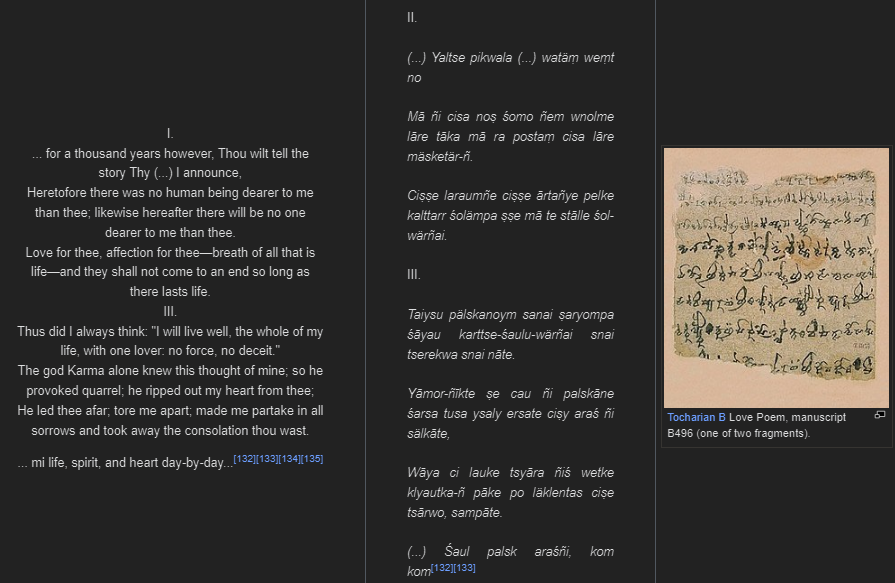
You may be forgiven for thinking the Tocharians were an uncreative people. What scant literature survives is almost entirely sectarian, and almost entirely in translation. Buddhist sutras, hymns, dramas, all from India. But one. One unique creation, one original work: a love poem

A brief note on Generative Energy by Ray Peat in paraphrasing.
Ray Peat speaks of life, or more aptly structures anticipating certain future energy inputs, as it relates to babies anticipating future caloric intakes and stressors based around the mother’s conditions while pregnant, adjusting their future growths and hormones to the inputs of earlier natal conditions.
I have anecdotal evidence that every exerciser shall recognize. I have noted in the past that there is a truth to muscle memory, anyone who has picked up weights after putting them down for too long has. That is not interesting, but what is interesting is that I noticed that if one obtains a reasonable size in overall mass, and merely works only one or two muscles once neglecting their workouts, muscles unrelated to those one or two muscles worked out will also regain in size quickly, anticipating future inputs based on past inputs. In short, my legs are growing as my arms grow, while only working out my arms, and if I only worked out my legs, I believe my arms would grow sympathetically to those inputs. The human body remembers the whole of the structure it once was when I was 95 kilos.
Something completely lost in translation at the start of Plato’s dialogue Laches, on ἀνδρεία, literally manliness, but encompassing more like courage and prowess, is in the second and third sentence.
In Greek it says
“οὗ δʼ ἕνεκα ὑμᾶς ἐκελεύσαμεν συνθεάσασθαι ἐγώ τε καὶ Μελησίας ὅδε, τότε μὲν οὐκ εἴπομεν, νῦν δʼ ἐροῦμεν. ἡγούμεθα γὰρχρῆναι πρός γε ὑμᾶς παρρησιάζεσθαι.”
In English it can be translated as such
“When Melasius and I invited you to see him with us, we neglected to give the reason why, but now we shall explain, because we think it especially right to be frank with you”
The last portion of this can also be translated as to speak openly, speak freely, or more accurately, to speak boldly with someone! From the very beginning you miss the foreshadowing of the whole conversation by translating παρρησιάζεσθαι.


Having now read half of The Camp of the Saints, I can now say it was suppressed and restricted in many countries and languages, not because it was offensive, but because it was accurate, though gratuitously graphic at times. Perhaps this was an explanation.

Your country has been made a colony by thirty or forty other nations. It will just never be formerly announced.


