

Politics obsessed Wisconsinite, digging into the data. A progressive, punster patriot defeating bad guys in 17 of the last 21 statewide elections. he/him
Joined April 2022
- Tweets11.6K
- Following1K
- Followers3.5K
- Likes14.8K





Pinned Tweet
What to expect on Election Night: Central Count Edition
While we don't know who will win or by how much, there are some things we can easily predict about Election Night. Since the conspiracy theorists love to talk about scary Milwaukee vote dumps late at night as evidence of
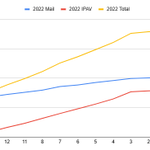
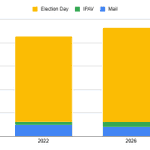
This all depends on WHO showed up- these are the kind of numbers Dems would hope to see IF we're seeing IPAV replacing mail. Conservative areas of the state holding onto less of their 2024 surge but up a fair amount over 2022. We'll have a closer look at geography tomorrow but so
PSA as we await numbers in the next 15 minutes or so... the numbers we will have tonight is TOTAL new requests- that includes mail AND IPAV combined. We won't have exact numbers but at least a sense of the possible scale.
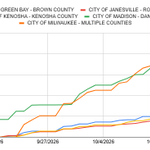
2,359 looks like City of Milwaukee’s 2022 Day One. Their last polling IPAV location just closed a few minutes ago so maybe we’ll see today’s numbers soon
Madison had ~1800 on Day One 2022. Hoping for a post tonight for comparison

👏End of Day 1 of in-person absentee voting, and over 1,800 @CityofMadison voters cast their absentee ballots in person today!
👉Find the full schedule here: cityofmadison.com/clerk/elec…
#MadisonVotes2022 #BeAVoter

This is the kind of analysis and breakdown you get from this account. "Mathematically hysterical"

ugh the clown has made it to my feed multiple times now. can't wait to see what is said about Wisconsin...

He should have couched this in clearer context because it sounds sofa-cking much like he settee’s endorsing Democrats. I thought for sure someone in the front sectional correct him but no one did. We need to keep our futon the gas and chaise those absentee ballots even if they

Toby MG retweeted

TODAY’S THE DAY!
In-person early voting begins today, and it’s time for you to make your voice heard!
Learn more at CrowleyforWI.com/Vote

Live precinct level results is a massive undertaking in Wisconsin. County clerks post results in myriad different formats (some scanned pdfs of printed paper) so I’ve never even bothered to try and bring it all together.
If they get this done for state legislative races it

Announcing @WisconsinElects, a new site providing precinct-level results for the 2026 elections in Wisconsin!
Most outlets only give a vague idea of what's actually going on under the hood in each county on election night, but this is the full picture.
sites.google.com/view/wi2026


This is an excellent point, and related to the post I just made about IPAV expectations- midterms are always lower in turnout than Presidential elections. The question is often about who DOESN'T show up.
In 2010 and 2014 we saw huge swings from the Presidential results two

What makes a wave?
To me, the biggest unanswered question about the midterms is what happens to Republican turnout over the next 15 days, particularly among voters who have participated consistently in past elections.
At this point, the early vote data increasingly suggest that voters who sat out 2024 but are turning out in 2026 are disproportionately Democratic. That's certainly encouraging for Democrats, but we're talking about a relatively small share of the eventual electorate. In a midterm, when overall turnout is substantially lower than in a presidential election, the much bigger question is which voters who participated in 2024 will stay home in 2026.
And that's something I think will have a huge part in deciding an ordinary Democratic victory and a blue tsunami.
To understand why, it's worth looking at "3 of 3" voters: people who voted in each of the previous three elections. These are the most reliable voters in the electorate, but even their turnout can vary substantially between parties in midterm years.
In fact, one of the interesting parts of the 2022 midterms was how differently these voters behaved across states (as seen in the graphic). Democrats held up pretty well in places like New Hampshire, Pennsylvania, Colorado, Kansas, and Maine, while Republicans enjoyed enormous turnout advantages in New York and Florida. Those differences among otherwise highly reliable voters were an important part of the very different electoral outcomes across states, even against the backdrop of the same national political environment under the Biden presidency.
That's the dynamic I'm watching most closely right now: Republican 3 of 3 voters are lagging considerably behind their Democratic counterparts in early turnout across a number of states, most notably Georgia and North Carolina. But what that means for November is still far from clear.
I see two broad possibilities.
The first is that Republicans' early turnout problems reflect something more fundamental. Lukewarm feelings toward the Trump administration, combined with the absence of Trump himself from the ballot, could be translate into a big enthusiasm gap. If those problems extend to voters who normally participate in every election, Republicans could easily end up facing turnout deficits of 6-10 points among their most reliable voters in some key states, as we saw in places like New York and Florida in 2022. That's the kind of turnout dynamic that can turn Trump's low approval and a favorable national environment into a total tsunami.
The second possibility is that Republicans are simply voting later. As I've said in past posts, Republicans have a lot of time to recover. GOP voters may be less enthusiastic and less inclined to participate early, but still broadly show up. Under this scenario, the substantial partisan gaps we're seeing in early voting could narrow considerably, looking much more like AZ and PA from 2022 than NY and FL.
Of course, the eventual outcome could fall somewhere between these scenarios. And, it could differ enormously by state—that was the big story in 2022. Democrats were able to maintain strong turnout among their reliable voters in Kansas, Colorado, Pennsylvania, New Hampshire, and Maine, winning a number of important races even as their party got totally squished in California, Florida, and New York. There was no single national turnout story that adequately explained what happened everywhere.
I wouldn't be surprised if 2026 produces similarly large geographic differences. And while the early evidence raises legitimate concerns for Republicans, I don't think we have nearly enough information yet to know how persistent those gaps will be.
One important note is that this phenomenon is largely unique to midterms. In presidential elections, nearly all 3 of 3 voters turn out regardless of party. In 2024, the partisan gap was less than two percentage points in every state. Wyoming had the largest gap at 1.7 points, followed by Kentucky at 1.5. New York, Florida, and Nevada were all at 0.9 points, Iowa was at 0.8, and the remaining states ranged from 0.0 to 0.6. There isn't much room for high propensity partisan turnout differences in presidential years; nearly every habitual voter votes. But in midterms, when even reliable voters are more likely to stay home, those differences can become much more consequential.
And that's why I'm paying so much attention to lagging Republican 3 of 3 turnout in states like Georgia and North Carolina. As we saw in Florida and New York in 2022, an early partisan turnout advantage doesn't necessarily disappear as voting continues, even if it narrows. Whether Republicans can eventually mobilize their habitual voters at acceptable rates is an open question, and the historical precedent for this is very mixed.
And finally, an important caveat that I try to emphasize whenever discussing turnout: persuasion remains an enormous part of the equation, and often the most important one. If you told me today that the 2026 national electorate would have voted Harris+2 in 2024, I wouldn't have the faintest clue who would win the Senate. Even perfect knowledge of the eventual electorate wouldn't necessarily tell us the election result.
But turnout can still absolutely help explain the difference between a close election and a wave. And over the next two weeks, I think one of the most consequential questions will be whether Republicans with a history of consistently voting end up coming out in large enough numbers.

there in 2022.
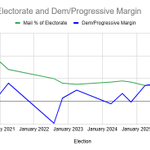
Republicans likely winning IPAV in 2024 complicates analysis- there's no clean turnout up or down is good or bad for either party- composition will matter a lot.
Assumptions that things can't change from 2024 already burned "analysts" in 2025 assuming that IPAV