

To Data & Beyond: Master data science, AI & Gen AI—beyond the basics. Join 27K+ learners!
Helsinki, Finland
Joined October 2023
- Tweets171
- Following16
- Followers374
- Likes124



Hands-on Docker, 2nd Edition is out!
The first edition had five chapters. This one has fifteen, taking you from Docker fundamentals to running and deploying ML models, LLMs, and AI agents.
The expanded edition covers:
- Foundations: Docker commands, Dockerfiles, and building small, fast, safe images.
- Data science and ML: notebooks, Dev Containers, Docker Compose, and GPUs.
- LLMs and agents: local LLMs, model serving, a complete RAG project, and MCP.
- Shipping: CI/CD with GitHub Actions and deployment to VMs, Cloud Run, Hugging Face Spaces, and Kubernetes.
Every command has been tested, versions are pinned throughout, and the model API examples now use FastAPI.
Each chapter includes key takeaways and a practical exercise, with answers in the companion repository. Three appendices also cover common errors, essential commands, and Docker without admin rights.
Get a 30% discount off the early price through the end of November. Link in the comments!

1
4
133

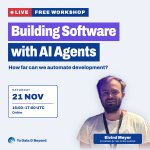
🟢 New Free Webinar | Building Software with AI Agents: How Far Can We Automate Development? by Eivind Meyer, CEO and Co-Founder of The Open Engine Company
In this free technical webinar, Eivind Meyer will explore how autonomous software development works, the engineering challenges behind it, and how far we can realistically push automation using modern AI agents.
We'll go beyond AI-assisted coding to explore the architecture of systems where multiple agents collaborate to implement, review, test, and improve software with minimal human intervention.
Book your seat using the link in the comments.


Last Saturday, Henrik Ibsen showed how he gives Claude Code and Codex one shared, searchable memory that lives on his own machine.
NOBLIVION is an open-source memory system he built after hitting the limits of built-in memory in coding agents: memory that only advises, recall that depends on file names, and context that gets lost on compaction.
Henrik walks through the NOBLIVION architecture: markdown notes as the source of truth, a local SQLite index with keyword and vector search, ranked recall injected through prompt hooks and MCP, guards that block tool calls that break a rule, and error recall so the same mistake isn't repeated.
He compares it with the memory in Claude Code and Codex, explains where it helps (large, long-running projects) and where it does not, and is open about what is still unproven, including token usage and benchmarking.
You can watch the full talk on our YouTube channel. Link in the comments

The 30% Early-bird price ends tomorrow, Monday, 16 November, for the Building and Fine-Tuning Decision Models for AI Agents - 4-hour live workshop
In this workshop, we’ll compare JEV with a general-purpose LLM across eight agent-workflow use cases, then build a local decision model together
You’ll generate and label training examples, fine-tune the model, and benchmark it across five datasets against a threshold-based baseline and five local open-source models. Everyone who registers gets the recording and all workshop materials.
Book your seat from the link in the comments!

🔵 New Free Blog | Building a Deep-Search Agent with the Claude Agent SDK- Part 3 by @YoussefHosni951
In Part 3 of Building a Deep-Search Agent with the Claude Agent SDK, Youssef builds the Python controller that makes those decisions.
It runs the planning, collection, and validation stages, checks time and spending limits before starting more work, and saves completed stages to a checkpoint. If the run has to stop, it can still return the validated findings, their citations, and the gaps it couldn’t close.
Youssef will walk you through three restart scenarios with runnable examples: a completed stage the controller can reuse, an interrupted model call it won’t replay automatically, and a run whose original deadline has already expired.
Read Part 3 for the Python code and the output from each scenario (Link in the comments!)
🤖 Made with AI

🔴 New 4 Hour Live Workshop Announcement | Designing, Building, and Deploying AI Agents with Karim Nabil.
An AI agent handling customer support needs access to accurate business information, tools for checking orders, and clear rules for when to involve a person. Once deployed, it also needs secure credentials, error handling, and visibility into its executions and costs.
In this four-hour workshop, Karim Nabil will guide you through building these capabilities in n8n. You’ll work through a customer support agent for an online store, starting with a conversational workflow and progressively adding business tools, document retrieval, human approval, and security checks.
The workshop follows the project through deployment, with demonstrations of both n8n Cloud and self-hosting using Docker. Along the way, Karim will explain the design decisions behind the workflow, how to investigate failures, and the operational responsibilities that come with each hosting approach.
30% early bird discount until 25 November. Book your seat from the link in the comments

1
3
116

🔵 New Free Blog | Building a Deep-Search Agent with the Claude Agent SDK- Part 2 by @YoussefHosni951
In Part 2 of Building a Deep-Search Agent with the Claude Agent SDK, Youssef extends the Python agent from Part 1 to handle that distinction.
The agent drafts a research plan and sends it to a separate reviewer before collection starts. After collection, it checks each claim against the saved source response, merges supported findings with their citations, and records what the evidence still leaves open.
Youssef also walks through a run where the reviewer rejected both drafts and the controller stopped before collection. You can inspect why the plan was rejected and see how the same workflow turns an unresolved question, such as the timing of the Baidu role, into a focused follow-up assignment.
Read Part 2 for the Python code and the artifacts from the runs (Link in the comments!)
🤖 Made with AI

1
2
59
To Data & Beyond retweeted

Yesterday, we hosted a 4-hour live workshop on building a production agent with the Claude Agent SDK. The workshop consists of 8 chapters and 5 code labs.
However, we managed to finish only 4 chapters and 2 labs, as you can see in the images below. We will need to add 3 more hours next week.
Honestly, I did not expect that this would stretch to 7-8 hours, but I am very happy with the output and the feedback and looking forward to the next session. If you have missed it, do not worry; it is available now as a self-paced course.
What you get:
- 5 hours of video lessons
- 160+ page book
- Five hands-on labs plus a final end-to-end run
- The complete code on GitHub
- The full slide deck
A 30% early-bird discount until the end of November. Link in the comments!


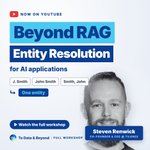
Our latest free To Data & Beyond workshop is now on YouTube: "Beyond RAG: Entity Resolution for AI Applications" with Steven Renwick, Co-Founder and CEO of Tilores.
Steven shows why vector search struggles with questions about a specific customer, since similar names can pull in the wrong person or miss records stored elsewhere.
He walks through how entity resolution matches records into one entity, how to combine it with RAG so the system resolves first and then retrieves, and finishes with a live demo in Tilores Studio, including a Claude chatbot connected through the Tilores MCP server.
The full 45-minute recording is linked in the first comment.

Tonight's Claude Agent SDK 4 Hour MasterClass is fully booked. All 25 seats are taken for the 4-hour live workshop, and we want to thank everyone who signed up.
Together we will build a deep-search agent in Python with the Claude Agent SDK, step by step and with the code running live.
If you didn't get a seat, the workshop will be available tomorrow as a self-paced course.
It includes the video lessons, hands-on labs, an assignment and a quiz to test what you have learned, the full code, the slide deck, and a 150-page ebook that comes with the course.
You can work through it at your own pace and go back to any part of the build whenever you need it.
🟢 We are live with Steven Renwick! Join us to learn how to give RAG applications and AI agents more accurate context with Entity Resolution.
Join us: luma.com/3y9ewkxx

3
47
LLM Roadmap 3rd edition is out!
We published the first version in 2024, and it became our bestseller.
Because the field keeps changing, we released the second version in June 2025, and enough has changed since then that we decided to release a third one.
The new version has 31 chapters instead of 21, with new chapters on pretraining, small language models, tool calling, coding agents, evaluating LLM applications, and landing an AI engineering role at the end, guided by projects to build.
Now the roadmap has 617 resources and projects; all are rebuilt with current models and the skills in demand in the market. The roadmap starts from the very beginning and prepares you for the market.
Early bird: 30% discount until Sunday, 15 November.
The link is in the comments.


