

President, @LawReformInst; previously executive director @uniformlaws, attorney @StateDept
McLean, Virginia
Joined January 2016
- Tweets826
- Following717
- Followers566
- Likes8.5K





Tim Schnabel retweeted

If we really want a surge of investment in cybersecurity ASAP, lame duck should pass a major cyber tax credits & deductions bill
Tim Schnabel retweeted

In other safety-critical industries like nuclear and finance, employees have defined channels for raising safety concerns confidentially with auditors and regulators. AI needs similarly clear rules governing relationships between labs, outside evaluators, and employees.
Calling an evaluator an independent auditor means little unless its access, and employees’ ability to speak candidly with it, are protected. OpenAI says they support embedded auditing but then fires employees for talking to those same auditors.
This case illustrates the weakness of leaving those protections to voluntary arrangements controlled by the labs themselves. Employees who are never clearly told which channels are permitted, and how they can be used, can't comply with the rule, and everyone watching learns that talking to evaluators is risky.
Even if OpenAI does give competent auditors the access they need, I am worried employees will be too afraid to tell the auditors what's really going on.

New: The three researchers OpenAI fired last month spent the summer fighting to keep AI's chain-of-thought process visible.
Then, OpenAI asked to see their Signal chats. A week later, they were let go.
More below from @keachhagey, @berber_jin1, and me.
wsj.com/tech/ai/the-signal-c…

Tim Schnabel retweeted

Best explanation I have for our firing: talking to auditors was too much safety, disappearing messages were too much security, and we should have paced ourselves.

The firings of three OpenAI safety researchers came in the throes of a battle over how to keep AI systems under human control—and who gets to see the secret designs that could determine the winners of the biggest commercial race in history. on.wsj.com/48bYPG8

Tim Schnabel retweeted
Congress has explicitly limited the Exec's export authority around information and software before, it can and should again. The only allowed model-blocking should be narrowly defined by Congress, and with strong procedural protections considering the prior restraint issue.
Tim Schnabel retweeted

Good.

The Government Accountability Office is making the oversight of artificial intelligence and emerging technologies over the next five years a priority, according to its strategic plan released Friday.
As Congress’ watchdog over the federal government, the GAO said in its 2027-2032 plan that it seeks to help the House and Senate “anticipate emerging science and technology trends, opportunities, and risks, including artificial intelligence,” and “monitor federal efforts to ensure the nation’s security from cyberattacks and other threats.” scoopmedia.co/4sjp5rE

Tim Schnabel retweeted

AI policy has almost exclusively focused on setting guardrails on AI companies and their models. This is reasonable, as we have seen some of AI's biggest risks materialize this year.
It's time we start talking about guardrails for government as well.
More in my latest:

Tim Schnabel retweeted

Dan is right. Even if, like me and him, you don’t let Claude write for you, you should try letting it help you research and cite check.

Law folks: If you’re not using Claude Code or ChatGPT’s Codex, you have no idea what you’re missing. So I’m distributing my research tools that provide a huge boost to legal scholarship. Research assistance, cite-checking, proofreading, and more (thread):
danepps.github.io/legal-rese…
Tim Schnabel retweeted

Happy #FreeSpeechWeek! The Uniform Public Expression Protection Act safeguards free speech by creating a clear process to dismiss a “strategic lawsuit against public participation,” or SLAPP.
Learn more about the Act here: tinyurl.com/27ktk47c

Tim Schnabel retweeted

Have not read bill text, so take with grain of salt, but I think the concern broadly that the executive have such substantial unilateral control over such decision making is a fair one? It’s certainly a fear I share.
Not specifically on your comment, but I see a lot of commentary these days encouraging ever stronger regulation, almost always carried out through the executive branch, which seems to assume away the dangers of the institutional interest of the executive in centralizing power. And this just seems straightforwardly bad to me.
There’s a balance here to strike between legislation that enables the executive to act quickly when needed without providing it with plenary power over the labs, and my sense is the current dynamic is to underrate the latter concern substantially and, oftentimes, view those who raise it as being in bad faith or insufficiently *pilled*.
This specific concern is totally reasonable from the labs imo, and is just a flat out tradeoff that will require careful thinking, not a bad faith effort.
Tim Schnabel retweeted

"The United States budget deficit approached $2 trillion in the 2026 fiscal year, its highest level since the pandemic." nytimes.com/2026/10/16/busin…

Tim Schnabel retweeted

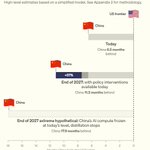
Looks like a 20x compute advantage only gives you ~6 months on model capabilities. Efficiency exponentials are real.
That's without anti-distillation measures. So maybe that makes it 12 months.
Tim Schnabel retweeted

Anthropic's released an impressive blogpost on new steps they've taken to deter distillation. It is great. But it has far from solved the problem:
1) The key result is that they've significantly reduced the reasoning tokens that can be extracted with new classifier defenses. This is great - and all labs need to follow suit. But it is far from a full solve.
Methods exist to still be able to gain proxies of reasoning from just the input/output that still benefit adversary's models. See "How to Steal Reasoning without Reasoning Traces" paper. Adversaries will still continue to leverage U.S. models for valuable data if they can access them. The game isn't over.
2) Anthropic says they have been restricting and banning accounts that attempt to distill. This is also great. However, there is a massive "transfer station" ecosystem of accounts based on fraudulent credentials that are easily dissolved and reconstituted. This only helps so much.
3) Policy measures from the USG remain necessary for tighter security:
- KYC to access U.S. models. Require credentials that are harder to make fraudulent.
- Offense against the transfer stations that enable unauthorized access.
- Narrowly scoped antitrust exceptions to allow U.S. labs to coordinate on anti-distillation security: methods & signal-sharing for detection & deterrence.
- Bring all relevant U.S. partners into this methods & signal-sharing coordination including e.g. OpenRouter.


Tim Schnabel retweeted

My final take: it seems that Argon can perform simple SWE tasks without CoT, and has nearly as much control over its CoT as its output - using both to do reasoning. It also knows how to evade a CoT monitor, though by default the CoT remains useful for our monitoring as it isn't trying to! That's all for now! Read the full report here: storage.googleapis.com/deepm…
Tim Schnabel retweeted

Job Opportunity: Lawyers, come join @AnthropicAI for a 4-month fellowship!!
Law is a field where it’s notoriously hard to define quality, and there’s so much interesting and important work to be done here.
Link here: job-boards.greenhouse.io/ant…

Conceptual Reasoning Fellow
Remote-Friendly, United States; San Francisco, CA
job-boards.greenhouse.io
Political scientists and economists: we're looking for researchers with deep expertise to come work with us for a unique 4-month fellowship at @AnthropicAI. You'll work closely with us to evaluate, improve, and apply Claude's capabilities in your field. It's going to be extremely fun and interesting work, and definitely worth taking a short leave from your university for if you need to!
More info here:
job-boards.greenhouse.io/ant…

Tim Schnabel retweeted

An admirable stance (one I wish more publications would hold the line on).
FAI's policy: we encourage full fluency with the latest AI tools (and deployment to help with research, ideation, typo-checks, microsites, etc.) but no writing for publication may be AI-generated.


Tim Schnabel retweeted

dear united airlines, please put starlink on your DCA/IAD-SFO aircraft as quickly as possible. thank you for your attention to this matter.
Tim Schnabel retweeted
Niche tweet, but there's a conversation to be had, although I don't recall it happening in public, about what the role of the @AmLawInst should be now that the Internet has made it so much easier to find out what the law is and academia has moved away from the legal profession.
Tim Schnabel retweeted
This is the precise reason why antitrust waivers for security coordination like the CATS Act are so necessary.
Across distillation, cyber, bio, loss of control, etc., the labs cannot coordinate live information at all right now. So these attacks will keep happening.

Tim Schnabel retweeted

Does AB 316's "may not assert" language prevent OpenAI from arguing that LASST cannot satisfy CDAFA's knowledge requirement without showing that a human knows something? Or does AB 316's focus on defenses make it fine to argue plaintiffs can't satisfy a mens rea element via AI?
Tim Schnabel retweeted

The Frontier Model Forum welcomes the emphasis on frontier responsibilities in the White House Accord announced yesterday.
We look forward to continuing to work across industry and the broader ecosystem to advance the norms, practices, and standards needed to develop frontier capabilities safely and securely.


