

CEO and publisher, The Technology Letter. Covering business and technology for 32 years for Barron’s, Fortune, Bloomberg, NY Times and others.
NYC
Joined November 2010
- Tweets25.1K
- Following945
- Followers14.6K
- Likes8.5K





Pinned Tweet
One of the things that’s different about The Technology Letter is ACCESS. I’ve done 232 interviews of CEOs and CFOs of public companies in 6 years, about 40 interviews a year. That gives me unusual insight into the intentions, the strategy, the ways that these executives have of thinking about where there businesses are going.
thetechnologyletter.com
The eighth rebalancing of the TL20 group of stocks to consider continues to track a broad semiconductor renaissance, the best of times for chip makers — but also a time filled with uncertainty over massive spending plans for AI infrastructure. Seven names are out, seven are in.
In addition, a second index, the TL20 Special Situations is an eclectic mix of companies with astronomical potential, sometimes beaten down valuations, and sometimes prospects years out in the future.
thetechnologyletter.com
It’s damned if you do, damned if you don’t, as the raging AI market creates terrific demand, but then limits upside for chip equipment makers because they can’t fulfill all the demand. Fact is, business is outstanding at the moment, even if no one wants to buy these stocks.
Scarcity is the boogey man for ASML, Applied Materials
Business is on fire for equipment makers ASML and Applied Materials, but that’s not helping the shares. The theme of scarcity dominates, the various factors that are limiting the upside for the companies and the pervasive fear should that scarcity go away and supply actually comes into balance with demand.
thetechnologyletter.com
$ASML $AMAT

The eighth rebalancing of the TL20 group of stocks to consider continues to track a broad semiconductor renaissance, the best of times for chip makers — but also a time filled with uncertainty over massive spending plans for AI infrastructure. Seven names are out, seven are in.
In addition, a second index, the TL20 Special Situations is an eclectic mix of companies with astronomical potential, sometimes beaten down valuations, and sometimes prospects years out in the future.
thetechnologyletter.com
$CBRS
Like high quality footwear
Just like bespoke suits or small-batch whisky, the investment choices of the Technology Letter 20 are made by hand.
The latest rebalancing of the TL20 introduces a second index of twenty stocks, Special Situations.
The eighth rebalancing of the TL20 group of stocks to consider continues to track a broad semiconductor renaissance, the best of times for chip makers — but also a time filled with uncertainty over massive spending plans for AI infrastructure. Seven names are out, seven are in.
The TL20 Special Situations is an eclectic mix of companies with astronomical potential, sometimes beaten down valuations, and sometimes prospects years out in the future.
It’s been a rough first two days for these two indices, the TL20 down 3%, the TL20 SS down fractionally. But I think it’ll turn around.
Subscriptions to the newsletter, and the TL20 and TL20 SS, are $1 a week for the first four weeks.
thetechnologyletter.com


It has been apparent for a while now that there is a lot of extra engineering work of the plain-old-fashioned hard engineering type, to make AI stuff work correctly in an enterprise setting. I had an interesting chat with Progress Software CEO Yogesh Gupta this week about how the acquisition of Domo fits into that. I’ll be interested to see if they can move the ball forward with this technology.
Progress CEO has an answer to tokenomics: ‘Combine the meters’
“If it was within our environment, we would optimize the LLM meter.”
Progress Software, having purchased a “consumption-based” software startup called Domo, has an intriguing opportunity to combine the token-counting of AI with Progress’s own consumption pricing. “We would optimize the LLM meter,” says CEO Yogesh Gupta.
thetechnologyletter.com
$PRGS
@ProgressSW

I have for a while now thought that enterprise artificial intelligence is going to require a lot of extra engineering work of the plain old variety. Some of it can be automated, however, claim Rick McConnell of Dynatrace and Jason Lopatecki of Arize, which just joined Dynatrace. The approach, a coding “loop” of iteration and correction, with automatic evaluation, makes sense. It’s still early, however, for the entire industry to see how many “9s” of reliability are reached.
Dynatrace CEO: Soon, humans aren't going to be writing code
Dynatrace’s $815 million acquisition of AI startup Arize will expand the company’s audience for its tools by bringing in the developers writing code. Increasingly, though, there is a feedback loop taking shape where automated software fixes the code and iterates again, a world without human code writers, says Dynatrace CEO Rick McConnell.
“My R&D leader is telling me that is his goal, that over the next six months or so, if not earlier, we would expect little to no human-written code going into production,” says McConnell of Dynatrace’s internal development.
thetechnologyletter.com
$DT

It’s entirely possible Nvidia and peers will build more AI chips than the market can absorb
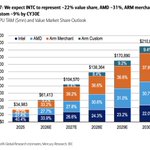
Merrill Lynch’s Vivek Arya has done a great job gathering all the data points on chip companies and what they may be able to sell to Google and the other cloud giants. What concerns me is all the spending by the cloud giants still isn’t enough for rosy expectations of semiconductor sales growth. A separate study by UBS suggests chip stocks are undervalued, which has been my view generally, but the market clearly doesn’t trust all the chip sales forecasts.
Forecasts for chip sales for AI are upbeat for years to come, but they’re not entirely supported by the spending plans of the cloud giants and the Neoclouds and sovereign states, as a new Merrill Lynch report shows.
thetechnologyletter.com
$MU $NVDA $AMD


Micron turned around a pre-market loss, rising 3% today. I think the “smart money” is looking at the prospect of higher margins being sustainable, and also the increased capital returns that will come with that.
Momentum walks away from Micron Technology but cash is king
Stock traders have concluded the surging prices of DRAM and NAND will moderate going forward, and so, they’re taking some profits on Micron Technology. But, the fundamentals of the business and its industry have only gotten stronger. The real focus going forward will be the enormous balance sheet now cruising toward a $100 billion in cash.
thetechnologyletter.com
$MU


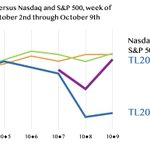
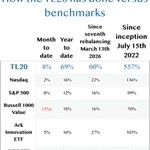
Animal spirits are firmly in charge again as worries about the AI bubble yield to fervor for rising AI leasing estimates for SpaceX and others. The TL20 has snapped the losing streak it was on early in the month, now up 8% for September, ahead of all relevant benchmarks.
thetechnologyletter.com


While estimates have risen for SpaceX’s AI compute revenue, it’s important to also take into account just how much is uncertain and unknown about those estimates. There is a verrrrrrrrrrrry wide range of estimates for AI revenue for next year and beyond.
SpaceX’s Launch 14 impresses but AI revenue is the thing
Analysts gushed over SpaceX’s Starship launch on Monday, but it’s still a long journey to prove “rapid” reusability of the rocket. The more nuts and bolts work is trying to guess how fast AI revenue rises. Also, Merrill Lynch helpfully says there’s no reason to worry about the AI trade unless it implodes.
thetechnologyletter.com
$SPCX
@spacexai
@SpaceX
@elonmusk


Ever the salesman, Nvidia CEO Jensen Huang tends not to have much of any profundity to offer on the social issues that the world keeps trying to drag him into regarding AI. On the matter of a pause on AI, he urged the reverse, buying more of his company’s chips to speed up the whole affair and make it safer. On the matter of public outcries over data centers, Huang reflected, vaguely, that “it could have been handled better.” On his company’s stock, he is bullish, calling it undervalued and even cheap. “We’ll be buying hundreds of billions more of our stock,” he said. On that last point he’s probably right.
Nvidia’s Huang’s answer to AI fears: buy more chips, and buy his stock
thetechnologyletter.com
$NVDA
@JensenHuang
@nvidia


Another sandboxing tool is not going to fix a deep lack of disclosure, lack of transparency about agentic AI development throughout the industry. But, it might have the amusing effect of causing more problems for AMD and Intel as Nvidia seeks to sell the whole basket of chips: GPU, DPU and CPU.
Nvidia: Using AI issues to torpedo AMD, Intel?
Nvidia’s set to buyback four percent of its stock through January of 2028, a nice boost for shareholders. Meantime, its “OpenShell” software is yet another in a crowded field of sandbox approaches to agentic AI. It doesn’t solve the crucial problem of the lack of transparency in artificial intelligence that is making security such a nightmare. But, by promoting “Vera” CPUs and “BlueField” DPUs, Nvidia may be able to really put the screws to Intel and AMD in the microprocessor business.
thetechnologyletter.com
$INTC
$AMD
$NVDA


I’ve been very skeptical of enterprise AI because it seems to me to involve extraordinary amounts of additional engineering work to make it function properly at all. It is encouraging that TD Synnex, the world’s largest distributor, has developed something that actually brings some productivity gain. More on that in my conversation with CEO Patrick Zammit.
“The approach by vendor has always paid off […] Even when I look at some distributors who emerge, and broke through, they always started with the support of one vendor.”
TD Synnex’s CEO may have cracked the code on ‘agentic’ AI
Efforts at tech distributor TD Synnex to implement “agentic” AI have sped up in recent months, and CEO Patrick Zammit says the approach is already yielding benefits for tasks known as “quote to cash.” Meantime, his company’s stock doesn’t fully reflect the “sum of the parts” after the most recent earnings report.
thetechnologyletter.com
$SNX

I had a very enjoyable conversation with Asana CEO Dan Rogers about how exactly one should charge for “value” in enterprise agentic AI. I think this has been a big missing piece of the puzzle, what exactly is being paid for and whether it’s worth anything. It will be most interesting to see if they can turn Asana’s years of experience with teams into something that finally works for companies as far as AI.
“What are good characteristics of processes that need some agentification? Lots of manual handovers,” he says, “lots of time delays, lots of use of email and Slack to get updates and notifications and status.”
Asana CEO: ‘AI alone maketh not an enterprise workflow’
Next month, software maker Asana plans to give away what it calls “requests” to its customers, the ability to freely try out agentic AI. CEO Dan Rogers is betting Asana’s years of selling to teams makes his company better equipped than most to “agentify” work. If he’s right, Asana could be on the verge of repeating the success of big companies such as ServiceNow and Rubrik. That would mean Asana’s dirt-cheap shares worth a look.
thetechnologyletter.com
$ASAN

There was a time, a decade ago, when Silicon Valley was obsessed with the “quantified self,” measuring your personal KPIs. This always seemed silly to me, typical Valley obsession with metrics. I’ve never used an Oura ring, and, though I don’t doubt the product’s quality, and its appeal to its customers, I question how broad the market is for this thing.
Oura IPO by the numbers: how big is this market really?
Oura, makers of snazzy health monitoring rings, has seen impressive growth in the past year, but it’s still very much a niche at five million members. The rate of churn of people who walk away from the membership, 13%, seems high. Just how big is the opportunity, really?
thetechnologyletter.com
$OURA


I like to be up-front about when I’ve made grave errors in letting go of perfectly good companies and stocks for silly reasons. Such is now the case, I’m afraid, for Everpure, Arista, and Advanced Micro Devices. Oh, well: Live and learn!
Everpure soars while Oracle uses the force
I removed Everpure from the TL20 in March for lack of what the Street calls “catalysts.” Then, the company delivered a catalyst in August, another win with a cloud giant. Now, the forecast for next year is stellar. I’ve made some mistakes in my time, and this is a doozy, even if I had decent reasons for believing as I did. Well, live and learn, as they say. Meantime, Oracle caused some jitters invoking force majeure, but the bulls assure us it’s alright.
thetechnologyletter.com
$P
$ANET
$AMD

Kudos to UBS’s Karl Keirstead for a spirited defense of CoreWeave given worries about its massive debt pile in a time of rising rates. I’m not convinced this is a good business, but I appreciate the effort he’s put into it.
Why Amphenol and CoreWeave are worth a look
“Connector” maker Amphenol is a good deal regardless of data center rhetoric about fiber optics while making the case for CoreWeave, which has become a tracking stock for Treasury yields, is a really hard job.
thetechnologyletter.com
$APH
$CRWV

Since the introduction of Meta’s Muse app on September 9th, it has crushed the benchmarks and even the AI-heavy TL20 group of stocks to consider with a 22% gain at a recent price of $754.76.
$META
