

@The_Colonel__
Account based inUnited Kingdom
About this account
- Account based in
- United Kingdom
- Connected via
- United Kingdom Android App
Account-level information from X, not a live location or the device used for a specific post.
PM - Green Ash Horizon Fund. Perusing latent space
London
Joined March 2021
- Tweets947
- Following1.3K
- Followers617
- Likes3.5K






"Experience has shown that, even now, there will still be people explaining in patronizing tones why none of this is real and none of it counts. If such people were capable of being impressed by anything that happens in the empirical world, of updating on anything, they would’ve already been impressed and already updated several years ago, long before things had reached the point of an actual Mathocalypse.
So, they’ll say, maybe the alleged solutions are not solutions at all, but just “AI slop.” Or maybe none of the 372 well-known open problems that were solved were real math problems, they were all just glorified contest puzzles and trivialities. (After all, there’s still no Riemann Hypothesis!) Or maybe the entire 4000-year-old discipline of mathematics needs to be jettisoned: turns out that it was all just puzzle-solving and trivialities; all that’s different is that now the triviality stands unmasked. In any case, what really matters is that the true inner sanctum of human creativity hasn’t been breached and probably never will be, and also, that Sam Altman and Dario Amodei are contemptible little nerds."
So good scottaaronson.blog/?p=10169

The linchpin of the AI infrastructure investment thesis is that there is insatiable demand for compute, and orders of magnitude more will be required to fully realise the economic benefits of AI at scale. Pacing the frontier does nothing to change this, as agentic AI is so early in its adoption curve (taking Codex users as a proxy, only 2% of those using AI in chatbot form are using long-horizon agentic AI which is where the real economic and productivity value lies). The slowdown being proposed is related to model releases, not development, and the capabilities AI researchers fear are not in today's models, or even their successors, but the prospect of models capable of recursive self-improvement (RSI; the ability to design their successors and iterate much more rapidly than human researchers). Anthropic's own system card for their latest models (Mythos 5.1/Fable 5.1), independently verified by METR, states we are still far from this.
You could argue that the frontier AI labs' getting together on self-regulation, and ducking under the aegis of the State when it comes to defending against Chinese competition is a double-positive for the AI infrastructure theme. Far more tokens will be spent in the training phase, as new RL environments are designed for alignment optimisation (LLM training provider Mercor recently said they are spending 3x more on tokens than employee salaries). And if there were any reduction in research or training token budgets due to slowing model iteration, this could quickly be allocated to revenue-generating inference, making the labs more profitable, and ensuring they can meet all of their cloud capacity and chip-purchasing commitments.


CRWV active power today 1.5GW, YE26 target 1.85GW, YE30 8GW
NBIS active power today 0.2GW, YE26 target 1GW, YE30 5GW
SPCX active power today 1.4GW, YE26 target 2GW, YE27 10GW
James Sanders ⚛🌍 retweeted
It's quite aspirational from the chips angle too - implies $350-420 billion in capex on NVIDIA chips over the next year and a half at ~$40-50 billion per GW, against current cash of $100 billion.
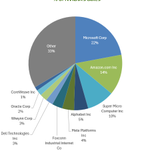
At the mid-point, it also amounts to about 57% of NVIDIA's forecasted datacentre revenues over the next six quarters. The servers for SpaceX/xAI's first 1.4GW were supplied at around a 50:50 split between Dell and SuperMicro - at last estimate, these two providers combined only amounted to 13% of NVIDIA's sales

ALT Source: Bloomberg supply chain estimates


After Meta spent $80BN failing to build the metaverse, Google have released it as a side project

Project Genie is a @GoogleLabs experiment that lets you simulate dynamic worlds you can navigate in real time with Genie, our general-purpose world model.
Today, we’re connecting Project Genie to nearly 20 years of Street View data from Google Maps — so you can now build interactive spaces based on real-world locations.
Street View imagery in Project Genie is available now for places in the U.S., and will expand to more locales over time.
#GoogleIO

James Sanders ⚛🌍 retweeted

Attempted to write a Steam Engine hype at the era of Industrial Revolution as if it was the age of AI —
The steam engine breakthrough is insane right now.
Watt’s separate condenser + new GRPO optimization just dropped the 405 hp-class engine. We went from 7 hp → 70 hp → 405 hp+ in basically three years. One machine now does the work of 50+ men or water wheels — nonstop, rain or shine, anywhere.
Textile mills, ironworks, everything scaling 5-10x overnight. Productivity exploding.
This isn’t incremental. It’s automating physical labor at massive scale. Jobs shifting forever. Society about to look unrecognizable.
The Industrial Revolution isn’t coming. It’s here and accelerating faster than anyone predicted.
Terrified. Excited. Both.
What a time to be alive. 🚂💨

So interesting. Do models learn easy tasks first because they need to understand those to learn the hard tasks, or are the hard tasks just less well represented in the training data?

This is an extremely beautiful plot because it sheds light on why scaling laws are so smooth, and reconciles empirical findings from both scaling laws and grokking.
Even though mean loss across all tasks (red line) decreases smoothly, we see that individual subtask losses drop in a much more phase transition / grokking-like way. Easier subtasks are learned first, harder subtasks learn much later. This is also consistent with many LLM evals where you see a sharp inflection as you scale, rather than smooth linear improvement.
It also suggests why robotics models have not yet seen sufficiently convincing scaling laws: even though we may collect enormous numbers of demonstrations & hours of data, the data do not contain enough diversity or "underlying subtask quanta" for the losses to "meld together" to form a clean scaling law.
It remains a mystery why natural data, sorted by subtask difficulty, seems to form a Zipfian distribution. Are tasks we perceive as "difficult" actually nothing more than "infrequent" in our training distribution? There is relationship between the length of the shortest program that can generate some data, and the frequency of that data. If a subtask were *more* frequent, then you could actually shorten the program needed to generate it, thereby making the task easier from a Kolmogorov Complexity POV.
And if you assume my previous claim about robotic scaling laws is true, why makes robotics data have such bad zipfian coefficients? Does the coefficient only get "good" once you do the tokenizer + dedup + operationalize the data collection just right?
Does a hard subtask take more steps to learn because it requires representations from "easier" subtasks to be learned first? Representational dependency enforces a strict ordering in tasks that can be learned (task B cannot be learned until task A is mostly learned, task C cannot learn until B is mostly learned)? This could explain why there is an "ordering" of difficulty - it arises from natural ordering of dependencies in distributed representations like DNNs.
It would be interesting to study this in a synthetic context, where one has the power to tune frequency of data independently of "minimum description length" as defined by P(Internet text), and see if it is possible to "learn hard tasks faster". Lots of potential in applying a better mechanized understanding to how scaling laws form to improving scaling properties on frontier models.

I wrote about Claude Code. Three weeks late for twitter, in-line for substack, and six months early for linkedin.
The Great Unhobbling: How Claude Code Stole Christmas
greenash-partners.com/docume…

