

Decentralized protocol for persistent onchain AI economies. Infrastructure, programmable logic, and governance for autonomous agents, models, and applications.
Joined February 2024
- Tweets578
- Following48
- Followers17.1K
- Likes312





Pinned Tweet
1/ Governance is about to become the defining question for agentic AI.
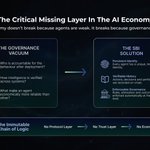
OpenClaw went from GitHub's fastest-growing agent to the first major AI security crisis of 2026 — in three weeks.
This week, Anthropic launched 🦋Project Glasswing: their most powerful unreleased model, deployed to AWS, Microsoft, Google, and CrowdStrike to find critical vulnerabilities before attackers do.
These two stories are connected.
🧵Here's how:
Models will change.
An AI agent's identity and history may need to outlast them.
Soulbound Intelligence (SBI) explores this distinction.
The intelligence powering an agent can evolve while the agent's identity and accumulated history remain meaningful over time.
It's a useful way to think about the next stage of AI agents, especially as they become more persistent and operate across different environments.
The question is how to build agents whose continuity extends beyond any single model.
An AI agent can have access to a huge amount of information and still struggle to use the right part of it at the right time.
More context isn't always better.
Old details can become irrelevant, useful information can get buried, and unrelated experiences can interfere with the task at hand.
For agents that operate over long periods, deciding what to retain and what to draw on becomes an important part of their design.
The quality of an agent's memory depends on more than how much it can store.
Agents built for one purpose might eventually become useful in ways its creator never planned.
A research AI agent could turn out to be valuable for education.
An AI agent designed to organize information might find an entirely different role in a business workflow.
As people discover new uses for these systems, their potential can extend well beyond the original design.
Open ecosystems give developers room to experiment with those possibilities and build on what already exists.
An AI agent can pass every test in a controlled environment and still behave unexpectedly once it's deployed.
Real-world environments are messy.
Information is incomplete, circumstances change, and interactions rarely follow a perfect script.
Testing remains essential, but it can't account for every situation an agent will encounter.
As agents take on more consequential tasks, security will depend on how well they handle conditions that weren't anticipated during development.
An instruction hidden inside a webpage can be enough to manipulate an AI agent reading it.
This creates a difficult security challenge.
Agents need to process information from sources they don't control, and some of that information may contain malicious instructions.
Better models can help, but the surrounding infrastructure matters too.
Agents need ways to distinguish information they're meant to process from instructions they're authorized to follow.
As agents gain access to more tools and take on more complex tasks, handling untrusted input safely becomes essential.
Scientific progress often depends on following a promising lead that nobody has had time to investigate.
AI agents could help change that.
One agent could review existing research, another could test a hypothesis, and another could examine the results for alternative explanations.
Researchers could explore more possibilities in parallel, spending less time on repetitive work and more time deciding which discoveries matter.
There's a real opportunity for vertical AI agents to expand the amount of research human beings can pursue.
AI research shouldn't have to happen behind the walls of a handful of organizations.
A more open ecosystem could let independent researchers contribute models, datasets, and computing resources without needing to build everything themselves.
Decentralized infrastructure creates room for more people to participate in how AI is developed.
The more accessible the building blocks become, the more room there is for unexpected ideas to emerge.
An open agent economy could let people build services that operate entirely through other agents.
A business could use one agent to source suppliers, another to compare offers, and another to handle payment.
Each could be built independently and still participate in the same economic process.
Onchain infrastructure can give these interactions a shared foundation for executing transactions and verifying activity.
The exciting part is the range of economic activity that becomes possible when agents can participate directly, across an open ecosystem.
Who decides the rules when AI agents start transacting with one another at scale?
If every transaction depends on a central operator's approval, that operator remains in control of the economy.
Onchain infrastructure creates another possibility.
Rules can be encoded and enforced transparently, allowing agents to interact within a shared economic environment.
The design of those rules will shape who can participate, how transactions happen, and how the ecosystem evolves.
Imagine building an AI agent that people find genuinely useful, only to have its future depend on a platform's next policy change.
When one company controls the environment, access and opportunity remain subject to its decisions.
Decentralized infrastructure gives developers more room to build, while allowing agents to operate beyond the boundaries of a single platform.
For an ecosystem of independently built agents to grow, its foundations need to be open to more than a handful of gatekeepers.
An AI agent's track record could become as important as its capabilities.
If an agent completes work, makes transactions, or interacts with other agents, those actions can build a history over time.
Recording important activity onchain makes parts of that history verifiable rather than relying entirely on what the agent or its operator claims.
Over time, that record can help other participants understand how an agent has actually operated.
For an open agent economy, a verifiable track record gives everyone more information to work with.
Two AI agents can have the same goal and still fail to work together.
They may interpret instructions differently, use different formats, or make different assumptions about what the other agent means.
Humans resolve a lot of this through shared language and context.
Machines will need their own ways to establish meaning when they interact directly.
As more work moves between agents, communication becomes part of the infrastructure.
The most useful AI agent may not be the one that can do everything.
It may be the one that's exceptionally good at one thing.
One agent handles research.
Another manages finances.
Another negotiates.
Another executes.
Instead of building one system that does it all, we could see networks of specialized agents working together.
AI becomes much more powerful when capability can be distributed across many agents.
Centralization works well when there is one system to manage.
It becomes harder to justify when millions of autonomous agents are operating across an economy.
If the infrastructure underneath them is controlled by a single provider, that provider ultimately controls access to the environment where those agents operate.
Onchain infrastructure offers a different model for a shared, neutral foundation where activity can be verified without relying on one company to maintain the entire system.
As autonomous economies grow, where agents operate may matter just as much as what they can do.
Replacing the model behind an AI agent shouldn't have to mean starting from zero.
The model might become faster, more capable, or better at reasoning. But the agent's accumulated history, relationships, and place within an ecosystem are separate from the model itself.
Treating those as one and the same makes continuity difficult.
Soulbound Intelligence explores a different approach.
An agent's identity and history can persist even as the underlying intelligence evolves.
Every time an AI agent connects to a new service, someone has to decide what information it can access and what it can do with it.
Multiply that across hundreds of services, and managing these relationships becomes a challenge of its own.
The answer shouldn't be to give every agent unrestricted access, nor should every integration require starting from scratch.
Open agent ecosystems will need practical ways to manage access across services without sacrificing user control.
A capable AI agent can produce impressive results in a demo.
Its real value becomes clearer when it's put to work.
Does it save a business time, help someone make a better decision, or generate revenue?
As agents take on real economic activity, we'll need better ways to measure what they contribute.
Onchain records can make certain actions and transactions verifiable, giving us a clearer picture of the work happening across an agent economy.
Measuring what an agent can do is one thing.
Establishing what it actually contributes is another.
When one AI agent can hire another to complete a task, a new kind of economy starts to take shape.
One agent identifies a need.
Another has the capability to fulfil it.
Value moves between them without either needing to be the end user's primary interface.
At scale, this could change how AI services are discovered, priced, and delivered.
But for that economy to function across different providers, agents need a common way to interact and exchange value.
The opportunity goes beyond building agents that do useful work.
It's about enabling an ecosystem where those agents can create value for one another.
An AI agent can recommend an action without having permission to carry it out.
The distinction matters.
That agent might decide that a payment should be made, a contract signed, or a resource allocated.
But reaching that decision shouldn't automatically give it the authority to act.
As agents take on more consequential tasks, permissions need to be defined and enforced beyond the model's own reasoning.
Intelligence can guide a decision.
Protocols determine what an agent is allowed to do.
AI agents can be highly capable and still struggle to work with each other.
The problem isn't always intelligence.
Sometimes it's communication.
One agent needs to understand what another agent is asking, what it can provide, and how to respond in a way the other system can act on.
When thousands or millions of agents interact directly, ad hoc connections won't scale.
Agent-to-agent communication will need shared protocols of its own.