







Pinned Tweet
People ask what I actually own.
Here’s the bulk of my long-term portfolio:
$HIMS Avg $25.73
$SOFI Avg $12.79
$LMND Avg $52.75
$ZETA Avg $18.17
$NBIS Avg $129.48
$OSCR Avg $14.38
$DUOL Avg $114.21
I’m not touching these positions until 2030+ unless the long-term thesis changes.
If the thesis gets stronger, I’ll continue averaging up… exactly like I’ve been doing.
A very important point for $SOFI.
During Q2 earnings, Anthony Noto said management was expecting TWO rate hikes in the second half of 2026.
And those assumptions were reflected in their guidance.
Noto specifically mentioned that if there were NO rate increases, they would probably have upside to the bottom line.
Now, if we don’t get another hike next week, that could create additional room for earnings upside.
And remember, $SOFI raised revenue guidance last quarter but kept profitability guidance UNCHANGED.
Could Q3 finally bring an earnings guidance raise?

This is where we stand heading into $SOFI Q3 earnings.
Members continue to GROW.
Revenue continues to GROW.
Yet the stock is still down roughly 50% from its all-time highs.
So what’s the key to changing sentiment?
Cross-selling and operating leverage…
I’ve been discussing these two factors for quite some time now.
It’s not just about adding more members.
It’s about getting existing members to use MORE products, generating MORE revenue per relationship and translating that growth into stronger profitability.
That’s where the real opportunity lies.
And that’s exactly what I’ll be watching this quarter.
Can $SOFI demonstrate that earnings are beginning to scale faster than revenue?
Can management deliver stronger margins and potentially raise its full-year earnings guidance?
Because at some point, continued fundamental improvement needs to translate into shareholder value.
Q3 is an important opportunity to prove that.
The business keeps growing. Now I want to see the operating leverage.


One thing I’m really watching heading into $SOFI Q3 earnings…
Remember, last quarter management RAISED its full-year revenue guidance but left profitability guidance UNCHANGED.
- Revenue: $4.75–4.85B
- Adjusted EBITDA: $1.6B
- Adjusted net income: $825M
- Adjusted EPS: $0.60
Management chose to reinvest in growth rather than raise earnings expectations…
An earnings guidance raise this quarter could be a major bullish catalyst.
This would suggest $SOFI is beginning to generate MORE profitability than previously expected, even while investing aggressively in expansion.
That’s operating leverage.
And for a company transitioning from high-growth fintech to a consistently profitable financial institution, that matters enormously.
Revenue growth has already been impressive.
Now I want to see that growth translate into MORE earnings per share.
I think that could be a key ingredient for a sustained $SOFI rerating.
$SOFI I’m very bullish heading into Q3 earnings next week.
I think this could be one of the most important earnings reports for $SOFI in quite some time.
Here are 4 reasons I’m particularly excited about $SOFI heading into Q3 earnings:
1. Operating leverage:
As $SOFI continues scaling, I expect earnings to grow faster than revenue.
The company has already demonstrated its ability to expand profitability while maintaining impressive growth.
And I believe Q3 could provide further evidence of that trend.
2. Cross-selling:
This is one of the most UNDER-APPRECIATED parts of the $SOFI investment thesis.
1) More members
2) More products per member
3) More opportunities to monetize existing relationships
4) Potentially lower incremental customer acquisition costs
That’s an incredibly powerful business model when executed properly.
3. Potential share buybacks:
Now, here’s something I’ve been thinking about.
I wouldn’t be surprised if management eventually introduced a share repurchase program.
Nothing has been confirmed.
And I wouldn’t make this the basis of my earnings expectations.
But as profitability strengthens, I believe capital returns could become an increasingly interesting discussion.
4. Guidance:
This is going to be CRITICAL.
I want to see management demonstrate confidence in the trajectory of the business.
1) Revenue growth
2) Improving margins
3) Stronger earnings
4) Potentially another increase to full-year guidance
Sentiment surrounding $SOFI has been extremely negative.
But the underlying business has continued growing.
And I’ve seen this before with other investments.
A stock can trade sideways for MONTHS while the fundamentals continue improving.
Eventually, the market may recognize that disconnect.
I’m not saying Q3 will automatically trigger a massive rally.
But I believe the upcoming report presents an important opportunity for $SOFI to change the narrative.
This remains one of my largest long-term positions.
$SPCX earnings were bullish for $CRWV $NBIS.
- $7.6 billion in quarterly AI related revenue
- AI revenue growing more than 800% YoY
- 1.7 GW of nameplate compute capacity
- $16.4 billion in quarterly AI capital expenditures
The neocloud sector has been absolutely HAMMERED over the past couple of weeks.
But these earnings reinforce something I’ve been emphasizing…
AI compute demand is not disappearing…
Companies are still spending enormous amounts of money securing computing capacity.
And infrastructure providers capable of delivering that capacity have a substantial revenue opportunity.
$SPCX is not directly comparable to $CRWV or $NBIS as all have very different balance sheets and financing structures…
But I think this is an important reminder that the demand opportunity remains enormous. The debate here is about who can capture it PROFITABLY.
After looking into $SPCX latest earnings and hear some of my notes on what they mean for $ASTS.
I think there are two ways to look at this…
First, $SPCX reportedly delivered some incredible numbers:
- $14.6 billion in quarterly revenue
- $4.4 billion in net income
- $5.25 billion in connectivity revenue
- Nearly $90 billion in cash and marketable securities
They also disclosed an agreement to acquire additional 800 MHz spectrum licenses for Starlink Mobile.
$SPCX is an extremely formidable competitor…
They have enormous financial resources, established satellite infrastructure and the ability to invest aggressively in expansion.
But here’s where I see the BULLISH argument…
As $SPCX expands further into satellite to phone connectivity, traditional telecommunications operators may become increasingly motivated to secure an independent alternative.
Think about it.
Why would major mobile operators want to become overly dependent on a company that could eventually compete more directly with them?
And this is exactly why I found yesterday’s European development so interesting…
Deutsche Telekom, Orange, Telefónica and Vodafone are exploring a joint satellite spectrum initiative.
ALL FOUR are existing $ASTS partners.
Now, that doesn’t guarantee $ASTS wins their business.
But I believe it reinforces the strategic value of having an independent satellite connectivity provider.
My takeaway?
SpaceX’s success is NOT automatically bullish for $ASTS.
In fact, it increases the competitive pressure considerably.
But I also don’t believe this has to be a winner takes all market.
The global telecommunications industry is enormous, and operators have strong incentives to maintain multiple connectivity options.
I continue to believe $ASTS has an opportunity to become a major player in this industry.
However, the biggest risk remains unchanged… execution
$SPCX has already demonstrated its ability to deploy satellite infrastructure at scale.
$ASTS needs to prove it can do the same.
$ASTS
Here’s where analyst price targets currently stand:
- Average target: $74.28
- Highest target: $108
- Lowest target: $42.50
- Current share price: ~$43.05
Implied upside to the average target: +73%.
Competition from SpaceX, satellite deployment delays and execution concerns have weighed heavily on sentiment.
But here’s what I find interesting.
The underlying opportunity hasn’t disappeared.
$ASTS still has partnerships with some of the world’s largest telecommunications operators.
And today’s developments in Europe reinforce the strategic importance of independent satellite connectivity.
Now, the analyst community is clearly divided.
Some see enormous upside, while others remain concerned about execution.
And I understand both sides.
But I continue to believe $ASTS has an opportunity to become a major player in global satellite communications.
The more I think about this development, the more bullish I become on $ASTS …
Europe clearly wants greater independence when it comes to satellite connectivity, especially as Starlink expands its influence.
And I think $ASTS is positioning itself as one of the most attractive alternatives.
Four major European telecom operators are already partnered with $ASTS.
Now they’re coordinating their satellite spectrum ambitions.
I genuinely believe $ASTS has an opportunity to become a major beneficiary of Europe’s push for independent satellite infrastructure.
The opportunity is there. Now it’s all about execution.
Wall Street sees some serious upside from $CRWV current levels.
After the recent selloff, here’s where analyst price targets stand:
- Average target: $140.58
- Highest target: $278
- Lowest target: $39
- Current share price: ~$62.93
Implied upside to the average target: +123%.
That’s more than a potential DOUBLE from current levels.
Analysts clearly see substantial upside if $CRWV can execute.
Goldman Sachs upgraded $CRWV from Neutral to Buy.
Goldman actually lowered its price target from $139 to $106…
So why upgrade the stock?
Because after a roughly 24% decline over five trading sessions, Goldman believes the market may be pricing in TOO much financing risk.
And this is exactly the debate I’ve been digging into over the past several days.
1. Financing costs:
One of the biggest concerns surrounding $CRWV has been its enormous debt burden and the cost of financing future AI infrastructure expansion.
$CRWV unsecured bonds have recently traded at yields around 13.5–15%.
It’s expensive… but Goldman makes an important distinction…
Those unsecured bond yields don’t necessarily represent the cost of ALL future financing.
$CRWV can also use asset-backed financing, where the underlying infrastructure and customer contracts help support borrowing.
Goldman expects the company’s blended borrowing costs to increase by approximately 100–200 basis points.
That’s a very different scenario from assuming every dollar of new debt comes at 15%.
2. Improving infrastructure economics:
Goldman also expects $CRWV annual recurring revenue per megawatt to increase over the next 24 months.
And this is something investors need to understand because It’s not just about how much revenue $CRWV generates.
It’s about how much revenue and ultimately CASH FLOW it can generate relative to the capital required to build its infrastructure.
If revenue per megawatt improves while financing costs remain manageable, the economics of these investments could become increasingly attractive.
The more I think about this development, the more bullish I become on $ASTS …
Europe clearly wants greater independence when it comes to satellite connectivity, especially as Starlink expands its influence.
And I think $ASTS is positioning itself as one of the most attractive alternatives.
Four major European telecom operators are already partnered with $ASTS.
Now they’re coordinating their satellite spectrum ambitions.
I genuinely believe $ASTS has an opportunity to become a major beneficiary of Europe’s push for independent satellite infrastructure.
The opportunity is there. Now it’s all about execution.
A very interesting development out of Europe this morning for $ASTS.
Four of Europe’s largest telecommunications operators have signed a letter of intent to explore a joint bid for satellite spectrum:
- Deutsche Telekom
- Orange
- Telefónica
- Vodafone
All FOUR are existing $ASTS partners.
Together, these operators represent an enormous opportunity, with $ASTS highlighting a European market of more than 500 MILLION mobile subscribers.
Now, remember what I’ve been discussing throughout this recent $ASTS selloff?
One of my arguments has been that SpaceX becoming a more direct competitor to traditional mobile operators could actually make an independent satellite provider like $ASTS more strategically valuable.
And I believe this development supports that broader thesis…
Europe’s largest telecom companies are looking to secure greater control over satellite connectivity and spectrum.
That’s a potentially significant opportunity for $ASTS.
But there’s an important distinction.
This is NOT a finalized spectrum acquisition, and $ASTS has NOT been awarded an exclusive contract through this initiative.
There are still regulatory hurdles, commercial agreements and satellite deployment milestones ahead.
$ASTS has already demonstrated considerable interest from major telecommunications operators.
But interest alone doesn’t generate revenue… the company needs to get its satellites into orbit, establish reliable commercial service and turn these relationships into meaningful cash flow.
Still, I think investors are overlooking something important.
SpaceX becoming more competitive doesn’t necessarily mean $ASTS loses.
In fact, traditional carriers may increasingly want an independent alternative…
and developments like this are exactly why I haven’t abandoned my long-term bullish outlook despite the recent volatility.
The opportunity is enormous.
Goldman Sachs upgraded $CRWV from Neutral to Buy.
Goldman actually lowered its price target from $139 to $106…
So why upgrade the stock?
Because after a roughly 24% decline over five trading sessions, Goldman believes the market may be pricing in TOO much financing risk.
And this is exactly the debate I’ve been digging into over the past several days.
1. Financing costs:
One of the biggest concerns surrounding $CRWV has been its enormous debt burden and the cost of financing future AI infrastructure expansion.
$CRWV unsecured bonds have recently traded at yields around 13.5–15%.
It’s expensive… but Goldman makes an important distinction…
Those unsecured bond yields don’t necessarily represent the cost of ALL future financing.
$CRWV can also use asset-backed financing, where the underlying infrastructure and customer contracts help support borrowing.
Goldman expects the company’s blended borrowing costs to increase by approximately 100–200 basis points.
That’s a very different scenario from assuming every dollar of new debt comes at 15%.
2. Improving infrastructure economics:
Goldman also expects $CRWV annual recurring revenue per megawatt to increase over the next 24 months.
And this is something investors need to understand because It’s not just about how much revenue $CRWV generates.
It’s about how much revenue and ultimately CASH FLOW it can generate relative to the capital required to build its infrastructure.
If revenue per megawatt improves while financing costs remain manageable, the economics of these investments could become increasingly attractive.
$CRWV now at a ~$33B market cap.
That puts $CRWV at approximately:
2.6× 2026 sales.
1.25× 2027 sales.
0.76× 2028 sales.
But, $CRWV debt burden is enormous.
Its Q2 adjusted EBITDA was $1.51B, compared with $640M in net interest expense.
Bank of America projects that operating profits could finally cover interest expenses in 2028.
If $CRWV delivers its projected growth while improving interest coverage and eventually generating positive free cash flow, I believe there’s substantial upside from these levels.
A very interesting development out of Europe this morning for $ASTS.
Four of Europe’s largest telecommunications operators have signed a letter of intent to explore a joint bid for satellite spectrum:
- Deutsche Telekom
- Orange
- Telefónica
- Vodafone
All FOUR are existing $ASTS partners.
Together, these operators represent an enormous opportunity, with $ASTS highlighting a European market of more than 500 MILLION mobile subscribers.
Now, remember what I’ve been discussing throughout this recent $ASTS selloff?
One of my arguments has been that SpaceX becoming a more direct competitor to traditional mobile operators could actually make an independent satellite provider like $ASTS more strategically valuable.
And I believe this development supports that broader thesis…
Europe’s largest telecom companies are looking to secure greater control over satellite connectivity and spectrum.
That’s a potentially significant opportunity for $ASTS.
But there’s an important distinction.
This is NOT a finalized spectrum acquisition, and $ASTS has NOT been awarded an exclusive contract through this initiative.
There are still regulatory hurdles, commercial agreements and satellite deployment milestones ahead.
$ASTS has already demonstrated considerable interest from major telecommunications operators.
But interest alone doesn’t generate revenue… the company needs to get its satellites into orbit, establish reliable commercial service and turn these relationships into meaningful cash flow.
Still, I think investors are overlooking something important.
SpaceX becoming more competitive doesn’t necessarily mean $ASTS loses.
In fact, traditional carriers may increasingly want an independent alternative…
and developments like this are exactly why I haven’t abandoned my long-term bullish outlook despite the recent volatility.
The opportunity is enormous.
$CRWV now at a ~$33B market cap.
That puts $CRWV at approximately:
2.6× 2026 sales.
1.25× 2027 sales.
0.76× 2028 sales.
But, $CRWV debt burden is enormous.
Its Q2 adjusted EBITDA was $1.51B, compared with $640M in net interest expense.
Bank of America projects that operating profits could finally cover interest expenses in 2028.
If $CRWV delivers its projected growth while improving interest coverage and eventually generating positive free cash flow, I believe there’s substantial upside from these levels.
And here comes more negative news’s from $CRWV as the stock is down 12% today…
CEO Michael Intrator and entities linked to him have sold nearly $1 billion worth of $CRWV shares since its March 2025 IPO.
That’s more than 10 million shares.
Now, before everyone immediately interprets this as a bearish signal, there’s an important distinction.
1. Most of these sales were prearranged.
The vast majority were executed under Rule 10b5-1 trading plans.
Approximately $40 million involved sales to cover taxes on vested stock.
So this wasn’t the CEO suddenly deciding to sell $1 billion worth of shares during this week’s market panic.
These transactions occurred over an extended period.
And I think that’s important context.
2. But the scale of insider selling still deserves attention.
Nearly $1 billion is a substantial amount of money.
And considering $CRWV recent financial concerns, I think investors have every right to ask questions about management’s remaining ownership and alignment with shareholders.
That doesn’t mean insider selling automatically signals trouble.
Executives sell stock for plenty of reasons.
But it’s another factor worth understanding.
3. My biggest concern remains $CRWV financing structure.
Look at what’s happened this week.
$CRWV bond yields surged toward 15–16%.
The stock has experienced enormous selling pressure.
And investors are increasingly questioning the economics of financing AI infrastructure.
Remember, management is targeting approximately:
$35–39 billion in 2026 capital expenditures.
That’s an extraordinary amount of investment.
Especially in an environment where inflation is running hotter than expected and additional interest-rate hikes remain a possibility.
4. But here’s why I still find $CRWV interesting.
The underlying demand story remains incredibly strong.
CoreWeave reported:
$2.58 billion in Q2 revenue
112% year-over-year revenue growth
$1.51 billion in adjusted EBITDA
$104.2 billion in backlog at the end of Q2
$129 billion in revenue backlog, reflecting subsequent commitments.
Those are extraordinary numbers.
The issue isn’t necessarily whether customers want $CRWV computing capacity.
It’s whether $CRWV can finance that demand efficiently enough to generate attractive returns for shareholders.
And that’s a completely different question.
$CRWV had one of the more interesting reversals I've seen in this recent selloff...
This morning, the stock traded all the way down to roughly $59.50.
By the close, $CRWV finished around $67.75.
That's nearly a 14% recovery from the intraday lows.
And what happened in the middle of that reversal caught my attention.
$NVDA CEO Jensen Huang came out publicly defending $CRWV.
He said $CRWV financial strength is improving and argued that its cost of capital is moving in the right direction.
He also said he does NOT believe $NVDA needs to provide $CRWV with some sort of financial backstop.
That last part is important...
And I actually agree with a large part of what he's saying.
But let me explain WHY.
First, remember that $NVDA isn't watching $CRWV from the sidelines.
Earlier this year, $NVDA invested another $2 BILLION directly into $CRWV at $87.20 per share.
That purchase added roughly 22.9M shares.
Following the transaction, $NVDA reported owning approximately 47.2M shares of $CRWV.
So when Jensen talks about $CRWV future, $NVDA has a VERY meaningful economic interest in the outcome.
And interestingly? ... That $87.20 purchase price
I've been really caught up digging into the neocloud trade over the last couple of days…
So I wanted to step away from AI infrastructure for a second and dig back into my largest long-term position: $HIMS.
And there have actually been a few interesting developments this week that I think reinforce where this company is trying to go.
1. International expansion continues moving FAST
Earlier this week, Hers officially launched across Australia.
This completes the broader $HIMS rollout there following the transition of Pilot to $HIMS earlier this year.
The Australian Hers platform now spans:
- Weight management
- Hair regrowth
- Menopause + perimenopause
- 24/7 clinical support
This is important because the strategy is increasingly:
1) Acquire established local infrastructure.
2) Bring it under Hims/Hers.
Then layer additional specialties onto the same customer relationship.
Australia is a perfect example.
Juniper already had an established women's-health customer base.
Now that infrastructure becomes part of the much larger Hers ecosystem.
And just two days later?
Hers Hair launched in the UK.
$HIMS is now expanding personalized women's hair-loss care there, including new chewable treatment formats where deemed appropriate by UK clinicians.
Again…
Another country.
Another specialty.
Another potential opportunity to increase revenue per customer.
That's the international flywheel I'm watching.
2. The peptide story just got more interesting
This one might ultimately be much more important.
The U.S. administration is reportedly advancing an interim policy that could temporarily allow compounding pharmacies to provide certain peptides while formal FDA rulemaking continues.
Important: this is NOT final approval.
There are still legitimate questions around safety, evidence and exactly which compounds would be permitted.
But the regulatory direction is worth watching.
And here's why this matters specifically for $HIMS:
They've already been preparing for this.
Management said in Q2 that $HIMS has been developing a peptide platform built around:
- U.S.-manufactured products
- Clinician-led protocols
- Ongoing blood testing
- A verified supply chain
The company has already been conducting stability and validation work on peptide APIs at its Menlo Park facility, including BPC-157.
And while it waits on regulators, management has said it plans to move ahead with already-permitted wellness offerings such as:
Sermorelin.
Glutathione.
NAD+.
Potentially before year-end...
If regulators eventually open a clearer pathway for additional peptides, $HIMS may not need to start building the infrastructure AFTER the decision.
They're trying to be ready BEFORE it happens.
3. The bigger $HIMS story continues becoming clearer to me:
More customers, more data, more personalization, more treatments per customer and potentially higher revenue per subscriber.
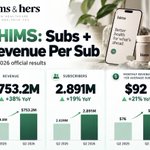
Q2 already showed:
~$753M revenue.
Nearly 2.9M subscribers.
And monthly revenue per average subscriber increased to $92 from $76 YoY.
That's exactly the direction I want to continue seeing.
Now the next BIG checkpoint is Q3 earnings on November 9.
I'm especially watching:
- International growth.
- Revenue per subscriber.
- Weight-loss trends.
- Margins.
- Subscriber growth.
And whether management gives us any additional color around peptides and the newer specialties.
Long $HIMS.
$SOFI defended 14$.
Q3 earnings on October 27’s very important.
Sentiment around $SOFI is terrible right now…
Q3 gives management an opportunity to change that narrative.
$SOFI just received a pretty interesting new BUY rating.
StoneX initiated coverage on $SOFI with a BUY and a $25 price target.
With $SOFI trading around $15, that implies roughly 60%+ upside from current levels…
but just like with most analyst calls, the price target itself isn’t what interests me most.
It’s WHY StoneX is getting bullish…
The analyst essentially believes there is a major disconnect between $SOFI stock performance and the underlying business.
$SOFI is down roughly 40% YTD.
Meanwhile, Q2 looked like this:
- ~$1.2B adjusted revenue
- +40% YoY revenue growth
- 15.8M members
- +35% YoY member growth
- 1.1M new members added in ONE quarter
- 2.2M new products added
- Record ~$14.8B loan originations
The stock has been moving LOWER while the underlying business continues moving HIGHER.
And that’s really the core of the StoneX thesis…
The market is concerned that $SOFI earnings haven’t scaled as quickly as revenue because management continues spending aggressively on marketing and growth.
But if those investments continue bringing millions of new members onto the platform, the real opportunity comes AFTER acquisition.
Because $SOFI isn’t trying to make money from a customer once.
It wants that member using:
Checking and savings… Then:
- lending
- investing
- credit cards
- insurance
- additional financial products
That’s the flywheel.
Acquire the member ONCE.
Then increase products PER member and revenue PER member over time.
And if that happens while operating expenses begin growing slower than revenue?
That’s where operating leverage can become VERY powerful.
StoneX also highlighted something I think the market is still underestimating:
SoFiUSD.
$SOFI is increasingly positioning itself beyond simply being a consumer-facing digital bank.
Payments.
Stablecoin settlement.
Financial infrastructure.
Enterprise services.
If those businesses continue scaling, $SOFI becomes increasingly diversified away from simply relying on lending.
Now let’s talk about the CHART.
Because this is where $SOFI gets especially interesting to me.
For roughly 6+ months, the stock has basically been trapped inside a broad range.
The two levels I’m watching:
~$15 SUPPORT
and
~$19.50–20 RESISTANCE
Look back at the chart.
$15 has repeatedly attracted buyers.
Meanwhile, the ~$19.50 area has rejected the stock multiple times.
So right now, $SOFI is basically sitting near the BOTTOM of that multi-month range.
That makes the risk/reward much more interesting to me.
$19.50 is the BIG level.
A convincing breakout above that area would finally suggest $SOFI is escaping this long consolidation and potentially beginning a new leg higher.
On the flip side?
If $15 breaks decisively and can’t be reclaimed, then the technical setup clearly changes.
Q3 earnings on October 27 could become an important catalyst.
I’ll be watching member growth, products, fee-based revenue, margins and most importantly whether all this growth is finally translating into stronger earnings leverage.
For me, the long-term thesis remains pretty straightforward:
More members.
More products per member.
More revenue per member.
More fee-based revenue.
And eventually, more of that revenue dropping to the bottom line.
The business has continued growing while the stock has spent 6+ months going essentially nowhere.
At some point, one of those two trends has to resolve.
I’m betting the fundamentals eventually win.
Long $SOFI.
$NBIS has been absolutely killed alongside the broader neocloud selloff.
The biggest concerns are obvious... higher financing costs, execution risk and the possibility that higher rates pressure high-growth infrastructure names even further.
But for $NBIS in particular, I think the selloff is starting to look excessive.
$NBIS has one of the strongest balance sheets in the sector, and the customer prepayments significantly reduce the financing burden associated with its massive buildout.
That doesn’t eliminate execution risk.
But financially, I think $NBIS is being grouped in with weaker neocloud balance sheets that look very different.
$RKLB delaying Neutron into 2027 sucks... there's really no way around that.
Neutron is one of the biggest pieces of $RKLB future, and obviously I would have preferred to see the inaugural launch happen this year.
But I think the selloff is also highlighting something investors sometimes forget:
$RKLB is not JUST neutron... neutron is OPTIONALITY.
Very valuable optionality.
Look at Q2:
$RKLB generated a record $234M in quarterly revenue, up 62% YoY.
And here's the part people need to understand:
$189.5M came from SPACE SYSTEMS.
Only roughly $44.6M came from Launch Services.
In other words, approximately 81% of Q2 revenue came from Space Systems.
That completely changes how I look at this company.
It's becoming an increasingly vertically integrated SPACE COMPANY.
There are MULTIPLE ways this business can make money.
1. ELECTRON
Electron is already an established commercial launch vehicle.
$RKLB doesn't need to wait for Neutron to generate launch revenue.
They launch satellites for:
- Commercial customers
- Governments
- Earth imaging companies
- Constellation operators
- National security customers
$RKLB had more than 90 launches in backlog following Q2.
Electron is already a real business.
2. HASTE
This one gets overlooked.
HASTE is essentially $RKLB suborbital testing platform for defense and hypersonic technology.
That creates another government revenue opportunity completely separate from normal commercial satellite launches.
- Missile defence testing.
- Hypersonic research.
- National-security missions.
This is becoming increasingly valuable as U.S. defence spending moves further into space.
3. SATELLITE MANUFACTURING
This might actually be the part of $RKLB investors underestimate the most.
$RKLB doesn't just launch satellites.
THEY BUILD THEM.
And increasingly?
They're becoming the PRIME CONTRACTOR.
Look at the government contracts already coming in.
$RKLB has a roughly $816M contract to build 18 missile-warning and missile-tracking satellites for the Space Development Agency.
They also have another major SDA program involving 18 Transport Layer satellites.
They've won contracts to build geostationary satellites for the U.S. Space Force.
4. SATELLITE COMPONENTS
Here's another important layer.
$RKLB sells components that OTHER satellite companies need.
- Solar panels.
- Reaction wheels.
- Star trackers.
- Radios.
- Avionics.
- Flight software.
- Separation systems.
- Optical systems.
- Laser communications.
- Robotics and precision mechanisms.
So $RKLB can potentially make money even when somebody else's satellite is launched on somebody else's rocket.
The company doesn't need to win every launch to participate in the growth of the space economy.
5. LASER COMMUNICATIONS
Through Mynaric, $RKLB has expanded further into optical communications.
As satellite constellations get larger, those satellites increasingly need to communicate with each other at enormous speeds.
Laser communication terminals become increasingly important infrastructure.
Again... completely separate revenue opportunity from Neutron.
6. SPACE ROBOTICS
$RKLB also acquired Motiv Space Systems.
That adds robotics, motion-control systems and precision spacecraft mechanisms.
We're talking technology with heritage on Mars missions.
And it also lets $RKLB bring more expensive satellite components IN-HOUSE.
That's important for both revenue and vertical integration.
7. NATIONAL SECURITY
This is becoming a HUGE piece of the thesis for me.
$RKLB is positioning itself across multiple areas where the U.S. government wants MORE suppliers and LESS dependence on a handful of legacy aerospace contractors.
That's potentially an enormous long-term market.
And then we finally get to...
8. NEUTRON
Neutron is still incredibly important.
If it works?
$RKLB moves into a completely different launch category.
But I don't view it as:
“Neutron succeeds or $RKLB has no business.”
I view it as:
$RKLB already has a growing business and Neutron dramatically increases what that business could become.
That's OPTIONALITY.
There are a LOT of different ways $RKLB can win.
Now...
Does delaying Neutron hurt? 100%.
It delays one of the biggest future catalysts and raises another execution question.
I'm not going to sugarcoat that.
But I'm also not going to value the entire company as if Neutron is the only thing $RKLB does.
And jokingly...
if there was ever a decent time to announce a delay, this market isn't exactly the worst one 😂
High-beta growth stocks are already getting destroyed.
Space stocks are already under pressure.
I'd rather $RKLB take additional time, fix the manufacturing issue properly and launch when the vehicle is actually ready than rush one of the most important products in the company's history simply to meet an arbitrary calendar deadline.
Rocket failures are MUCH more expensive than rocket delays.
I want to document a mistake I made with $RKLB.
I’ve always said that I want this page to be a place where I share my analysis, my positions, my wins and my mistakes.
Well, here’s one of those mistakes.
My $RKLB swing entry around $63 played out almost exactly how I had anticipated.
The stock rallied to $75+, giving me approximately a 20% unrealized gain on what was a pretty large swing position for me… but I didn’t take profits.
Let me break it down.
1. The original setup was interesting:
When I originally started accumulating $RKLB around the $60–64 area, I was looking at a few important technical levels.
My thesis was relatively straightforward:
$60–64 was my accumulation zone, where I believed the risk/reward was becoming attractive.
The 50-day moving average, around the $70–72 area, was an important level I wanted to see reclaimed.
$72–75 was my first major resistance/target zone.
$76–80 was the next upside objective if momentum continued.
And around $81–82 sat the 200-day simple moving average, another potentially significant technical level.
The idea was to capture a strong swing move from a consolidation area toward these higher resistance levels.
And that’s exactly what happened.
$RKLB recovered, reclaimed important technical levels and eventually pushed above $75.
On October 6, it even briefly traded above $78 intraday.
From my ~$63 average, that was a very meaningful unrealized return.
Especially considering the amount of capital I had allocated.
2. So where did I make the mistake?
I became too focused on the $80 target.
Instead of recognizing that the stock had already delivered an excellent return in a relatively short period, I kept looking for that extra move.
I wanted to see $RKLB push toward the 200-day moving average.
And to be fair, that wasn’t an unreasonable technical objective.
But here’s the problem.
I allowed my upside target to become more important than managing the profits I had already accumulated.
My own original analysis had identified $72–75 as an important resistance area.
The stock reached that area.
I had a roughly 20% unrealized gain.
And I had a substantial amount of capital exposed.
Yet I didn’t even trim part of the position.
Looking back, that’s where I believe I made the mistake.
3. Position size changes everything:
Something I’ve mentioned before is that my swing trades are generally built around a 1–3 month timeframe.
I also tend to allocate heavier capital when I have conviction in a particular setup.
That makes risk management even MORE important.
A 20% return on a relatively small speculative position is one thing.
A 20% unrealized return on a large swing position is another.
The dollar amount at risk becomes significant.
And when you’re trading with meaningful capital, protecting gains has to be part of the strategy.
I didn’t need to completely exit $RKLB at $75.
I could have taken partial profits, reduced my exposure and allowed the remaining shares to run toward $80.
Instead, I maintained my entire position.
4. What would I do differently?
Three things.
First, I need to become more disciplined about taking partial profits when a swing reaches an important resistance zone.
Second, I need to adjust my profit-taking strategy based on position size.
And third, I need to remember that the goal of a swing trade isn’t to capture every dollar of upside.
It’s to identify an attractive risk/reward setup and manage the trade properly.
There’s absolutely nothing wrong with leaving some potential upside on the table.
But allowing a substantial unrealized gain to disappear without taking ANY profits?
That’s something I need to improve.
6. Where do I stand on $RKLB now?
I still like $RKLB and I like it even more long-term…
My conviction in the company’s longer-term opportunity hasn’t suddenly disappeared.
But I also need to separate two VERY different things.
Liking a company and managing a swing trade are NOT the same thing.
$CRWV had one of the more interesting reversals I've seen in this recent selloff...
This morning, the stock traded all the way down to roughly $59.50.
By the close, $CRWV finished around $67.75.
That's nearly a 14% recovery from the intraday lows.
And what happened in the middle of that reversal caught my attention.
$NVDA CEO Jensen Huang came out publicly defending $CRWV.
He said $CRWV financial strength is improving and argued that its cost of capital is moving in the right direction.
He also said he does NOT believe $NVDA needs to provide $CRWV with some sort of financial backstop.
That last part is important...
And I actually agree with a large part of what he's saying.
But let me explain WHY.
First, remember that $NVDA isn't watching $CRWV from the sidelines.
Earlier this year, $NVDA invested another $2 BILLION directly into $CRWV at $87.20 per share.
That purchase added roughly 22.9M shares.
Following the transaction, $NVDA reported owning approximately 47.2M shares of $CRWV.
So when Jensen talks about $CRWV future, $NVDA has a VERY meaningful economic interest in the outcome.
And interestingly? ... That $87.20 purchase price
I want to document a mistake I made with $RKLB.
I’ve always said that I want this page to be a place where I share my analysis, my positions, my wins and my mistakes.
Well, here’s one of those mistakes.
My $RKLB swing entry around $63 played out almost exactly how I had anticipated.
The stock rallied to $75+, giving me approximately a 20% unrealized gain on what was a pretty large swing position for me… but I didn’t take profits.
Let me break it down.
1. The original setup was interesting:
When I originally started accumulating $RKLB around the $60–64 area, I was looking at a few important technical levels.
My thesis was relatively straightforward:
$60–64 was my accumulation zone, where I believed the risk/reward was becoming attractive.
The 50-day moving average, around the $70–72 area, was an important level I wanted to see reclaimed.
$72–75 was my first major resistance/target zone.
$76–80 was the next upside objective if momentum continued.
And around $81–82 sat the 200-day simple moving average, another potentially significant technical level.
The idea was to capture a strong swing move from a consolidation area toward these higher resistance levels.
And that’s exactly what happened.
$RKLB recovered, reclaimed important technical levels and eventually pushed above $75.
On October 6, it even briefly traded above $78 intraday.
From my ~$63 average, that was a very meaningful unrealized return.
Especially considering the amount of capital I had allocated.
2. So where did I make the mistake?
I became too focused on the $80 target.
Instead of recognizing that the stock had already delivered an excellent return in a relatively short period, I kept looking for that extra move.
I wanted to see $RKLB push toward the 200-day moving average.
And to be fair, that wasn’t an unreasonable technical objective.
But here’s the problem.
I allowed my upside target to become more important than managing the profits I had already accumulated.
My own original analysis had identified $72–75 as an important resistance area.
The stock reached that area.
I had a roughly 20% unrealized gain.
And I had a substantial amount of capital exposed.
Yet I didn’t even trim part of the position.
Looking back, that’s where I believe I made the mistake.
3. Position size changes everything:
Something I’ve mentioned before is that my swing trades are generally built around a 1–3 month timeframe.
I also tend to allocate heavier capital when I have conviction in a particular setup.
That makes risk management even MORE important.
A 20% return on a relatively small speculative position is one thing.
A 20% unrealized return on a large swing position is another.
The dollar amount at risk becomes significant.
And when you’re trading with meaningful capital, protecting gains has to be part of the strategy.
I didn’t need to completely exit $RKLB at $75.
I could have taken partial profits, reduced my exposure and allowed the remaining shares to run toward $80.
Instead, I maintained my entire position.
4. What would I do differently?
Three things.
First, I need to become more disciplined about taking partial profits when a swing reaches an important resistance zone.
Second, I need to adjust my profit-taking strategy based on position size.
And third, I need to remember that the goal of a swing trade isn’t to capture every dollar of upside.
It’s to identify an attractive risk/reward setup and manage the trade properly.
There’s absolutely nothing wrong with leaving some potential upside on the table.
But allowing a substantial unrealized gain to disappear without taking ANY profits?
That’s something I need to improve.
6. Where do I stand on $RKLB now?
I still like $RKLB and I like it even more long-term…
My conviction in the company’s longer-term opportunity hasn’t suddenly disappeared.
But I also need to separate two VERY different things.
Liking a company and managing a swing trade are NOT the same thing.
Now after digging deeper into both selloffs, I have a few thoughts on $NBIS vs. $CRWV …
It’s fascinating studying these two companies side by side. They’re both operating in the neocloud sector.
Both are benefiting from enormous AI infrastructure demand.
Both are expanding aggressively.
But financially…? They are two very different businesses.
And in an environment like this, those differences matter more than ever.
1. $CRWV has the larger revenue base and contracted backlog:
Look at Q2.
$CRWV:
Revenue: $2.58B
Revenue growth: +112% YoY
Adjusted EBITDA: $1.51B
Revenue backlog: $104.2B
$NBIS:
Revenue: $582M
Revenue growth: +454% YoY
Adjusted EBITDA: $236M
More than $40B in customer commitments
$CRWV is operating at a substantially larger revenue scale… and its contracted backlog is enormous.
But $NBIS is growing from a smaller base at an extraordinary rate.
Both have very compelling demand stories… but that’s not where my biggest concern lies.
2. The financial structures are very different:
This is where I currently prefer $NBIS.
At the end of Q2, $NBIS had:
~$8B in cash and equivalents
~$8.6B in debt, excluding leases
more than 9B in expected 2026 customer prepayments
and management secured a $775M asset-backed financing facility at: SOFR + 2.50%.
Now compare that with $CRWV:
~$5.5B in cash
~$35.6B in debt principal outstanding.
~$52B in debt and lease obligations combined
And approximately:
$640M in Q2 net interest expense
That’s a MASSIVE difference in financing exposure.
Now, to be fair, $CRWV also has access to secured, investment-grade financing structures.
But some of its unsecured bonds have recently traded at yields approaching 15%.
And that is something I simply cannot ignore.
3. Today’s CPI report makes these differences even more important:
Inflation came in hotter than expected.
3.7% YoY headline CPI.
And the market is now assigning a MUCH greater probability to another Federal Reserve rate hike.
But here’s the problem.
HIGHER RATES = POTENTIALLY HIGHER FINANCING COSTS.
HIGHER FINANCING COSTS = PRESSURE ON FUTURE PROFITS.
HIGHER DISCOUNT RATES = LOWER VALUATIONS FOR FUTURE CASH FLOWS.
And when you’re talking about companies spending TENS OF BILLIONS on infrastructure?
Those effects can become enormous.
That’s why I currently prefer $NBIS financing structure.
4. But here’s where $CRWV gets really interesting:
At approximately $65 PER SHARE, $CRWV has a market capitalization around:
$36 BILLION.
Management is guiding toward:
$12.4–13.2B in 2026 revenue.
And analysts are estimating approximately:
$26.3B in 2027 revenue.
Using those figures, $CRWV trades at roughly:
2.8X 2026 revenue.
1.4X estimated 2027 revenue.
For a company growing at this pace?
That’s VERY interesting.
But there’s an important catch.
Those are EQUITY price-to-sales multiples.
When you account for debt and other enterprise-value adjustments, the multiples are closer to:
6.4X 2026 revenue.
3.1X estimated 2027 revenue.
Still potentially interesting.
But not nearly as cheap as the equity multiples alone make it appear.
And THIS is exactly why balance sheets matter.
5. Now imagine $CRWV without the financing concerns:
If $CRWV could deliver its projected revenue growth with substantially lower leverage, cheaper capital and strong free cash flow conversion?
I think the market could justify a valuation considerably ABOVE $65.
Potentially MUCH higher.
But that’s the entire issue…
You can’t simply remove the financing risk from the valuation.
The debt is real.
The capital expenditures are real.
The interest expense is real.
And the execution risk is real.
$CRWV is targeting:
$35–39 BILLION IN 2026 CAPEX.
$NBIS is targeting:
$20–25 BILLION.
Neither company has an easy road ahead.
But their approaches to financing that expansion are different.
Which one do you prefer?
And now the $NBIS selloff… is this an overreaction?
Let’s break it down.
1. The entire neoclouds sector is under pressure:
$CRWV has been getting crushed as bond yields surged toward 15%.
Now, with CPI coming in hotter than expected, markets are increasingly pricing in the possibility of additional Fed reserve hikes.
That’s BAD sentiment for capital-intensive growth companies.
Higher rates mean potentially higher financing costs and higher discount rates can compress the valuations of companies whose profits are expected to grow substantially in future years.
BUT HERE’S MY QUESTION.
Should $NBIS be getting punished to the same extent as $CRWV?
Because their financial positions are NOT identical.
2. $NBIS has substantial financial resources:
At the end of Q2, $NBIS reported:
- $8 billion in cash and equivalents
- $8.55 billion in debt, excluding leases
- $2.25 billion in quarterly operating cashflow
And management expects: more than $9 billion in customer prepayments in 2026.
$NBIS isn’t trying to finance its entire expansion with unsecured corporate borrowing.
And it isn’t starting from a position of zero liquidity.
Now, the operating cash flow figure requires context.
Customer prepayments contributed significantly, so that is NOT equivalent to $2.25B in recurring free cash flow.
But those advance payments still help finance infrastructure deployment.
3. The financing model is more interesting than people realize:
Management disclosed: More and than $40 billion in customer commitments…
and approximately 70% of its Q2 deals included prepayments.
For those deals, upfront payments covered around 50–60% of associated capital expenditures.
$NBIS also secured a:
$775 million asset-backed financing facility at SOFR + 2.50%.
This demonstrates that the company can use contracted customer cash flows and GPU infrastructure to help secure financing.
Not every dollar of growth needs to come from issuing additional shares.
4. The capital requirements are still enormous:
Management is targeting:
$20–25 BILLION IN 2026 CAPEX.
And despite strong operating cash inflows, free cash flow remains substantially negative due to infrastructure spending.
$NBIS also raised approximately $2.8B through its ATM equity program during Q2.
So dilution is a REAL consideration.
A strong cash position doesn’t eliminate the need for future financing.
5. But the the underlying growth is extraordinary:
Look at Q2.
- $582M revenue +454% YoY.
- $575M AI cloud revenue +514% YoY.
- $236M group adjusted EBITDA.
- ~50% AI cloud adjusted EBITDA margin.
And management reported a:
$3 billion annualized revenue run rate.
That’s before much of the capacity expected to come online later in 2026 and 2027 contributes fully to revenue.
Management is targeting a $7–9B annualized revenue run rate by year-end 2026.
But that remains a target, not realized revenue.
6. So is this an overreaction:
I think there’s a legitimate argument that $NBIS is being punished by association with the broader neocloud sector.
But I wouldn’t call it risk-free or automatically cheap.
The market is still valuing $NBIS at a substantial multiple of its current revenue.
And the company needs to prove that its aggressive expansion generates attractive returns AFTER capital expenditures, depreciation and financing costs.
That’s the real test.
I still believe the long-term AI infrastructure opportunity is enormous.
And I think $NBIS customer commitments, liquidity and financing flexibility deserve more recognition.
What do you guys think?