

managing editor by trade, here i curate free and open research daily-ish...just whatever i think is interesting.
USA
Joined October 2024
- Tweets244
- Following196
- Followers25
- Likes75






Groundhog Day & the S&P 500
Punxsutawney Phil's prediction on Feb 2 has been tracked since the late 1800s, but reliable S&P 500 daily data aligns best from ~1950 onward (with some studies extending to 1928).
Key finding from research (Shanaev, Shuraeva & Fedorova, 2021, Finance Research Letters):
When Phil predicts early spring (no shadow, ~18 cases in 1928–2021): Buy-and-hold abnormal returns around the event are significantly positive.
When Phil predicts long winter (sees shadow, majority of cases): Returns are lower by ~2.78% relative to early spring forecasts.
The divergence appears in abnormal returns (adjusted for expected performance), starting ~10 trading days before Groundhog Day and persisting for weeks after, with early spring linked to stronger upward drift.
A separate analysis (Capitalogix, post-1944 data):
No shadow years (13 cases): Median S&P 500 return from Feb 2 to first day of spring ≈ +3.01%, positive in >75% of cases.
Shadow years (59 cases): Median return ≈ +0.54%, closer to or below seasonal norms.
This "Groundhog Day anomaly" is likely attributed to behavioral factors eg rarer early-spring predictions may trigger temporary investor optimism, rather than any predictive power from the hog. Results hold after controlling for other calendar effects (January, turn-of-month, etc) in robust subsamples.
sciencedirect.com/science/ar…
In celebration of the anniversary of her statehood, we look at Wyoming, scientific microcosm of North America.
The research in this issue spans millennia, we’ve got tailored clothing evidenced by early Paleoindian bone needles and the discovery of a new sauropod dinosaur (Ardetosaurus viator). We also examine critical modern issues, including the health of Wyoming’s ecosystems, the restless geology of Yellowstone, and the social cost of losing community services for isolated elders.
Featuring work by Spencer R Pelton et al, Tom TP van der Linden et al, Lusha M Tronstad et al, Wynne E Moss et al, Eric S Boyd et al, Manuel A Florez et al, William J Ripple et al, N Thompson Hobbs et al, Kathryn E Watts, and Leslie Richardson & Aaron J Enriquez.
ellswortheditorial.substack.…
cc @ESA_org @ScienceAdvances @science @ESAMonographs @GeoScienceWorld @FrontiersIn @tandfonline #openaccess

If aliens are real, where is everybody? There are thousands (maybe 100,000) alien civilizations in the Milky Way. They get as advanced as we’ll be in a few centuries, then level off. No one builds Dyson spheres, no one floods the galaxy with probes, no one runs billion-year beacons. It’s too hard and too expensive, or too boring once you’ve met the neighbors and realized they’re entirely uninteresting. So the galaxy stays quiet. We’re not alone, we’re not special, and nobody’s coming because nobody cares. Just a lot of ordinary planets doing ordinary things a few hundred light-years apart.
Thoughts on this take?
arxiv.org/abs/2509.22878

Light pollution is eating the night sky...fixing the problem could save trillions.
Featuring research by Robin Voigt et al, Sharolyn Anderson et al, Derrick Thomas et al, Alejandro Borlaff et al, Imed Jribi, and Emma Moyse et al.
ellswortheditorial.substack.…

Asteroids carry life’s starter kit. Sugars, amino acids, nucleobases, water-altered minerals, ammonia-rich organics. Read more about them here.
Featuring work by Yoshihiro Furukawa et al, Daniel P Glavin et al, Maxime Devogèle et al, Evie Kendal et al, and C Pilorget et al.
ellswortheditorial.substack.…

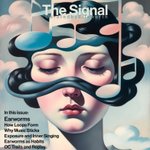
Life is a series of loops. Some get stuck in your head, in musical form. Earworms are mental loops triggered by repetition, low focus, and familiarity. Even the tone deaf join the cycle.
Featuring work by Emery Schubert, Claire Arthur, Callula Killingly et al, Chris M Dodds, and Barbara Tillmann et al.
ellswortheditorial.substack.…
#OpenAccess

Carnivory leans on shape. One species turns rain into a springboard that snaps prey off the rim. Others build glands that work like tiny stomachs. Some widen the peristome so insects slide cleanly into the pool. Some trade photosynthesis for deeper tubes and slower returns. And across the lineages, the rules behind how traps regulate themselves keep branching in new directions. Wild stuff!
Featuring work by Anne-Kristin Lenz et al, Matthias Freund et al, Derek E Moulton et al, Kadeem J Gilbert et al, and Andrej Pavlovič.
ellswortheditorial.substack.…
cc @HadrienOliveri @thorogoodchris1 @OUPAcademic @OxUniPress

Salt. It builds in farm soils where crops quit cooperating. It rides marsh crabs and snails like a courier. It slips off winter roads into rivers and aquifers. It tilts amphibian ponds toward stay or go. It shoots through volcanoes in salt-rich jets. It keeps old cooperatives on the Black Sea working. It once powered Maya brine workshops that held a whole economy together.
Featuring work by Md Khurshid Alam Bhuiyan et al, Carley E Winter et al, Sujay S Kaushal et al, Noah D Charney et al, M Colombier et al, Anna S Antonova, and Heather McKillop & E Cory Sills.
ellswortheditorial.substack.…

Black Friday, y'all!!!
Here we accidentally run somebody over with our car en route to a great deal on a televi- er, dig into how shopping actually works. Social identity shapes choices, everything is a lie. Happiness is tied to why you buy, not what you buy. And, malls.
Featuring work by Murat Bayraktar, Yihe Huang, Tao Chen et al, Weiyao Meng et al, and Olaya Moldes.
ellswortheditorial.substack.…

Ellsworth's Scientific Concern retweeted

I made an infographic about the patterns in how we talk about patterns

Happy Hendrix birthday and Thanksgiving.
Five quick hits of guitar science:
String bends and whammy moves are pure tension physics.
Tremolo pitch jumps unevenly because of core mass, not string gauge.
When two players improvise their brains sync up on EEG and lock to both guitars.
Play ahead of the beat and your body leans forward. Lay back and you lean back.
Turn up distortion and the amp invents new notes you never played.
Jimi sounded like a UFO.
Go rip a solo and eat some turkey.
open.substack.com/pub/ellswo…

Here we look at the big and bangy problems threatening our understanding of the universe. We thought we knew the "rulebook" of the cosmos, but new observations are breaking it. First, scientists can't agree on how fast the universe is actually expanding, different measurements give conflicting answers. Second, the James Webb Space Telescope (JWST) keeps finding huge, fully-formed galaxies that are so old they shouldn't exist yet. Our standard model of the universe is starting to look incomplete and needs updates.
This issue of The Signal explores this critical juncture in cosmology, featuring work by Eleonora Di Valentino et al, Adam G Riess et al, Michael Boylan-Kolchin, Ivo Labbé et al, and Licia Verde et al.
Read the full analysis in Issue 50: ellswortheditorial.substack.…
#Space #Science #JWST #BigQuestionscc @licia_verde @NatureAstronomy
