

Cut the Noise. Follow the Money. Unfiltered insights on macro, markets, and building real wealth.
Joined November 2022
- Tweets1.1K
- Following21
- Followers828
- Likes1.9K


Pinned Tweet
Watch $MSTR Michael Saylor Now 👇

"One of the best explanations of BITCOIN." (Thank you!)
Did you watch @TheROShowPod all inclusive interview with the great @saylor?
Link in reply ⤵️

✨The RO Show Podcast✨ retweeted

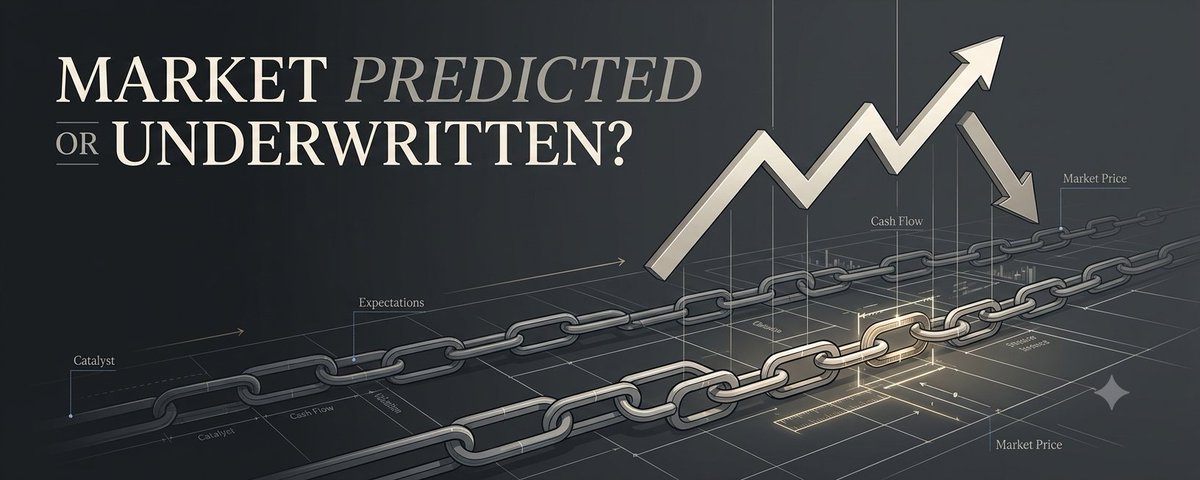
At 2:00est today, the Fed gives markets the conclusion. From there, investors begin underwriting the mechanism.
Headlines can move prices. The assumptions beneath them determine whether the repricing deserves to hold.
xitter.cf/FrankDPrestia/status/2…

✨The RO Show Podcast✨ retweeted

⚡ The AI power value chain, fuel to rack. Five stages, and every one is a bottleneck somebody owns.
1️⃣ Fuel: $CCJ $BWXT → uranium demand is a decade contract, not a trade
2️⃣ Firm generation: $CEG $VST $TLN → the only megawatts data centers will sign for are the ones that never blink
3️⃣ Next-gen reactors: $SMR $OKLO $NNE → the 2030s supply answer, priced today on execution faith
4️⃣ Power gear & cooling: $GEV $VRT → the picks-and-shovels inside the picks-and-shovels, backlogs measured in years
5️⃣ Storage & firming: $EOSE $FLNC $TE $BE → the layer that turns intermittent grid into 24/7 compute
The frame that matters: a token is refined electricity. 🔋 Every query monetizes an electron that traveled this entire chain, and every stage takes its toll on the way through.
Ledger: stages 3 and 5 are execution stories with real binary risk. Sized accordingly or not at all.
Follow the electron. It knows where the margins are.
DYOR. Not FA.

✨The RO Show Podcast✨ retweeted
🚨 The average midterm year bottoms at the end of June.
Which means the payoff everyone quotes sits on the other side of a summer nobody wants to sit through.


✨The RO Show Podcast✨ retweeted
🌍 The next decade of AI, mapped by what must physically exist at each stage. McKinsey, Goldman, PwC and Gartner all publish the forecasts. Almost nobody maps them to the layers that have to get built first. That's the part you can invest in.
⚡2026 · Enterprise scale. ~$725B of infrastructure spend this year, 88% of companies deploying. But tokens are refined electricity: this stage runs on megawatts, transformers, and energized sites. The spend flows through $NVDA $AVGO $TSM at the top, and lands on power and land underneath: $IREN $DGXX $TE $EOSE.
⚡2027 · Frontier reasoning. The labs forecast systems that reason across domains. Whatever you believe about the date, the physical requirement is fixed: bigger clusters, connected by light. Interconnect scales with cluster size, not unit count: $AAOI $SIVEF $CRDO $MU $SNDK. The constraint relocates from power to bandwidth.
⚡2028 · Physical AI. Humanoids at manufacturing scale, ~30K units a year projected. Intelligence leaves the chat window and needs eyes, ears, and autonomy stacks: $ONDS $MRLN $AMBA $OUST, with $TSLA and Figure assembling the bodies.
⚡2030 · GDP transformation. Projected $15.7T added to global output. The value migrates up: from infrastructure to the merchants selling finished AI by the token ($DOCN $NET $AKAM) and the operators using it to run leaner: $OPEN is the live experiment, 11 humans per transaction down to 1.
⚡2035 · Full autonomy. Agentic software at ~30% of enterprise revenue, and the layer above all of it, orbital coverage and sensing, matures: $ASTS ⚡.
The ledger, because forecasts deserve one: these are extrapolations, and extrapolated demand curves have a humbling record. AGI dates slip. CAGRs are sell-side. Anyone who tells you they know the load in 2035 is selling something. What doesn't slip: every stage requires the one before it, and the layers get paid by every contestant regardless of which logo wins.
"Every AI selloff has been a buying opportunity" is true so far, past tense. The realistic version: every selloff has been a buying opportunity in the companies that survived it. Own the layers. Size for the drawdowns. The decade does the rest. 💪
DYOR. Not FA.

✨The RO Show Podcast✨ retweeted
📋 Signed revenue, not guidance. The backlog board:
1️⃣ $NBIS → ~$50B contracted
2️⃣ $IREN → $9.7B
3️⃣ $RKLB → $2.22B backlog
4️⃣ $ARM → $2.07B RPO
5️⃣ $WYFI → $924M RPO
6️⃣ $PL → $816M RPO
7️⃣ $EOSE → $645M backlog
8️⃣ $ONDS → $457M pro-forma
Here's why this board matters more than any price chart right now: the past six weeks repriced every one of these names 25-60% lower. The contracts repriced zero percent. Backlog is the book that front-runs the print: revenue already sold, waiting to be recognized, indifferent to the tape.
The discipline: RPO and backlog are not cash. Contracts can slip, get renegotiated, or walk. The number to watch is conversion, quarter after quarter. 📊
But when price falls 50% and the signed book grows, one of them is wrong. Earnings season is the arbitration, and it starts now.
DYOR. Not FA.

✨The RO Show Podcast✨ retweeted
The market is a Jenga tower. 🧩
Every pull works → leverage added, volatility sold, one more chase → and the tower keeps standing. That's the trap: standing gets mistaken for stable. Every successful pull teaches the table that towers don't fall, while the structure quietly leaves the building.
Then one block ends it → and everyone blames the block. Wrong defendant. The collapse was manufactured by every prior pull. The last block just collected the bill.
A physicist proved this in 1987. Per Bak built a sandpile, dropping grains one at a time until it reached what physics calls a critical state → where the next grain might do nothing, or trigger an avalanche that reshapes the whole pile. Bak proved WHICH grain is unknowable. Not hard to predict → unknowable. The avalanche isn't caused by the grain. It's caused by the state of the pile.
The trigger is trivia. The structure is destiny.
And this isn't metaphor → econophysicists have shown market returns follow the same power laws as avalanches, earthquakes, and forest fires. No bell curves protecting you → fat tails, where the rare event is the main event arriving on schedule with no date attached. And at the critical point, everything correlates → your fifteen "diversified" positions become one position, precisely when it matters. Crashes need no cause. A steep enough pile IS the cause.
Every great trader arrived at this same law through losses instead of equations:
⭐️ Taleb → stop predicting the grain, own convexity to the avalanche. Be what gains from disorder.
⭐️ Tudor Jones → defense first, always. Offense is a bet on which block. Defense is a position on the tower.
⭐️ Druckenmiller → size so being wrong is survivable. He lost $3B in six weeks the one time he forgot → and he already knew better.
⭐️ Annie Duke → judge decisions, never outcomes. In a power-law world, outcomes carry luck you can't audit.
⭐️ Lynch → know what you own. When the avalanche comes, knowledge alone tells you whether to buy the rubble or flee it.
⭐️ Tepper → the avalanche IS the opportunity, for whoever kept capital to meet it. He built his fortune buying what the 2009 panic buried → bank debt nobody would touch at any price. You can only shop the rubble if you weren't standing under it → "there is a time to make money and a time to not lose money," and knowing which is which is the whole career.
Six careers. One conclusion. The tower, not the block.
And two thousand years earlier, a Greek slave carved it first. Epictetus: some things are within our power, and some are not → and every ounce of misery comes from confusing the two. The market's direction, the Fed, the avalanche's timing → not in your power. Your size, your leverage, your cash, your exits written in advance → entirely in your power. The Stoics even rehearsed disaster while calm → premeditatio malorum → so it arrived already handled. A tripwire list, written in Latin.
The law, in three languages:
Physics → you cannot predict the avalanche. You can only choose your exposure to the pile.
Trading → you cannot know the outcome. You can only control size, survival, and process.
Stoicism → you cannot command events. You can only command yourself.
Same law. Every discipline that studies uncertainty seriously ends up carving it into the wall.
Everyone at the table is watching the next block. The entire edge → the only durable one → is keeping your own base wide while they pull.

✨The RO Show Podcast✨ retweeted
⚡ The AI interconnect supply chain, wafer to test. 20 names, 7 stages, one thesis: the market owns the top, the asymmetry lives at the edges. 🧵
🔸 Wafer → $AXTI $IQE. InP substrate, the true upstream.
🔸 Light → $LITE $SIVEF $POET. The external light source layer.
🔸 Optics & modules → $COHR $AAOI $FN. Where the ramp is measured in ports.
🔹 Interconnect → $CRDO $MRVL $AVGO $ANET. Electrical to optical, end to end. Marvell just paid $3.25B for Celestial AI to own more of this shelf.
🔹 Packaging & foundry → $TSEM $LPKF $GLW. The neutral arms dealers.
🔹 Test & analog → $AEHR $VIAV $SMTC $MTSI $CIEN. Validation hasn't run yet. That's the tell.
Why the edges: the top of this chain is priced for the buildout. The edges are priced like it's optional. Same demand signal reaches every stage with a lag, and the lag is the trade. ⏱️
Ledger: edge names are small, execution-sensitive, and the first cut in any de-gross. Six weeks ago proved it. Size accordingly.
DYOR. Not FA.

✨The RO Show Podcast✨ retweeted
🏛️ High beta is a pendulum, and many forget the second half of the physics.
The same qualities that carried these names up triple digits are what's carrying them down by half. Thin floats, levered holders, narrative fuel, systematic flows that chase what's moving. None of that switched sides. The amplitude was always the deal, and you don't get to keep the upswing and vote out the return trip.
Traders watch Fibonacci’s Golden Ratio: 1.618 on the extension, 0.618 on the retracement. Same number, read from opposite ends of the arc. I don't think the market obeys sacred geometry. I think enough people watch the same levels that the levels become real, and either way the lesson holds: the swing that overshoots in one direction has never once ended at equilibrium on the way back.
Pendulums don't stop in the middle. They pass through it.
The mechanics under the design: FORCED selling overshoots fair value going down for the same reason euphoria overshoots it going up. More sentiment driven. Flows, not fundamentals, set the extremes. Fundamentals set where it eventually hangs.
Position for the arc you're actually in. Size for the fact that it swings. ⚖️

✨The RO Show Podcast✨ retweeted
📉📈 The strangest six weeks I've tracked in a while. The prices went one direction. The filings went the other.
$EOSE → stock red YTD. Record revenue, record $807M backlog, collections above revenue, Pentagon added to the customer list.
$AAOI → cut in half from the high. Broke ground on 400K sq ft of new capacity against $324M of hyperscale orders.
$ASTS → down 59% from the peak. Placed $1B of 7-year converts overnight at a $149 effective conversion price, institutions oversubscribed.
$NBIS → down a third. ~$50B contracted.
Two ledgers, one company, opposite directions. That's not a market being wrong. That's a market pricing flows while the businesses price demand: de-grossing, margin unwinds, systematic selling, none of which reads an 8-K.
The discipline: sometimes price is early and the filings catch down. Watch conversion, not headlines, and the next two earnings weeks are the arbitration.
But price and fundamentals cannot diverge forever. One of them closes the gap, and it's usually the one that wasn't forced.
DYOR. Not FA.

✨The RO Show Podcast✨ retweeted
🌈 Six worlds. One map. The money is where they touch.
🟡 Photonics: $AAOI $CRDO $SIVEF → light replacing copper, because electrons ran out of headroom
🟢 Compute & neoclouds: $NBIS $IREN $WYFI → the buildout's shovels
🟠 Semis & memory: $MU $SNDK $ADEA $PENG → the substrate everything rides on
🔵 Physical AI: $AMBA $AUR $ONDS → intelligence leaving the screen
🔴 Energy & storage: $TE $FLNC $BE → the buildout's fuel line
🟣 Space: $ASTS $RKLB $PL → the layer above all of it
The insight isn't the circles. It's the seams. Compute × energy decides who scales. Photonics × semis decides who connects. Space × defense decides who gets funded regardless of rates. Single-category companies compete on price. Intersection companies compete on physics. ⚡
Ledger: intersections cut both ways, two worlds de-rating hits twice as hard. The past six weeks proved it.
Own the intersections. That's where pricing power lives. 🌎

✨The RO Show Podcast✨ retweeted
🚨 Two >20% drawdowns in 32 months reads scary until you check the historical pattern.
The 90s cycle paid roughly one 20% correction per year for five years and still finished 11x from the blow-off. 1998 and 2024 ran the same script: violent flush, leverage cleared, trend intact. ✅
Drawdowns like these are not interruptions of a secular run. They are its maintenance schedule. ✅
Held lightly, analogs get picked because they fit. The map lives or dies on capex, and the reports have begun. ✅


✨The RO Show Podcast✨ retweeted
🚨The most important market-structure chart of the month, and it explains the whole year. 🧐
Everyone keeps asking how the index stayed calm while semis fell 13% and the high-beta tier fell 50. Here’s the mechanical answer: a record cohort INSIDE the index now trades against semis. The two legs cancel. The S&P has become a pair trade with itself. ✅
Which rewrites what index calm means. A quiet tape used to say risk is low. Now it says correlation is NEGATIVE → the risk didn’t leave, it netted. Same reason index puts failed every high-beta book this year: you can’t insure a dispersion event with an instrument whose legs offset. ✅ (see other post on index puts)
Semis stopped being just a sector. They’re a factor now, like rates or oil, with a long and short cohort inside every benchmark. ✅

✨The RO Show Podcast✨ retweeted
🚨This chart deserves the attention, and the July 16 FINRA release just extended it: June FINRA margin debt printed $1.502T. First print in history above $1.5T. Up $281B in a single Q, +49% Y/Y, and net credit balances crossed negative $1T for the first time. 🧐
One addition to the chart. Margin debt is collateralized by portfolios, not by national income, and scaled to total equity MC it sits near 2.3%: inside the same 1.8-2.3% band it has occupied at every cycle peak since 2000. The GDP ratio doubled largely because equities re-rated against GDP, not because leverage re-rated against its collateral.
Both readings are true, and they answer different questions. One measures how large the fuel load has grown relative to the economy that has to absorb an accident. The other measures how stretched the borrowers are against their own collateral. Record fuel, ordinary stretch.
What the level cannot do, on either ruler, is date anything. This is the June 30 snapshot, taken at the very top, one day before the July flush. The print that matters is July's, due mid-August: leverage clearing while price stabilizes is how de-grosses end. That's the tripwire, stated in advance.
The record is the fuel. The change is the fuse. 😎


✨The RO Show Podcast✨ retweeted
🚨For the high-growth AI trade: if your stocks fell 30-50% while the index barely moved, this one is for you.
This year ran a live experiment on hedging. The index barely blinked while the high-beta tier fell by half. Everyone who protected that book with $SPY puts learned the lesson: the insurance paid nothing because the thing that crashed was not the thing they insured. Plus $SPX near ATHs.
$QQQ puts → a handful of megacaps in a trenchcoat. Your small to mid-cap optics name is not in the coat.
$SQQQ → wrong underlying, wrong math. Daily-reset leverage decays in chop. Right and still not enough.
Index vol trades at a correlation discount. Your book doesn't. Index puts are cheap because they insure someone else's house. In a de-gross the index naps while dispersion does the killing.
What actually matches the risk, from an options book:
⚡️Protective Puts on what you own → real insurance, married to the position. Long-dated and OTM it becomes a convexity bet: small carry, payoff that explodes exactly when your collateral is weakest.
⚡️Covered Calls → yield on inventory, not armor. The premium cushions points, not halves. Anyone selling calls as crash protection has never sat through the crash.
⚡️The Collar → the adult structure. Sell the call to finance the put, own the band, sleep. The cost is your right tail, which is why timing is the whole trade: you write the calls when the tape is greedy and vol is rich, you own the puts before the storm, and you never cap your upside at the bottom of a drawdown.
Ledger: hedges are a cost center, protection bleeds theta in up years, mechanics not advice.
Insure your own house. Nobody crashes into the neighborhood average.

RT @RosannaInvests: 🚨 Late-day rallies did not go extinct by accident. The mechanism is worth understanding.
The CLOSE is where the FORCED…
✨The RO Show Podcast✨ retweeted
I mapped the entire future economy. Nine layers, from bedrock to orbit → and every layer is investable.
🛰️ SPACE → the orbital economy: $ASTS $RKLB $PL
⚡ ENERGY & STORAGE → powering the buildout: $TE $EOSE $SPKL
🚁 AUTONOMY & DRONES → machines that operate themselves: $ONDS $AUR $MRLN $KRKNF
🤖 PHYSICAL AI → intelligence that acts: $OUST $AMBA $OSS
💡 PHOTONICS → light replaces copper: $CRDO $SIVEF $AAOI $LITE
🏗️ AI INFRASTRUCTURE → the compute buildout: $IREN $NBIS $DGXX $WYFI
🔬 GLASS & OPTICAL MATERIALS → the substrate light runs on: $GLW $LPTH $LPKF
📡 CONNECTIVITY & RF → moving the signal: $AMPG
⛏️ CRITICAL MINERALS → the hard constraints under everything: $MP $UAMY $ASPI
Here's what the map teaches that a watchlist can't: these aren't nine separate trades. They're one machine → the minerals feed the glass, the glass carries the light, the light feeds the compute, the compute powers the intelligence, the intelligence drives the machines, and the machines reach for orbit. Every layer is a chokepoint for the one above it.
Which is the entire investing philosophy in one image: don't chase the logo at the top of the stack → own the layers everything above is FORCED to buy from. Logos compete. Layers collect.
Important note: a map is a thesis, not a timing tool → layers de-rate together when the factor gets sold (see: this month), and not every name survives to see its layer win. Diversification across a stack is still one machine.
The future economy isn't a sector. It's a supply chain → and it's hiring.

✨The RO Show Podcast✨ retweeted
🚨 Earnings season starts Tuesday. Guidance will move every stock in my book → and I'll be listening closely, because forward numbers are where re-rates begin.
But guidance is a promise. Backlog is a receipt → and receipts are how you know which promises to believe.
So here's the screen: companies walking into earnings with the revenue already SIGNED → sitting in RPO and contracted backlog, waiting to become prints:
→ $WYFI $921M contracted → more than 10x its annualized revenue. Anchor live and billing.
→ $IREN $3.1B in contracted ARR → megawatts already spoken for.
→ $ONDS $457M backlog, up from $68M at year-end → against a $4.3B pipeline.
→ $NBIS a $27B hyperscaler deal underneath everything else.
→ $RKLB, $EOSE, $PL, $ARM: billions more signed across launch, storage, imagery, and licensing.
The playbook: when guidance gets raised WITH backlog growing faster than revenue, the raise is underwritten → believe it. When guidance gets raised on air, that's a request, not a receipt. The gap between the two is where the trade lives. ⚡️
Guidance moves the stock. Backlog tells you whether to believe the guidance. Read them together → trade the gap. 🤝

✨The RO Show Podcast✨ retweeted
The AI + autonomy buildout runs through 7 chokepoints.
Here's who owns each one 👇🌌
🛰️ SPACE → launch + connectivity
$ASTS $RKLB $PL $RDW
🤖 DEFENSE + AUTONOMY → sensing, subsea, flight
$KRKNF $ONDS $OUST $MRLN
🔌 OPTICAL → how GPUs talk
$CRDO $AAOI $COHR $SIVEF
⚡ POWER → the grid gates the GPU
$BE $TE $EOSE $POWI
🔋 POWER SEMIS → efficient delivery to the chip
$ON $NVTS
🖥️ COMPUTE → neoclouds + data centers
$IREN $NBIS $WYFI $DGXX
🧠 MEMORY → the constraint that proved it
$MU $KXIAY $SNDK $PENG 🐧
The constraint is the investment. Own what they're forced to buy. 🧐

✨The RO Show Podcast✨ retweeted
📝 Quick note for new followers:
Beyond what I post here, I host @TheROShowPod — currently at 300K+ subscribers on YouTube.
One of my favorite past episodes:
A 3-hour deep dive with Michael Saylor on Bitcoin as more than money — covering thermodynamics, property rights, sound currency, and why he believes Bitcoin is the most secure financial asset ever created.
I’ve been on hiatus for a few months and coming back soon.
Search “The Ro Show Podcast” on YouTube to catch up. The Saylor episode is one of the most-watched.
In BITCOIN We Trust | Michael Saylor Ep.76
youtu.be/cmPsyNLHs0M

✨The RO Show Podcast✨ retweeted
It’s always about DEMAND! Made a video about this 3 years ago @TheROShowPod 🎬
youtu.be/hw21IGaos7w?si=dV6g…
