
Here you’ll find geekitude for blind and low vision space and astronomy enthusiasts. [email protected]
- Tweets144
- Following18
- Followers86
- Likes2


ALT A black, relatively empty field with a variety of stars and galaxies spread across it. Most are very small. A couple of galaxies and stars are larger with visible details. In the center is a relatively small, irregularly-shaped galaxy; it is formed of many very small stars and a few slightly larger, bright stars, all surrounded by a very faint glow that marks the borders of the galaxy.


ALT This illustration of the periodic table shows all of the known chemical elements. Most of the elements have one or more colors associated with their symbol and name. Approximately 8 of the elements are grayed out, indicating that the origins of those elements require more scientific study. The colors and their corresponding origins are: Green, big bang fusion. Yellow, dying low mass stars. Orange, exploding massive stars. Pink, cosmic ray fission. Dark blue, merging neutron stars. Aqua blue, exploding white dwarfs. The simplest elements, hydrogen and helium, are far and away the most abundant.


ALT An infographic shows 5,243 confirmed exoplanets, including TOI-4582b, a gas giant planet discovered in 2023. The total includes 1822 Neptune-sized, 1626 gas giants, 1595 super-Earths and 195 terrestrial planets. Five are an unknown type, meaning we don't have enough information to classify them.


ALT Wispy, nebulous red clouds extend from the lower left of the image. At the top and right the dark background of space can be seen through the sparse nebula. Along the left and in the corner are many layers of brightly colored gas and dark, obscuring dust. A cluster of small, bright blue stars in the same corner expands out across the image. Many much smaller stars cover the background.


ALT This optical image of the edge of the blast wave resembles a slightly twisted, thin veil of orange fire stretching across the image horizontally. On the right hand side of the fiery structure, and just below it, is a small area of glowing blue light. Spots of light, stars, are present in both the foreground and background of the image.


ALT Labeled graphic showing the surface composition of solar system object Chariklo and its rings, using data from Webb’s NIRSpec instrument. A line graph features a jagged white line with three valleys, two small dips and one very large dip towards the right. These dips are highlighted with transparent blue bars, and they represent signatures of water ice. This graph plots Brightness of Light on the vertical y-axis (moving up from dim to bright), versus Wavelength of Light in microns on the horizontal x-axis (running from 0.6 to 4.1 microns). In the background is a grayscale illustration of Chariklo and its rings, as seen from an oblique angle.


ALT Graphic highlighting data from Webb’s NIRCam instrument. At the top, a labeled diagram shows the change in relative position of a background star with respect to an icy body, Chariklo, and its rings. Chariklo is represented as a central dark circle, and its rings as two thin white loops around it. Just above this central circle and behind the rings, a series of tiny circles represent the star’s path behind Chariklo’s rings. The star appears to move behind the rings at two points along the path. Below the diagram is a graph showing the change in relative brightness of the star between 9:33 a.m. and 9:41 a.m. in Baltimore, Maryland, on Oct. 18, 2022. Two dips in brightness of the star, shown in the graph as narrow valleys, line up with where the star disappears behind the rings in the diagram. The brightness of the star is an otherwise constant line.

ALT The two galaxies appear in shades of gold and beige on the mostly black background of space. The galaxy toward the top of the image is many times larger than the smaller galaxy at lower left. The large galaxy is a face-on spiral, dotted with blue stars. The galaxy's spiral arms are very well defined near the core of the galaxy. The arms become more wispy in appearance the farther out from the core you go. A faint spiral arm is cut off by the top and left borders of the image, and that light, misty arm is touching the smaller galaxy.

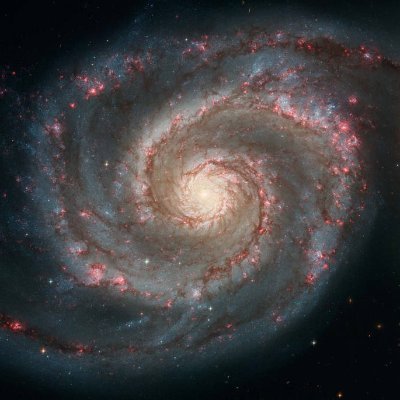
ALT A beautiful spiral galaxy seen face-on, similar to looking directly at the eating surface of a dinner plate. The core of the galaxy is bright in this optical image from Hubble Space Telescope resembling well-creamed coffee in color. The galaxy's two symmetric arms are filled with hundreds of thousands of blue stars, and possibly more. The shape of the galaxy's arms causes the galaxy to appear as though it's rotating left. Dark dust lanes are scattered throughout the galaxy, including a lane that runs across the core of the galaxy from our vantage point. At least five foreground stars are present in this image. Those stars appear much larger than the others in the galaxy because they are closer to Earth.

ALT In this composite image of 30 Doradus, royal blue and purple gas clouds interact with red and orange gas clouds. Specks of light and large gleaming stars peek through the colourful clouds. The patches of royal blue and purple gas clouds represent X-ray data collected by the Chandra Observatory. The brightest and most prominent blue cloud appears at the center of the image, roughly shaped like an upward pointing triangle. Darker X-ray clouds can be found near the right and left edges of the image. The red and orange gas clouds represent infrared data from the James Webb Space Telescope. These patches resemble clouds of roiling fire. The brightest and most prominent infrared cloud appears at our upper left, roughly shaped like a downward pointing triangle. Wispy white clouds outline the upward pointing bright blue triangle in the center of the image. Inside this frame is a brilliant gleaming star with six long, thin, diffraction spikes. Beside it is a cluster of smaller bright spec

ALT The background of space is black. Thousands of galaxies appear all across the view. Their shapes and colors vary. Some are various shades of orange, others are white. Most stars appear blue, and are sometimes as large as more distant galaxies that appear next to them. A very bright star is just above and left of center. It has eight bright blue, long diffraction spikes. Between 4 o’clock and 6 o’clock in its spikes are several very bright galaxies. A group of three are in the middle, and two are closer to 4 o’clock. These galaxies are part of the galaxy cluster SMACS 0723, and they are warping the appearances of galaxies seen around them. Long orange arcs appear at left and right toward the center.

ALT In this image, a student reads a tactile eclipse map from NASA’s Chandra X-ray Observatory Tactile Universe resources. A pair of hands with a watch on one wrist are positioned over an off-white page from a spiral-bound book with the text “Map of the United States” and “Path of Totality,” and a NASA insignia in the corner. Faintly raised shapes appear on the page. The image is watermarked with “Credit: NASA/CXC.”