

The first purpose-built colocation infrastructure for digital markets.
Joined October 2025
- Tweets328
- Following17
- Followers1.1K
- Likes1.6K







TheHUB retweeted
When we think about latency, fiber length usually gets most of the attention. That makes sense, since fiber cables often cover most of the physical distance between two points in a trading network, such as market data endpoints and exchanges. But there's another important, often overlooked factor: the switches an order passes through.
Even inside the same data center, one trading firm's orders may cross more switches than another firm's before reaching a matching engine. Each additional switch introduces delay, potentially giving one firm a latency advantage over the other.
TheHUB not only equalizes fiber path lengths but also standardizes how orders travel through its switching infrastructure, ensuring that each packet follows the same switching path once it enters the equalized latency envelope. With this setup, rack position no longer determines who gets a shorter path to a market operating from TheHUB.


TheHUB retweeted
An exchange doesn’t operate in isolation.
Behind it, there's an ecosystem of market makers, node operators, compute providers, and other infrastructure participants.
At TheHUB, all of them can deploy in the same physical environment as the exchange’s matching engine, with equalized network paths to the engine for colocated participants. This makes it easier for new markets to launch and existing ones to grow.
The more participants and infrastructure come together, the more useful that environment becomes for everyone.
TheHUB retweeted

daily early projects
@iris_credit – fixed-rate borrowing protocol, competitive quotes from the deepest liquidity, launching q4
@TheHUB – purpose-built colocation infrastructure for digital markets, equalized latency and fair access
@zroai_ – private, high-speed, multi-region inference for coding agents, open models, zero request retention
@NummoHQ – one app for on-chain trading and lending, built on sonic
@backtrade_xyz – crypto perps with up to 1000× leverage, liquidation engine that works for you, waitlist open
@soter_insure – digital asset insurance for institutions (series b, Galaxy, SC Ventures, SBI Group, Token Bay Capital)
@RegistryChain – open registry for companies and ai agents, who owns it and who answers for it
@PlinthProtocol – financial ethereum infrastructure for real-world assets
bookmark if useful
follow or miss tomorrow's alpha

TheHUB retweeted

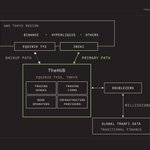
I love that @TheHUB offers bare metal in Tokyo, with full DoubleZero multicast and network connectivity built in 🫡

TheHUB retweeted

I’m in Hong Kong this week for @HongKongFinTech and @CosmoverseHQ.
If you’re around, I would love to meet and talk about all things trading!




TheHUB retweeted
TheHUB provides purpose-built colocation infrastructure for latency-sensitive markets, with its first facility inside Equinix TY15 in Tokyo.
Exchanges, trading firms, bare metal providers, and node operators can operate in the same building, connected through one network, under equalized latency. Participants can bring their own servers or use bare-metal or on-prem cloud providers.
Inside TheHUB, every trading firm’s network path to a venue’s matching engine is designed to be the same length, so no participant can buy a shorter connection.

TheHUB retweeted
Trading infrastructure in digital asset markets is following a path TradFi has already taken.
As traditional markets matured, proximity to matching engines, reliable market data, and high-performance, low-latency connectivity became essential parts of the trading stack. Infrastructure that was once a competitive differentiator became a requirement to compete.
Digital asset markets are heading in the same direction, yet the opportunity remains to build that foundation differently.
TheHUB is a common physical environment for exchanges, trading firms, and infrastructure providers, with equalized access to every market inside it. It gives digital asset markets the foundation traditional markets came to rely on, designed specifically for them.

TheHUB retweeted
Deploying an autonomous trading agent also means choosing where it runs, setting up market data feeds and how it connects to the venue. For strategies that rely on execution timing, those choices are critical.
Inside TheHUB, agents can run colocated with the venues they trade on, reach the matching engine over an equalized network. The compute is the participant’s choice: their own machines, bare metal, or on-prem VMs.
TheHUB gives autonomous agents predictable infrastructure built into the trading environment, with what they need to trade in one place.

TheHUB retweeted
Most crypto markets still run on generic cloud infrastructure or fragmented proprietary deployments.
TheHUB gives trading venues a purpose-built alternative across Tokyo, New York, and London: bare-metal compute, colocation, deterministic networking, synchronized timestamping, a standardized market data and messaging layer, and equalized access.
Venues share the foundation common to every exchange while keeping the matching engines, rules, and market models that differentiate them.
TheHUB retweeted
OKX (@okx) migration to Tokyo reinforces the region’s role as a center of gravity for crypto activity.
It’s no coincidence that we chose Tokyo as the first location for @TheHUB.

OKX moved its trading infrastructure from Hong Kong to Tokyo this week.
Our latency probes caught the switch live:
Hong Kong: ~5ms → ~63ms
Tokyo: ~52ms → ~4ms
A clean swap. If you’re co-located in Hong Kong for @okx, it’s time to move to Tokyo.
👉 latency.glassnode.com/cex

TheHUB retweeted

The future of high-performance crypto isn’t just better consensus or VMs.
It’s the full stack:
Purpose-built L1s (@fogo )
Dedicated global fiber networks (@doublezero)
Optimized Colo's Infra (@TheHUB)
We’re moving from “blockchain running over the public internet” to purpose-built infrastructure for distributed systems. The physical layer is finally getting attention. 🚀
#TheHub #DoubleZero #Fogo
TheHUB retweeted

“That is what we are building at @TheHUB: a measurable and equalized access layer, so the edge comes from strategy, pricing, and risk, not from an opaque route to the engine.”
🤝

Great thread by @moonshiesty and the @blinktrade team.
The most interesting point to me is that crypto venues are now mature enough for microstructure details like batching, queue position, and execution priority to matter.
@HyperliquidX has pushed the category forward. Threads like this push the analysis forward.
TradFi spent decades debating these questions behind closed doors. Crypto makes the data public, the analysis open, and the next frontier increasingly obvious.
The direction is clear: execution infrastructure is becoming part of market structure itself.
That is what we are building at @TheHUB: a measurable and equalized access layer, so the edge comes from strategy, pricing, and risk, not from an opaque route to the engine.
TheHUB retweeted
Great thread by @moonshiesty and the @blinktrade team.
The most interesting point to me is that crypto venues are now mature enough for microstructure details like batching, queue position, and execution priority to matter.
@HyperliquidX has pushed the category forward. Threads like this push the analysis forward.
TradFi spent decades debating these questions behind closed doors. Crypto makes the data public, the analysis open, and the next frontier increasingly obvious.
The direction is clear: execution infrastructure is becoming part of market structure itself.
That is what we are building at @TheHUB: a measurable and equalized access layer, so the edge comes from strategy, pricing, and risk, not from an opaque route to the engine.

we reverse-engineered how the @HyperliquidX engine executes TWAP orders from public fill data (240hrs)
we found TWAP orders are executed in batches. when a batch contains multiple TWAP orders for the same side/market, orders farther back in the queue have a higher price-impact
right now, TWAP queuing for the most part only affects the HYPE market
if TWAP volumes continue to grow, there are a few obvious ways hyperliquid TWAPs micro-structure can be improved
