

Professor at Rutgers, director of a cognitive & network neuroscience lab – neuroimaging, connectivity, cognitive control, NeuroAI ([email protected])
Rutgers University-Newark
Joined July 2013
- Tweets1K
- Following846
- Followers3.8K
- Likes2.3K




Pinned Tweet
Inspired by Edinburgh’s legacy of big ideas (e.g., Hume), on a train leaving the city, I crafted a book proposal about big ideas in network neuroscience—how brain flows generate representations that compose our minds. The rest is history, and this book: shorturl.at/dSfwB

My latest post to Neural Flows!
"Fluidized brain flows and the dynamics of consciousness"
A new model from my forthcoming book (Brain Flows) that may help explain the purpose of the brain’s "dark energy"
neuralflows.substack.com/p/f…

My latest post to Neural Flows!
“What’s generative about generative network neuroscience"
A new field of network neuroscience covered in my forthcoming book Brain Flows
Gaining fundamental understanding of cognition by modeling network flows
open.substack.com/pub/neural…

My latest post to Neural Flows!
“Generative network neuroscience"
Gaining fundamental understanding of cognition by modeling connectivity-constrained neural generative processes
A perspective shift in neuroscience and the (other) cognitive sciences
open.substack.com/pub/neural…

My latest Neural Flows newsletter post!
“Enhancing scientific inference with evidence quality maps”
Automated inference as a scalable engine of discovery
neuralflows.substack.com/p/e…

My latest Neural Flows post:
“Living in a compositional universe is a prerequisite for intelligence”
Brain flow dynamics take advantage of our environment’s compositionality to accomplish goals
neuralflows.substack.com/p/l…

Why do our visual systems have “shortcut” connections (V1-V4)? What do they add beyond the classic hierarchical (V1-V2-V3-V4) pathway?
The lab’s latest study takes activity flow modeling to the next level to answer these questions
biorxiv.org/content/10.64898…
1/n

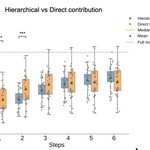
Together, these results validate a new method to test complementary roles of distinct flow pathways: direct visual pathways rapidly generate detailed visual information, while hierarchical pathways build up compressed representations (e.g., shapes rather than lines). 14/n
Thanks to first author Alexandros Tzalavras and coauthors!
The paper: biorxiv.org/content/10.64898…
15/n