

NATURE’S WAY - Let’s dive deeper into ancient Chinese nature-based thinking 📚, movement ☯️ and writing ✍️, and learn some things together.
Brussels
Joined November 2010
- Tweets3.4K
- Following241
- Followers728
- Likes273




Hanneke Siebelink 汉娜 retweeted

"The best time to plant a tree was 20 years ago. The second best time is now." – Chinese Proverb

Hanneke Siebelink 汉娜 retweeted

De Nederlandse read out van de ontmoeting van Berendsen met Wang Yi. Veel multilaterisme en wat wollig taalgebruik over de noodzaak van communicatie over halfgeleidertechnologie (lees: ASML). Opvallend: de opmerking over consultatie over wapenbeperking. government.nl/documents/2026…


Hanneke Siebelink 汉娜 retweeted
Rule in Daoism: There is no disadvantage. You always take things as they are, and try to turn them to your advantage. #tao #dao #ancientchina

✍️ Shells were commonly used as a form of currency in ancient times. That is why the Chinese characters related to wealth often have 贝 (bei = sea shell, currency) as a radical. For instance: 财 (cai) = wealth, money, fortune. Can you spot the shell?

I think Walt Whitman, whom I came to know quite well when I wrote my Lincoln book, had an ancient Chinese soul #Whitman

Walt Whitman, shortly after his paralytic stroke, on what makes life worth living themarginalian.org/2026/10/0…

43

2/2 📙 Here’s what he said, with a twinkle in his eyes: ‘I did not tell half of what I saw because no one would have believed me.’ #MarcoPolo
43
📙 Marco Polo (1245-1324) wrote in incredible detail of the birds, animals, plants and other aspects of nature he saw when he travelled in China as a young merchant. Later, when he was back in Venice, a priest asked him if he wanted to admit his stories were false. 1/2

I found a “Marco Polo” statue inside a Guangzhou temple!
In the Hall of Five Hundred Arhats at Hualin Temple华林寺, Arhat No. 100 has distinctly Western features. Locals have long called it Marco Polo, even though he never set foot in Guangzhou.
The arhats were made in 1849 (Daoguang 29), modeled after those at Hangzhou’s Jingci Temple. This particular figure was originally based on the Indian missionary monk; the craftsmen simply gave him a Western appearance. In the late Qing, people popularly identified him as Marco Polo — a folk symbol of Guangzhou’s openness and cultural exchange, reflecting Lingnan’s inclusive spirit.
The original statues were clay covered in gold lacquer (see image 3). All were destroyed during the Cultural Revolution; the present ones are wooden replicas carved in 1997.
Hualin Temple is traditionally regarded as the place where Bodhidharma, the Indian founder of Chan (Zen) Buddhism, landed in China around 526/527 — the starting point of Chinese Zen.


31
Lessons for Leaders from China’s 老子 Lao Zi leadershipwatch-aadboot.com/… ‘Flexibily and softness are friends of life.’

35

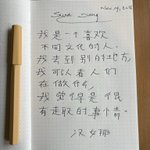
✍️ Secret Diary - Special prize for who can tell me what I wrote (no AI translators allowed 😃)
Notebook and pen: @_papierbrussels_

Master Complexity: Leadership Insights leadershipwatch-aadboot.com/… Illustrated with a story from the Zhuangzi #GreatBooksOfChina

75
On the origin of Chinese writing ✍️: linkedin.com/posts/hannekesi…

67


