

Independent ETF Issuer & White Label Service Provider | Subscribe: https://xitter.cf/t.co/94tIflx6X0
Burlington, VT
Joined September 2019
- Tweets3.2K
- Following4.1K
- Followers6.3K
- Likes39




Brazil's Agriculture Ministry said on October 15 that Center-South mills made 2.86 million metric tons of sugar in the second half of September. That's down 6% from a year earlier.
The drop was 41.6% in the first half of September, when rain slowed the cane harvest. Mills crushed 38.64 million tons of cane, down 2.9%.
Broker StoneX says mills lost an average of 31 harvest days from October to December in the past decade. Watch for the possibility that mills lose closer to the 45 days StoneX models for a wet season.
hubs.li/Q04BL7Js0

U.S. exporters sold 1.12 million metric tons of corn for 2026/27 delivery in the week to October 8, per USDA data released October 16. That's up 46% from the week before.
Mexico bought 544,500 tons, nearly half the total. Japan bought 220,100 tons and South Korea 199,900.
Analysts surveyed by The Wall Street Journal expected 600,000 to 1.2 million tons. Shipments fell 15% to 1.36 million tons.
USDA updates its corn export forecast on November 10. Watch for the possibility that USDA raises it if Mexico keeps buying.
hubs.li/Q04BL80Y0

USDA inspected 2.0 million metric tons of U.S. soybeans for export in the week to October 15. That's up 80% from the week before and 26% above a year earlier.
China took 1.28 million tons, or 64% of the total. Mexico was second at 213,260 tons.
Inspections since the marketing year began September 1 total 7.16 million tons, 27% ahead of last year. USDA's next inspections report comes out Monday, October 26. Watch for the possibility that China takes more than half of that week's loadings too.
hubs.li/Q04BL86r0

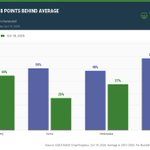
Farmers harvested 44% of the U.S. corn crop by October 18, per USDA. That's 8 points behind the 52% five-year average, up from 6 points a week earlier.
Iowa farmers have harvested 26% of their corn, against a 50% average. Nebraska is at 37% against 48%. Illinois is ahead at 63%.
Many farmers harvested soybeans first, per Brownfield. The soybean harvest jumped 18 points to 64%, 1 point behind average.
USDA updates Crop Progress on October 26. Watch for the possibility that farmers move combines back to corn and narrow the gap.
hubs.li/Q04BL87j0

Money managers sold 3,725 Chicago wheat contracts in the week to October 13, per CFTC. That was their sixth straight week of selling.
Their net short grew to 32,555 contracts, the largest since August 11. They added 2,155 longs and 5,880 shorts.
They've sold 47,459 contracts since holding a net long of 14,904 on September 1. They were net short in 48 of the last 52 weeks.
USDA inspected 240,308 tons of wheat for export in the week to October 15, down 51% from a year earlier. Watch for the possibility that money managers add to the short while exports trail last year.
See here: hubs.li/Q04BL80S0


Brazil's Ministry of Agriculture said October 1 that Center-South mills made 2.12 million metric tons of sugar in early September. That's down 41.6% on the year.
Rain slowed the cane crush, which fell 34.2% to 30.16 million tons. Mills also sent more cane to ethanol.
March 2027 raw sugar futures on ICE rose to 19.93 cents a pound on Friday, October 2. That's the highest front-month price since March 20, 2025, per DATAGRO.
Watch for the possibility that Brazil's second-half September data shows another drop in sugar output.
bit.ly/4dqWBpD

Federal grain inspectors cleared 6,671,688 metric tons of U.S. wheat for export from June 1 to October 1, per USDA. That's 35% behind last year's 10,264,408 tons by this date.
Inspectors cleared 302,356 tons in the week ending October 1, against 592,223 a year earlier.
USDA reported 315,400 tons of wheat exports for the week ending September 24, 32% below the prior 4-week average. Brownfield tied the shortfall to slower global demand.
Watch for the possibility that USDA lowers its wheat export forecast in the October 9 WASDE.
bit.ly/4zcgvwP

Farmers harvested 25% of U.S. soybeans by October 4, per USDA. The five-year average for the date is 33%.
Iowa sits at 5% against a 38% average. Nebraska is at 9% against 34%, and Minnesota at 25% against 51%.
USDA counted 1.2 days suitable for fieldwork in Iowa last week. Iowa Agriculture Secretary Mike Naig described "a historically wet September."
DTN forecasts a dry, warm week across much of the Midwest. Watch for the possibility that next Monday's Crop Progress report shows Iowa farmers closing part of their 33-point gap.
bit.ly/4hOMKv3

USDA rated 54% of the U.S. corn still in the field good to excellent as of October 4. That's down 3 points from 57% a week earlier.
It rated 18% poor or very poor, up from 17%. Farmers had harvested 23% of the crop by then, against a 27% average.
Iowa rates 72% good to excellent and Nebraska 46%. DTN reported notable declines in both states.
USDA publishes a new corn yield estimate on Friday, October 9. Watch for the possibility that USDA cuts it.
bit.ly/4hIfSnQ

Money managers cut their corn net long by 22,877 contracts in the week to September 29, per CFTC. It was their second straight weekly cut.
Their net long is now 381,220 contracts, down 33,240 from the 52-week high of 414,460 set September 15. They cut 31,623 longs and 8,746 shorts.
That net long still equals 20.5% of corn futures open interest. They were net long in 30 of the last 52 weeks.
CFTC's next report comes out Friday, October 9, with positions as of October 6. Watch for the possibility that it shows a third straight cut.
See here: bit.ly/4j7M9Hk


USDA rates 43% of U.S. topsoil short or very short of moisture as of September 27. That's down from 47% a week earlier and matches a year ago.
Pasture and range improved a little. USDA rated 19% good to excellent, up from 17%. A year ago it was 32%.
Farmers have planted 27% of the winter wheat crop, against a 34% average. Oklahoma has planted 7% versus a 25% average, and 81% of its topsoil is short or very short. Texas sits at 30% planted against 39%.
Watch for the possibility that the planting gap could widen next week if Oklahoma and Texas stay dry.
hubs.ly/Q04yCRTb0

USDA Grain Stocks, Sept 1:
Corn: 2,095 million bushels (trade avg 1,924) Soybeans: 315 million (trade avg 323) Wheat: 1,846 million (trade avg 1,849)
Corn is the surprise, coming in above the highest trade estimate of 2,005 million.
...details below
Corn
USDA says corn stocks on Sept 1 totaled 2,095 million bushels. The trade average was 1,924 million, and the highest guess was 2,005 million.
That's 35% above a year ago, and 173 million above the 1,922 million USDA carried for old-crop ending stocks in the September WASDE.
Watch for the possibility that USDA raises 2025/26 corn ending stocks in the Oct 9 WASDE.
Soybeans
USDA pegs Sept 1 soybean stocks at 315 million bushels. The trade average was 323 million, and a year ago it was 325 million.
June through August use totaled 744 million bushels, up from 683 million last year.
Wheat
USDA puts Sept 1 wheat stocks at 1.846 billion bushels, down 14% from last year and in line with the 1.849 billion trade average.
The Small Grains Summary has 2026 all wheat production at 1.534 billion bushels, down 23% from 1.989 billion in 2025. Yield is 48.1 bushels per acre, down 5.2, on 15% fewer harvested acres.

Farmers harvested 17% of U.S. soybeans by September 27, per USDA. That matches the five-year average. Last year it was 18%.
USDA says 75% of the crop is dropping leaves, right on the average. It rated 58% good to excellent, unchanged on the week and down from 62% a year ago.
The September 30 Grain Stocks report also counts old-crop soybeans. USDA's September WASDE assumed 325 million bushels. Old-crop stocks become new-crop beginning stocks. Watch for the possibility that a lower count could cut USDA's 310 million bushel ending stocks estimate in October.
hubs.ly/Q04yCRRF0

Farmers harvested 18% of the U.S. corn crop by September 27, per USDA. That matches the five-year average and runs a point ahead of last year.
USDA rated 57% of the crop good to excellent for a third straight week. A year ago it was 66%. It rates 17% poor or very poor, up from 10% a year ago.
USDA counts old-crop corn stocks on September 30 at noon ET. Its September WASDE assumed 1.922 billion bushels were left on September 1. Watch for the possibility that a lower count could pull new-crop ending stocks down from 1.567 billion by the same amount.
hubs.ly/Q04yCRX40
