
#bitcoin, gold, euro, dollar, inflation, deflation, oil, silver, deficit spending, hayek, rothbard, mises, menger, ricardo, bastiat
Joined May 2010
- Tweets9K
- Following1.3K
- Followers916
- Likes10.2K





Er is een fundamenteel verschil tussen dat iemand geld verdient op basis van producten en diensten die ik vrijwillig koop versus iemand die geld verdient betaald door geld dat van mij onvrijwillig is afgepakt (belasting).

Lijst militaire acties USA
share.google/aimode/G9KH2Ttt…
Lijst militaire acties USSR/Rusland
share.google/aimode/49y0Qdno…


Je gelooft Rutte niet, mr wel als hij zegt dat er geen dreiging is van rusland? Jullie zien het hele plaatje niet, de escalerende oorlog nu is het resultaat van lakse beleid de voorbije decennia, en kon vermeden worden. Verdiep je eens in Ruslands geschiedenis, m.b. putin en al de invasies & oorlogen die hij reeds startte. Want als je gelooft dat dat echt aan 't Westen ligt dan begrijp je er niks van. Oekraine niet meer steunen zou natuurlijk consequenties hebben, er is een reden dat we er zoveel in investeren en tis niet omdat rusland te vernietigen zoals hun propaganda dat graaég laat uitschijnen.
Tering Nering retweeted

My dear American friends, in my last post I gave you a snapshot of where France stands today. Now let me show you how we got here. I want you to see the whole movie before you buy the ticket.
After the war, France was a machine. We called it the Trente Glorieuses, thirty glorious years. We built Concorde, the most beautiful aircraft ever made. We built a fleet of nuclear reactors in about fifteen years and gave ourselves some of the cleanest, cheapest electricity in the world. We built Ariane and put Europe in space. We built the TGV, the fastest train on earth. We invented the Minitel, an online network in millions of homes before most of you had heard of the internet. We were not a museum. We were builders.
Then came 1981. François Mitterrand. Think of him as our Bernie Sanders, except he actually won. At his side, in the office next to his at the Élysée, sat a 37-year-old prodigy named Jacques Attali, his special adviser for the next ten years. The brightest minds of the left, convinced they could run an economy from a ministry.
Here's what they did. They governed with Communist ministers. In 1982 they nationalized dozens of banks and the biggest industrial groups in the country: Paribas, Suez, Saint-Gobain, Thomson, Pechiney, Rhône-Poulenc. They lowered the retirement age to 60. They cut the work week to 39 hours and added a fifth week of paid vacation. They created a wealth tax. They hired massively into the public sector.
Reality hit in less than two years. Capital fled, inflation ran wild, and the franc was devalued three times. In March 1983 Mitterrand had to slam on the brakes and impose austerity just to stay in the European monetary system.
But here's the trick: the brakes never reversed anything. They just slowed the ratchet. The so-called right came back with Jacques Chirac, and nothing was undone. Under Chirac's presidency, France passed the 35-hour work week. Left or right, every government added one more program, one more rule, one more tax, and nobody ever took one away.
At the same time, the political class did something even more destructive than bad economics. It turned the youth into a political instrument. Instead of teaching young people, including millions of children of immigrants, to love the country they lived in, it taught them a story of guilt and grievance: France as the oppressor, France as the thing to resent. You cannot integrate people into a country you've taught them to despise. We are living with the consequences of that narrative today, in our schools, our suburbs, our streets.
Then forty years of slow decline, all the way to Macron. And the story has a perfect ending. In 2007, Jacques Attali chaired a commission on how to unleash French growth. Its deputy rapporteur was a young civil servant named Emmanuel Macron. The commission proposed more than 300 reforms to free the economy. Almost none were ever implemented. Even the men who built the system knew it wasn't working, and even they couldn't undo it.
No balanced budget since 1974. Public spending around 57% of GDP. Debt above 3,300 billion euros. Growth stuck under 1%.
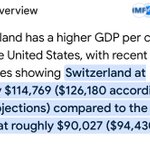
Now the number that should keep you up at night. In 1995, GDP per person in France was about $27,000. In America, about $29,000. We were neck and neck. Today France is around $49,000. America is around $90,000. You are now nearly twice as rich per person as we are.
What changed? Not our talent. Not our engineers. Not our schools of mathematics. The only thing that changed is that we went all in on socialism. The 35 hours, the endless regulation, the taxes that chase out anyone who builds, the belief that the state should do everything and the individual should ask permission for everything.
There's a line people love to attribute to Einstein: insanity is doing the same thing over and over and expecting different results. We tried. For forty years, we tried. Every government promised that one more program, one more tax, one more regulation would finally fix things. You just saw where it got us.
So if you choose the Democratic Party, which is literally turning socialist in front of your eyes, you will deserve what comes next.
Let me tell you exactly what will happen if you go down that road. Nobody will vote for decline. Every single measure will sound generous, compassionate, reasonable. Your builders will slowly leave or stop building. Your state will grow every year and never shrink. Your debt will compound. And in thirty years, your kids will look at a chart like the one I just described and wonder when it all went wrong.
You still have something we lost. You have Elon Musk sending rockets to orbit and landing them on their tail. You have Palmer Luckey building the defense industry of the future. You have Jeff Bezos, Jensen Huang, and thousands of founders nobody has heard of yet, building in garages right now.
Trust your entrepreneurs. Don't trust your politicians.
I come from your future. Don't make it yours.


I’m French. I want to talk to Americans who are about to vote Democrat. Not to insult you. To warn you.
I come from your future.
In France we did everything your progressive politicians promise. Free healthcare, free college, generous welfare, strong unions, heavy regulation, high taxes on the rich, a state that takes care of everything. Public spending close to 57% of GDP, one of the highest on the planet. On paper, it’s the dream.
Here’s what it looks like from the inside. France hasn’t passed a balanced budget since 1974. Our debt is above 3,300 billion euros. Interest on that debt is becoming one of the biggest items in the national budget. Our hospitals are collapsing despite record funding. Our schools rank lower every year. Young people with degrees can’t afford an apartment in the city they were born in. Our best engineers leave for London, Zurich and San Francisco. And the rich you wanted to tax? They left too, and took the jobs with them.
The promise was protection. The result is stagnation.
The worst part is that nobody in France voted for decline. Every single step sounded generous, compassionate, reasonable. One more program. One more regulation. One more tax to fund it. Each step alone makes sense. Fifty years of them, and you wake up in a country that can no longer build a nuclear plant on time or keep its streets safe.
I love America because it’s the one place on earth where people still believe they can build something from nothing. I came to Silicon Valley as a self-taught kid and it changed my life. That spirit is the most precious thing your country has.
Before you vote, ask yourself one question: is the program you’re voting for making America more like America, or more like France?
Trust me. You don’t want to be France.
Toch ongelofelijk? Moet het (arme) EU het VK sponsoren? Ik hoop dat de EU hard Nein! roept.

Waarom zou het VK weer willen aansluiten bij de EU? Omdat de welvaartsstaat Groot-Brittannië verplettert volgens de @WSJ
Het stijgende aantal mensen met een arbeidsongeschiktheids- en ziekte-uitkering blaast de welzijnsrekening van het land op en brengt de lange termijn financiële stabiliteit in gevaar 🧵
wsj.com/world/uk/united-king…


Tering Nering retweeted

Nobody built the Mediterranean economy. It just happened.
Around 1000 BCE, Phoenician merchants from cities like Tyre and Sidon started planting small trading posts along coastlines: Cyprus, Sardinia, Carthage, southern Spain. No emperor issued a decree. No central committee drew up a plan. Individual traders looked at a map, spotted a gap, and put an ancient version of a warehouse there because it made them money.
This is spontaneous order in action. Complex, functional systems emerge from millions of individual decisions rather than top-down commands. Your local farmers market works the same way, except the Phoenicians were doing it across 2,500 miles of open water.
Each post solved a local problem. Tin from Britain needed to reach bronze-smiths in Egypt. Purple dye from Murex snails needed buyers who could afford it. The trading posts became nodes in a price-discovery network, transmitting information about where things were scarce and where they were abundant. Prices did what no bureaucrat can manage: they coordinated strangers who never met.
The Phoenicians had no navy protecting their trade routes, no tariff regime, no World Trade Organization. They had reputation. Merchants who cheated got blacklisted across ports from Carthage to Cadiz. Contract enforcement came from the community itself, not a court. Free market thinkers call this polycentric law: rules maintained by competing private interests rather than a monopoly state.
You want to understand why the ancient Mediterranean grew wealthy? Forget the empires. It was merchants in small boats, calculating risk and reward at every harbor, building something extraordinary without once attending a planning meeting.

2 bakers run a bakery and bake bread for a neighbourhood, each day. Then they buy a modern automated oven. 1 Baker can produce all the bread. The price of the bread halves.
The other baker starts making pies & cakes. People buy those from their savings on cheaper bread.
#SaysLaw

Milton said it too
youtube.com/shorts/zwD5ol727…


The Economist claims non western immigrants are net positive for the economy.
Without calculations this is hard to believe. Yes, low wages are positive for big companies (readers of Economist), but the costs are socialized on the society.

@lanegreene Non-Western Immigrants & Descendants have represented a net deficit for the state, largely due to lower employment rates and higher reliance on social transfers.
The Min of Fin of Denmark estimated they cost the public sector a net $4.9 billion annually, ~1.4% of GDP
Tering Nering retweeted
Venice built the greatest commercial empire in European history without a central bank, without industrial policy, and without a single economic development agency. While Byzantine bureaucrats strangled Constantinople with regulations and Frankish kings debased their currencies, Venetian merchants created wealth through voluntary exchange and sound money.
The lagoon dwellers who fled Attila's hordes in 452 AD had nothing but salt marshes and fish. No natural resources. No agricultural surplus. No inherited infrastructure. What they possessed was something far more valuable: distance from the coercive apparatus of mainland states. This geographic accident forced them to survive through trade rather than taxation, commerce rather than conquest.
Venice's constitution deliberately fragmented power to prevent any single authority from controlling trade. The Doge held ceremonial functions while competing merchant families checked each other's ambitions. No guild could monopolize an industry without rivals organizing alternative trading networks. When the state tried to restrict private commerce in 1297 with the Serrata del Maggior Consiglio, it marked the beginning of Venice's decline, not its peak.
The Venetian ducat maintained its gold content for over 500 years while every other European currency suffered debasement. Merchants could calculate profits across decades, plan investments across generations, and accumulate capital without worrying about monetary manipulation. Compare this to England, where Henry VIII cut silver content by 83% in just 20 years.
Voluntary association and sound money create abundance. Coercion creates poverty. Venice proved this. The same economic laws that enriched Venetian merchants still operate today, waiting for governments brave enough to get out of the way.

Over 2025, M2 of china has risen +8,7%, not 13.6%.
(319k to 347k billion).
I think you should add up al percentages of each central bank, not the values in dollars.


In the last year, the world has printed 9.3% more money.
Global M2 money supply has reached $141T in 2026.
When inflation starts to run hotter again, they will blame it on Iran and other proximate factors.
But the root driver is the money printer has been running hot for the last year. Where?
China increased their money supply by 13.6% in the last 12 months. Their M2 is now $50T, making it the largest global driver of fiat inflation.
US growth in M2 is just 4.6% over the last 12 months, making the US comparatively responsible. (But make no mistake, this means your dollars have been debased by almost 1/20th of their value in just a year.)
Since we live in a global economy, we're subject to the aggregate impact of GLOBAL money printing. The US has been accustomed to being the largest monetary base and therefore largely controlling global debasement.
But China's money supply is now 2x as large as the USA's. Your savings are being debased by Chinese monetary policy decisions and you have no control.
Nobody asked your permission. Nobody told you it was happening.
But your savings just got diluted by 9.3% in one year.
Note: I'm currently updating the Global Asset Landscape for 2026 (see prior tweet). It will be out in the next few weeks, stay tuned!

Tering Nering retweeted
Paul Volcker didn't "crush" inflation in 1981-82 through heroic central banking. He cleaned up the mess that central banking created in the first place.
The Federal Reserve had spent the 1970s debasing the dollar, pumping money supply growth above 10% annually while inflation ravaged American savers. By 1979, consumer prices were rising at nearly 15% per year, and the dollar was collapsing internationally. Gold hit $850 per ounce as investors fled fiat currency. The Fed's own policies had destroyed the purchasing power of American wages and savings.
Volcker's "solution" was to jack interest rates to 20% and trigger the worst recession since the 1930s. Unemployment hit 10.8% by late 1982. Manufacturing collapsed. Small businesses went bankrupt by the thousands. Free market economists grasped the real story: central banks create business cycles through credit manipulation. The recession was the economy's attempt to reallocate resources misallocated during the inflationary boom.
The mainstream celebrates Volcker for "breaking the back of inflation," but this ignores the fundamental problem. Central banks create business cycles through credit manipulation, then get praised for cleaning up their own disasters. The 1970s inflation came from Nixon closing the gold window in 1971 and the Fed monetizing government deficits. The 1981-82 recession was simply the hangover from that monetary binge.
Central banking itself is the source of monetary instability. Volcker demonstrated this by cleaning up the very disaster the Fed had created.


Tering Nering retweeted

🚨 THEY CAUGHT THE MACHINES 🚨
A forensic exam of a Dominion machine in Ware County, GA reportedly found that when an equal number of votes for President Trump and Joe Biden were run, the machine spat out about 87% for Trump and 113% for Biden instead of 100% each.
That means the tabulator manufactured a 26% lead for Biden out of thin air.
This is EXACTLY why the Lindell Offense Fund is on OFFENSE to end electronic election platforms and move America back to transparent, hand-counted elections the people can SEE and VERIFY. 🇺🇸
If you’re tired of rigged, black-box systems:
🔁 SHARE this everywhere
📲 Join the fight at LindellOffenseFund.org
This perfect diagram corresponds exactly with Thatcher’s “poor poorer” argument
youtu.be/pdR7WW3XR9c


Jetten is first OPENLY gay PM.
Old PM Rutte is a closet-gay.
And Balkenende too (visiting his friend secretly many weekends on the island of Malta).

Jetten becomes Netherlands' youngest and first gay PM bbc.in/4c9Knlq

