

School, made smarter. The only school with proven Better Results For Every Child® Award-winning school & homeschool | Gr R-12 👉 2027 are enrolments open
Joined February 2026
- Tweets49
- Following1
- Followers1
- Likes0



Pinned Tweet
A Matric university pass. Or your fees back.
🎓 Join Teneo in Grade 8, 9 or 10 in 2027, keep to the conditions, and if your child doesn’t get a Matric university pass, we refund the fees you paid.
Conditions and limits apply: teneoschool.co.za
20
Other schools give stickers for effort. 🌟
We pay cash into the kid's own investment account. For showing up and handing work in. Never for marks. 💰
2027 enrolments are open.
👉 Enrol now at teneoschool.co.za

2
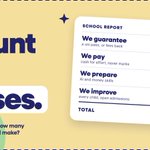
Four promises. Ask your school how many it makes:
✅ We guarantee (uni pass or fees back)
💰 We pay (cash for effort)
🤖 We prepare (AI + money)
📈 We improve (every child, open admissions)
Count the yeses.
2027 enrolments are open
👉 Enrol now at teneoschool.co.za

You already know families looking for a better school.
What if every introduction earned you money? 💰
Join the Teneo Advisor programme: earn up to R3,000 per learner. No quotas, no fees to join.
Open to anyone 18+: adviser.teneoschool.com/Teac…
19
She'd spent her whole life in international schools.
So when her parents told her she'd be moving to Teneo Online School, she was heartbroken.
Two months later, she was impressed by the standard of teaching.
A few months after that, she was on the academic leaderboard.
By the end of the year, she'd achieved 100% in Visual Arts.
Having spent her life in international schools, her parents said, that meant everything.
The school a child becomes loyal to isn't always the most prestigious.
It's the one that paid the most attention to who she specifically is.
17
For years, online school meant something specific.
A fallback. A workaround for unusual circumstances.
The option you chose when better options weren't available.
That perception has shifted.
Not because of marketing — because of results.
Families who switched from well-regarded private schools and didn't look back.
Children with high averages getting higher.
Learners writing exams from different countries and outperforming their cohorts.
The evidence has accumulated quietly.
Online school isn't the alternative to a great education.
For a growing number of families, it's the reason for one.
15
The school system wasn't broken.
It was designed for a different century — and we kept it.
Designed for compliance, not curiosity.
For coverage, not mastery.
For the industrial economy, not the intelligence economy.
The most ambitious parents in the world are quietly reaching the same conclusion:
The best school for my child isn't the most prestigious one.
It's the one designed for the world they're actually going to live in.
That's the school we're building.
14
Their family was preparing to move to the UK.
Stability for their children — academic stability, specifically — was the priority.
They needed a school that aligned with the British curriculum. One that universities in the UK would recognise. One that would travel with them.
Their Year 8 child and their IGCSE student adapted within weeks.
More confident. More independent. More self-disciplined than either parent had expected.
"What started as a temporary solution quickly became the best decision we could have made."
Sometimes the best school is the one that stays constant while everything else changes.
11
Learning gaps don't appear suddenly.
They build slowly — often from Grade 3 or 4 — invisible to a system tracking class averages rather than individual trajectories.
By Grade 9, what started as a detectable gap has compounded into a failing grade.
Early detection isn't a premium feature.
It's a design choice.
Teneo Online School's learners improve an average of 12% in their first year — not because the curriculum is different, but because the system is watching for what's opening before it closes.
7
The most expensive thing in education isn't school fees.
It's a system that doesn't notice.
Doesn't notice when a learner is being under-stretched.
Doesn't notice when a gap is opening before it becomes a grade.
Doesn't notice when a capable child is coasting on competence.
Private schools cost more because of what they promise.
The question is whether the system underneath the brand is delivering.
A school that notices — and acts on what it notices — is worth any fee.
One that doesn't, regardless of price, is expensive.
4
Their son was writing his exams from Hong Kong.
Different time zone. Same commitment.
At the end of the year, his parents wrote to say he'd made remarkable strides — particularly in Mathematics, Physics, and the subjects he loves most.
Despite the time zone gap, he adapted his schedule, stayed engaged, and showed up.
The biggest change, his parents said, wasn't academic.
It was his belief in himself.
That's not a school feature.
That's what a school is for.
4
The question we come back to, more than any other, is this:
What do you actually need from a school?
A building? A uniform policy? A consistent commute?
Or a child who is growing. Improving. Genuinely engaged.
Teneo Online School holds three internationally recognised accreditations — IEB, SACAI, and Pearson Edexcel. It has been operating for over a decade. 20,000+ learners.
It's not an experiment in what online school could be.
It's evidence of what it already is.
5
300 million children attend school every day and learn nothing measurable.
That's UNESCO.
But that's not the full picture.
Hundreds of millions more are attending school, learning adequately — and landing significantly short of what they're actually capable of.
The global education system has a floor problem.
It also has a ceiling problem.
Most conversations focus on the floor.
The ceiling question — are we unlocking the full potential of children who are already succeeding? — is almost never asked.
We ask it constantly.
5
"She's been to four countries this year."
"And hasn't missed a day of school."
That's the message a parent sent us recently.
Her daughter travels with her. School travels with her daughter.
Not recordings gathered in a panic.
Not catch-up work dumped on a Sunday evening.
Live classes from hotel rooms. Recorded lessons from airport lounges.
A school that moves when the family does.
The assumption that quality education requires a fixed address is one of the quieter myths of the modern era.
5
The number that surprised us most in our learner data wasn't +12%.
It was +25%.
Not because the improvement was unexpected — the methodology points there — but because it confirmed something the data shows over and over:
Educational improvement doesn't compound in most schools.
It resets.
New teacher. New year. New baseline.
The context of last year's learning profile, quietly lost.
At Teneo Online School, each year builds on the last.
+12% in Year 1.
+25% by Year 4.
That's not improvement.
That's compound learning.
4
The internationally mobile family has a curriculum continuity problem.
Every relocation means:
A new curriculum framework.
New grading systems.
Disrupted academic momentum.
A child who has to start over.
Diplomats. Executives. Remote workers. Global families.
They move. Their children pay the academic price.
A school tied to geography was never going to work for a life that isn't.
4
Her daughter completed Grade 12 through Teneo Online School.
Her son watched it happen — the flexibility, the personalised feedback on every assessment, the absence of unnecessary friction — and told his parents he wanted to switch too.
He joined in Grade 8.
That, more than any review, is the signal worth paying attention to.
When a sibling chooses the same school, it's not marketing.
It's evidence.
6
The strongest predictor of long-term academic performance isn't IQ.
It isn't even effort.
It's whether a child knows how they learn.
Metacognition — the ability to understand and direct your own thinking — is one of the most robust findings in learning science.
Children who understand how they learn, retain more.
Children who can manage their own thinking, outperform children who can't.
Almost no school explicitly teaches it.
At Teneo Online School, metacognition is embedded throughout the curriculum — not as an add-on, but as infrastructure.
4
65% of children starting school today will work in jobs that don't exist yet.
That's World Economic Forum data.
So the question isn't whether your child is passing.
The question is whether the school teaching them is building the kind of thinking that transfers — across industries, across technologies, across a career that doesn't have a map yet.
Curriculum coverage isn't future readiness.
The two are not the same thing.
4
Her overall average was 82%.
By any measure — a capable learner.
Good school. Good results. Good future ahead.
Her parents wondered if she could be doing better.
They moved her to Teneo Online School in Grade 10.
By the end of the year, her average was 88%.
The school didn't fix her.
There was nothing to fix.
It gave her the individual attention her previous school, at scale, simply couldn't.
Most schools optimise for the class.
The best ones optimise for the child.
5