

Old-timer in video and computer art, digital aesthetics and media history. Creating and collecting: https://xitter.cf/t.co/YMtYthi5vY
SF Bay Area
Joined May 2009
- Tweets4.9K
- Following775
- Followers1.3K
- Likes19.1K




Pinned Tweet
Nice to see that my 40 yrs old article has aged well. During my extensive research in pre-internet times I connected with many personalities of the 1st hour by phone, letters, and IRL. A pdf is available here: archive.org/details/ETC2766
and here:
monoskop.org/images/d/d7/Die…


One of the best early articles on computer art.
In 1986, @TeleCulture looked back at the first decade of computer art (1965–1975). He traces the shift from scientist led exhibitions to artists seriously using computers as a creative medium. It’s still one of the clearest overviews of the early years of digital art.

It's great to see the rediscovery of Charles Csuri and his pioneering work over many decades. I had the honor to meet Chuck several times. We both were on a panel on "Aesthetics of Computer Graphics" SIGGRAPH '85 and visited Koichi Omura, the designer of LINKS-1 in Osaka, Japan.


"Caroline Csuri on Charles Csuri and Computation as Playground" by Peter Bauman @monkantony_tez
Caroline Csuri on her father, Charles Csuri + the computer he considered his “playground” and “magic black box”
🐦 lerandom.art/editorial/carol… 🐦
Mentions: @CharlesCsuri @MuseumModernArt @michaelspalter @OhioState @NSF @Pixar @NASA @artforum @ClevelandArt @still_museum
Roman used this work for the poster of his show at the Honeywell gallery in 1989. Signed: 1/1/89
In our collection.

A former monk who turned his Minneapolis studio into an “electronic scriptorium.” Roman Verostko (1929–2024) wrote his own code to drive pen plotters and produced algorithmic drawings that fuse pure form, controlled chance, and the logic of illuminated manuscripts, often finished by hand with gold leaf. As co-founder of the Algorists, he treated the algorithm as both score and visual scripture.


Just made reservations. Looking forward to it.

Love to see friends IRL at upcoming opening (10/28) at @GrayAreaorg . I'm really excited about the project, 20+ years in the making.
grayarea.org/exhibitions/sca…
🙏 @modal

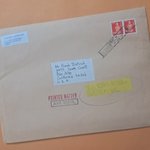
Manfred Mohr kindly sent me a good dozen of his wonderful catalogs over the years. One was very special: he used his own postage stamps on the mailer (see close up), marking a significant new direction in his work. For the 1st time he used color from 2004 onwards.


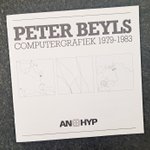
Would have loved to see this rare show of Peter Beyls' work. It reminded me that I have an old catalog from him. At least I could read an informative interview with the artist. And so can you!


Tonight is the Peter Beyls New Work opening at the Bantam Tools Machine Arts Gallery in Peekskill New York. I interviewed Peter this week and the article is live on our website. Check it out! bantamtools.com/blogs/machin…


Hiroshi Kawano was so kind to send me several theoretical articles he published in Memoirs of Tokyo Metropolitan Institute of Technology in 1990.
The time has come to return them to Japan into the hands of distinguished artist and historian of digital art @hasaqui


Last night #Stampfigang collected a handful of my works, including Neo Proun I & II, some of my earliest mints a couple of years ago. Thank you my friend.
BTW There are still a few Neo Prouns available for 5TZ.
objkt.com/tokens/KT1KDGwcta3…


I have just collected "First day of Winter" by @conrad46b on @objktcom
objkt.com/tokens/KT1XaCf6gkj…

Based on extensive research and presented with documented evidence.
Highly recommended read.

Who really made the first oscilloscope art?
Hy Hirsh’s photographs and Norman McLaren’s filmmaking complicate the familiar “Ben Laposky, 1950” origin story.
A new article on Güerita Art examines surviving artworks, contemporary records, and the later accounts that shaped this history. Drawing on museum collections and archival research, it revisits the contributions of Hirsh, McLaren, Bute, Laposky, and Franke.
guerita.art/journal/drawing-…


Sitting in an English garden
Waiting for the sun
I have just collected "Generative Mesh Painting 04 02 25" by @nftaverse

Still Friday in California, still time to post a #FractalFriday pic.
Thinking of minting a couple from this series.
