

Built in Detroit. Volunteer Led. Advocating & fundraising for Parkinson’s research-100% proceeds goes directly to The MJFF for Parkinson's Research -100%!!
United States
Joined August 2016
- Tweets1.6K
- Following481
- Followers327
- Likes2.2K






Team Fox retweeted

Did you know that one of the most effective treatments for Parkinson's disease, levodopa, may also be obtained from a plant? In this video, I discuss an important challenge facing the Parkinson's community: millions of people around the world lack reliable access to this essential medication. We explore the potential of plant-based sources of levodopa, including Mucuna pruriens, and how researchers are investigating ways to make treatment more accessible and affordable. The challenge is not simply growing a plant. It is finding safe, reliable ways to deliver consistent doses of levodopa to people who need it. Plant-based preparations are not yet a standardized replacement for prescription levodopa. I believe that where you live or how much money you have should never determine whether you can receive effective Parkinson's treatment. Levodopa for all should be a global priority.
youtube.com/shorts/9N_La16hj…
Team Fox retweeted
What resonates most with me about the exciting new Parkinson’s drug solengepras (CVN424) is that it represents a genuinely novel mechanism of action and a potential new addition to our treatment armamentarium. Rather than acting directly on dopamine, this once-daily medication blocks the GPR6 receptor in the brain’s indirect motor pathway, essentially easing the foot off the brain’s brake on movement. In the Phase 3 ARISE trial involving 341 people with Parkinson’s disease, the 150 mg dose reduced daily OFF time by 1.56 hours compared with 0.95 hours on placebo, a net benefit of approximately ~30-40 minutes per day, while also increasing good ON time without troublesome dyskinesia. These are modest but meaningful improvements, particularly for patients struggling with unpredictable motor fluctuations. The study also reported improvements in daily functioning, daytime sleepiness, and quality of life, although insomnia was more common (6.2% versus 0.9% with placebo). What excites me is not that this drug is a game changer for everyone, but that we are finally expanding beyond traditional dopamine-based approaches. Every additional treatment option matters, and even 30–40 minutes of better movement each day can make a difference for some people living with Parkinson’s. One important clarification: solengepras has not yet received FDA approval. These positive Phase 3 results are an encouraging step toward a potential regulatory submission, and we should celebrate the progress while awaiting full data and FDA review.

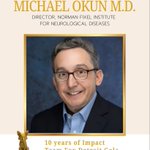
We are honored to welcome Dr. Michael S. Okun, Lisa Boudreau, Patrick Morrissey, and Brendan Cusick as featured speakers for Team Fox Detroit’s 10th Anniversary Gala, September 19, celebrating An Evening of Gratitude and Hope.
Each brings a meaningful voice to this mission from Parkinson’s research, care, and patient advocacy, to leadership, resilience, community, and hope.
Their insight reminds us why this work matters: because behind every dollar raised, every story shared, and every person who shows up, there is a shared commitment to moving Parkinson’s research forward.
As we celebrate 10 years of impact, we are grateful to have these inspiring speakers join us for a night dedicated to gratitude, hope, and the future we are all working toward better treatments and, one day, a cure.
#TeamFoxDetroit #MJFF #ParkinsonsResearch #GratitudeAndHope #10YearsOfImpact

Team Fox retweeted
What resonates with me about this excellent review of gastroparesis is how relevant it is to Parkinson’s disease and parkinsonism, where impaired gastric motility can become much more than a gastrointestinal symptom: delayed emptying can contribute to nausea, bloating and early satiety, but it can also make absorption of critical Parkinson’s medications, particularly levodopa, delayed and unpredictable. The review specifically recognizes Parkinson’s as a neurological risk factor for gastroparesis and reminds us how remarkably limited our therapeutic toolbox remains. Metoclopramide is the only FDA-approved drug for gastroparesis, yet because it blocks dopamine D2 receptors and carries a risk of parkinsonian symptoms and tardive dyskinesia, it is generally a particularly poor choice for people with Parkinson’s and other parkinsonian disorders. This is where I think we should all be making more noise: domperidone (Motilium), a peripheral dopamine antagonist commonly used in many countries, does not readily cross the blood-brain barrier and can be useful in Parkinson’s, yet it remains unavailable as a routinely FDA-approved prescription in the United States because of cardiac safety concerns. We need safer treatments, better trials and a workable regulatory pathway because for people with Parkinson’s, the stomach can determine whether the medication that works beautifully on paper actually reaches the brain when it is needed. You will find domperidone sold all over the world, and here are some of the names it goes by in different countries: Motilium, Motilium Rapid, Peridon, Peridys, Cilroton, Cinet, Costi, Domstal, Domperitop, Nauzelin, Neoperidys, Oroperidys, Permotil, Remotil, Riges, Tametil, Touristil, and Zilium.
jamanetwork.com/journals/jam…

We are honored to have Dr .
Michael Okun, M.D. speaking as one of our guest speakers for our 10th Anniversary Gala.
Dr. Okun is an American neurologist, neuroscientist, and New York Times bestselling author who co-founded and directs the Norman Fixel Institute at the University of Florida Health. A Distinguished Professor, he previously served as Chair of the UF Department of Neurology and has been continuously funded by NIH and many foundation grants.
He has served as the Medical Director/Advisor to the Parkinson's Foundation since 2006. Dr. Okun is internationally recognized for building innovative models of care and tor pioneering device-based and circuit-based therapies for neurological and neuropsychiatric disorders.
He has authored 600+ scientific publications and 15 books, including most recently the NY Times Bestseller The Parkinson's Plan.

Team Fox retweeted

So… your friend has Parkinson’s.
Harrison Ford and Michael J. Fox share advice on how best to be there for someone with Parkinson’s, from navigating changes in handwriting to staying connected and helping counter social isolation.
Learn more about how you can help find a cure for Parkinson’s on our website. bit.ly/4xuz8M4
THEY ROWED AN OCEAN. NOW THEY’RE TAKING THE TEAM FOX DETROIT STAGE.
We are incredibly honored to welcome Human Powered Potential co-founders Brendan Cusick and Patrick Morrissey as speakers at the 10th Annual Team Fox Detroit Gala.
Their story is almost impossible to summarize in one post. In 2024, Brendan, Patrick and their Human Powered Potential crew took on the World’s Toughest Row – Pacific, becoming the first four-man U.S. team to complete the route.
But this was about so much more than crossing an ocean.
Patrick, diagnosed with early-onset Parkinson’s in 2019, became the first person living with Parkinson’s to row the Pacific. Together, the HPP team turned an extraordinary feat of endurance into extraordinary impact raising $43 MILLION for The Michael J. Fox Foundation and Parkinson’s research.
Today, Human Powered Potential continues to prove what is possible by creating bold athletic endeavors led by people living with Parkinson’s every stroke, stride and mile moving us closer to a cure.
Grit. Courage. Purpose. Impact.
Brendan and Patrick embody everything Team Fox Detroit stands for, and we cannot wait for you to hear from them on September 19.
👉 Learn more about Human Powered Potential and meet the people behind the mission:
humanpoweredpotential.org
10 Years of Team Fox Detroit.
One mission. A cure for Parkinson’s.

Team Fox retweeted

Yes: handwriting still matters.
A new study has confirmed that writing by hand activates far more complex and widespread neural networks in the brain than typing, underscoring its importance for learning and memory.
Researchers at the Norwegian University of Science and Technology used a high-density EEG cap with 256 electrodes to record brain activity in university students. They found that the intricate, sensory-rich movements involved in handwriting, especially cursive, trigger highly synchronized brain waves across extensive areas of the parietal and central regions. These coordinated patterns are strongly linked to memory formation, cognitive processing, and encoding new information.
In contrast, typing, which involves repetitive, simpler finger movements, produced significantly less neural connectivity and engagement. The difference was striking: the brain appears much less active during digital writing.
The researchers conclude that the unique motor and sensory experience of holding a pen plays a key role in brain development and learning. As a result, they argue that handwriting instruction should remain a core part of education to support deeper comprehension and cognitive growth in the next generation.
[ “Handwriting vs. Typing: A High-Density EEG Study on Brain Connectivity During Learning” — Norwegian University of Science and Technology (published in Frontiers in Psychology, 2025)]

Everyone has a reason for showing up.
In this video, you'll hear why our Team FOX members are attending the 10th anniversary Team FOX Detroit Gala and what this incredible evening means to them.
Now we want to know... who are YOU coming for? • Join us for an unforgettable night of hope, impact, and community. Every ticket helps make a difference.
Get your tickets today before they're gone!
Link in bio. share.google/ FTfitygfu7sYOSzlv#teamfoxdetroit
#parkinsonsawareness #teamfoxmjff #parkinsonsresearch
Parkinson’s is part of my story, but purpose, hope & community write the next chapter. We raise funds for MJFF because research gives hope—and hope keeps us believing in what’s possible.
#michaeljfoxfoundation #teamfoxmjff #teamfoxdetroit
Join us for the Team Fox Detroit Gala as we celebrate 10 years of impact in support of The Michael J. Fox Foundation. Together, we are raising critical funds for Parkinson’s research and honoring the power of community, hope, and action.
We would love to see you there!

Team Fox retweeted

“When we imagine a future of disability and decline, we're taking steps to prepare for that—rather than taking steps to live fully today."
👉 Watch the full episode here: buff.ly/v3FhbI8
Team Fox retweeted
Focused ultrasound and pallidotomy: what can lesions teach us that DBS cannot? A lesion means creating a permanent interruption in a brain circuit. Deep brain stimulation (DBS) uses electricity to modulate and reshape abnormal circuits without destroying tissue and importantly it can be adjusted, optimized and reversed if needed. Adam Zaidel and colleagues described in a fascinating paper (2008) in the European Journal of Neuroscience how prior pallidotomy lesions altered the physiology of the subthalamic nucleus (STN) years later in folks living w/ Parkinson's disease. As focused ultrasound lesioning rapidly expands across the globe, this older work may provide important clues into how lesion therapies and DBS differ in their effects on brain circuits. Thanks to my friend Hagai for reminding me about this one.
Key points:
- Prior pallidotomy reduced abnormal activity and oscillations in the STN, suggesting that lesioning one node in a network can reshape activity in distant connected regions.
- The effects were durable and measurable years later, supporting the idea that lesion therapies may permanently reset portions of dysfunctional brain circuitry.
- Despite these changes, STN DBS remained effective in many individuals, highlighting that lesioning and stimulation may improve symptoms through overlapping but distinct mechanisms.
My take: The recent enthusiasm surrounding focused ultrasound is exciting and appropriate. For carefully selected folks, lesion therapies can be transformative. However, focused ultrasound and DBS are fundamentally different interventions and should not be viewed as interchangeable. DBS is more like installing a dimmer switch in a room. You can turn it up, turn it down, move the settings around and adapt as the disease evolves. Focused ultrasound is more like removing a wire from the circuit entirely. Sometimes that may be exactly the right strategy, however, once the wire is cut there is no putting it back.
Here are 5 points that resonated w/ me:
1- Lesions teach us important aspects of neuroscience because they reveal what happens when a node in a brain network is permanently removed.
2- DBS teaches us something different because it allows us to observe and manipulate brain networks in real time.
3- Parkinson's disease and tremor are network disorders and not simply diseases of one structure or one target.
4- The reversibility and programmability of DBS remain major advantages, especially for younger folks and for diseases that evolve over decades.
5- Focused ultrasound and DBS should not compete against one another. The future is matching the right therapy to the right person at the right time in their disease journey. The next decade will likely teach us that lesioning and stimulation are complementary tools. Understanding when to use each may be every bit as important as understanding how they work.
onlinelibrary.wiley.com/doi/… #parkinson #tremor

Team Fox retweeted
Join the revolution in interdisciplinary neurological care at the Norman Fixel Institute for Neurological Diseases at the University of Florida. We believe the person living w/ disease is the sun, and every member of the care team orbits around helping them live their best possible life. If you are a social worker who believes care should be coordinated, compassionate and deeply human, this is your opportunity to help redefine what Parkinson’s disease, dystonia, Alzheimer's, ALS and movement disorders care can look like. Work side-by-side w/ neurologists, therapists, neuropsychologists, nurses, researchers and families in one truly integrated environment. If you believe the person w/ disease is the sun, then apply for this job:
explore.jobs.ufl.edu/en-us/j…

Amazing!!

Tears of alpha synuclein? Parkinson’s disease detected in your tears: a new window into brain biology? What does alpha synuclein seeding mean? It refers to a process where tiny misfolded proteins act like templates that trigger other proteins to misfold, allowing scientists to detect disease signals even at very low levels. Sezgi Canaslan and colleagues describe in a new paper that just dropped in NPJ Parkinson’s Disease how tear fluid may reveal Parkinson’s biology using a sensitive protein amplification assay.
Key Points:
- Tear fluid showed detectable alpha synuclein seeding activity in about two thirds of folks w/ Parkinson’s disease, while controls remained negative.
- The assay was able to distinguish Parkinson’s disease from controls and even from prion diseases by using a noninvasive sample.
- Tear based testing had lower sensitivity than CSF, but offered important advantages including ease of collection and repeatability.
My take: This is fascinating however not surprising. The technology is definitely not ready for routine use, however it points to a future where diagnosis and tracking may become simpler, safer, and more accessible. There may be clues in many body fluids and we may be able to harness them for science and for medicine.
Here are 5 points that resonated w/ me:
1- Parkinson’s disease biology can be detected outside the brain; in this case in your tears.
2- Misfolded protein amplification assays are extremely sensitive and can detect disease signals at very low levels.
3- Tear testing is noninvasive, and could be performed repeatedly over time, though making people cry may limit the technique!
4- Current accuracy is promising but not yet sufficient to replace established approaches.
5- The future may include screening and early detection strategies using accessible fluids like tears, saliva or blood.
nature.com/articles/s41531-0… @ParkinsonDotOrg #parkinson

Team Fox retweeted
The people have spoken and the company is listening. We have reached a public health milestone.
“For decades we have warned that certain pesticides increase the risk of Parkinson’s and other serious diseases. This moment proves that advocacy, data and courage can change the trajectory of disease.”
"Fewer people are going to develop Parkinson’s disease in the future.”
"The voices of the Parkinson’s community, the voices of those who’ve been highlighting the toxic effects of this weed killer … are being heard and they’re having an impact.”
Folks w/ Parkinson's, "tell your story," as that is the best way to create impact and contribute to the PLAN. pdplan.org
theguardian.com/environment/…

Hey friends,,
Jumping on the trend and having fun with this caricature trend… hope you like it and stay tuned for some fun flashbacks of the 10 years. #teamfoxdetroit10 #michaeljfoxorg #teamfoxmjff #parkinsonsdisease #followers

10 years strong! Save the dates as we celebrate a decade of impact, community, and movement in support of Parkinson’s community in the Metro Detroit area &The Michael J. Fox for Parkinson’s Research. #teamfoxdetroit10 #10yearsstrong #act4pd #parkinsonsawareness #strongtogether


