

The official Educational Innovations Twitter account. Creating Super! Wow! Neat! science materials since 1994. Teachers Serving Teachers.
- Tweets5.7K
- Following457
- Followers1.5K
- Likes3.8K







ALT Margaret Hamilton was born on August 17, 1936. An American computer scientist, systems engineer, and business owner. She was director of the Software Engineering Division of the MIT Instrumentation Laboratory, which developed on-board flight software for NASA's Apollo program. She later founded two software companies—Higher Order Software in 1976 and Hamilton Technologies in 1986, both in Cambridge, Massachusetts. Hamilton has published more than 130 papers, proceedings, and reports, about sixty projects, and six major programs. She is one of the people credited with coining the term "software engineering". On November 22, 2016, Hamilton received the Presidential Medal of Freedom from president Barack Obama for her work leading to the development of on-board flight software for NASA's Apollo Moon missions.

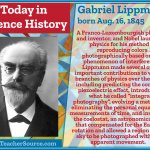
ALT Gabriel Lippmann was born on August 16, 1845. A Franco-Luxembourgish physicist and inventor, and Nobel laureate in physics for his method of reproducing colors photographically based on the phenomenon of interference. Lippmann made several other important contributions to various branches of physics over the years, including predicting the converse piezoelectric effect, introducing what he called "integral photography", evolving a method of eliminating the personal equation in measurements of time, and inventing the coelostat, an astronomical tool that compensated for the Earth's rotation and allowed a region of the sky to be photographed without apparent movement.

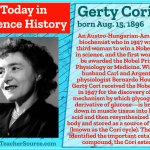
ALT Gerty Cori was born on August 15, 1896. An Austro-Hungarian-American biochemist who in 1947 was the third woman to win a Nobel Prize in science, and the first woman to be awarded the Nobel Prize in Physiology or Medicine. With her husband Carl and Argentine physiologist Bernardo Houssay, Gerty Cori received the Nobel Prize in 1947 for the discovery of the mechanism by which glycogen—a derivative of glucose—is broken down in muscle tissue into lactic acid and then resynthesized in the body and stored as a source of energy (known as the Cori cycle). They also identified the important catalyzing compound, the Cori ester.

ALT In 1969, he was awarded the Louisa Gross Horwitz Prize from Columbia University together with Max Delbrück, co-winner with Luria of the Nobel Prize in Physiology or Medicine in 1969. In the U.S. he won the 1974 National Book Award in Science for his popular science book Life: the Unfinished Experiment[12] and received the National Medal of Science in 1991.

ALT Vikram Sarabhai was born on August 12, 1919. An Indian physicist and astronomer who initiated space research and helped develop nuclear power in India. He was honored with Padma Bhushan in 1966 and the Padma Vibhushan (posthumously) in 1972. He is internationally regarded as the Father of the Indian Space Program. Known as the cradle of space sciences in India, the Physical Research Laboratory (PRL) was founded in 1947 by Sarabhai. PRL had a modest beginning at his residence, the "RETREAT", with research on cosmic rays and the properties of the upper atmosphere. Research areas were expanded to include theoretical physics and radio physics later with grants from the Atomic Energy Commission.

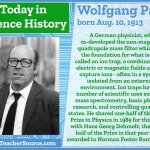
ALT Wolfgang Paul was born on August 10, 1913. A German physicist, who co-developed the non-magnetic quadrupole mass filter which laid the foundation for what is now called an ion trap, a combination of electric or magnetic fields used to capture ions - often in a system isolated from an external environment. Ion traps have a number of scientific uses such as mass spectrometry, basic physics research, and controlling quantum states. He shared one-half of the Nobel Prize in Physics in 1989 for this work with Hans Georg Dehmelt; the other half of the Prize in that year was awarded to Norman Foster Ramsey, Jr.

ALT Amedeo Avogadro was born on August 9, 1776. An Italian scientist, most noted for his contribution to molecular theory now known as Avogadro's law, which states that equal volumes of gases under the same conditions of temperature and pressure will contain equal numbers of molecules. In tribute to him, the number of elementary entities (atoms, molecules, ions or other particles) in one mole of a substance , 6.02214076×10^23, is known as the Avogadro constant, one of the seven SI base units and represented by NsubA.

ALT Roger Penrose was born on August 8, 1931. A British mathematician, mathematical physicist, philosopher of science and Nobel Laureate in Physics. Penrose has contributed to the mathematical physics of general relativity and cosmology. He has received several prizes and awards, including the 1988 Wolf Prize in Physics, which he shared with Stephen Hawking for the Penrose–Hawking singularity theorems, and one half of the 2020 Nobel Prize in Physics "for the discovery that black hole formation is a robust prediction of the general theory of relativity". He is regarded as one of the greatest living physicists, mathematicians, and scientists, and is particularly noted for the breadth and depth of his work in both natural and formal sciences.

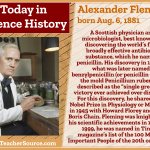
ALT Alexander Fleming was born on August 6, 1881. A Scottish physician and microbiologist, best known for discovering the world's first broadly effective antibiotic substance, which he named penicillin. His discovery in 1928 of what was later named benzylpenicillin (or penicillin G) from the mold Penicillium rubens is described as the "single greatest victory ever achieved over disease". For this discovery, he shared the Nobel Prize in Physiology or Medicine in 1945 with Howard Florey and Ernst Boris Chain. Fleming was knighted for his scientific achievements in 1944. In 1999, he was named in Time magazine's list of the 100 Most Important People of the 20th century.

ALT Neil Armstrong was born on August 5, 1930. An American astronaut and aeronautical engineer, he was the first person to walk on the Moon. He was also a naval aviator, test pilot, and university professor. On July 20, 1969, Armstrong and Apollo 11 Lunar Module (LM) pilot Buzz Aldrin became the first people to land on the Moon, and the next day they spent two and a half hours outside the Lunar Module Eagle spacecraft while Michael Collins remained in lunar orbit in the Apollo Command Module Columbia. When Armstrong first stepped onto the lunar surface, he famously said: "That's one small step for [a] man, one giant leap for mankind." It was broadcast live to an estimated 530 million viewers worldwide.

ALT John Venn was born on August 4, 1834. An English mathematician, logician and philosopher noted for introducing Venn diagrams, which are used in logic, set theory, probability, statistics, and computer science. In 1866, Venn published The Logic of Chance, a groundbreaking book which espoused the frequency theory of probability, arguing that probability should be determined by how often something is forecast to occur as opposed to "educated" assumptions. Venn then further developed George Boole's theories in the 1881 work Symbolic Logic, where he highlighted what would become known as Venn diagrams.

ALT Koichi Tanaka was born on August 3, 1959. A Japanese electrical engineer who shared the Nobel Prize in Chemistry in 2002 for developing a novel method for mass spectrometric analyses of biological macromolecules with John Bennett Fenn andand Kurt Wüthrich (the latter for work in NMR spectroscopy). In February 1985, Tanaka found that by using a mixture of ultra fine metal powder in glycerol as a matrix, an analyte can be ionized without losing its structure, solving a problem in existing mass spectrometry at the time.

ALT John Tyndall was born on August 2, 1820. A prominent 19th-century Irish physicist, his initial scientific fame arose in the 1850s from his study of diamagnetism. Later he made discoveries in the realms of infrared radiation and the physical properties of air, proving the connection between atmospheric CO2 and what is now known as the greenhouse effect in 1859. Tyndall also published more than a dozen science books which brought state-of-the-art 19th century experimental physics to a wide audience.

ALT Stephanie Kwolek was born on July 31, 1923. A Polish-American chemist who is known for inventing Kevlar. Her career at the DuPont company spanned more than 40 years. She discovered the first of a family of synthetic fibers of exceptional strength and stiffness: poly-paraphenylene terephthalamide. For her discovery, Kwolek was awarded the DuPont company's Lavoisier Medal for outstanding technical achievement. As of August 2019, she was the only female employee to have received that honor. In 1995 she became the fourth woman to be added to the National Inventors Hall of Fame.

ALT On July 30, 1971 the first Lunar Roving Vehicle (LRV) was delivered to the surface of the Moon by the crew of Apollo 15. They explored the lunar surface until August 2nd before flying back home, leaving the LRV on the Moon.

ALT Isidor Isaac Rabi was born on July 29, 1898. An American physicist, he won the Nobel Prize in Physics in 1944 for his discovery of nuclear magnetic resonance, which is used in magnetic resonance imaging (MRI). He was also one of the first scientists in the United States to work on the cavity magnetron, which is used in microwave radar and microwave ovens. In 1942, Oppenheimer attempted to recruit Rabi to work at the Los Alamos Laboratory on a new secret project. He declined, but did work as a consultant on the Manhattan Project.

ALT Charles H. Townes was born on July 28, 1915. An American physicist, Townes worked on the theory and application of the maser, for which he obtained the fundamental patent, and other work in quantum electronics associated with both maser and laser devices. He shared the 1964 Nobel Prize in Physics with Nikolay Basov and Alexander Prokhorov. Townes was an adviser to the United States Government, meeting every US president from Harry S. Truman (1945) to Bill Clinton (1999).

ALT Loránd Eötvös was born on July 27, 1848. A Hungarian physicist, he is remembered today largely for his work on gravitation and surface tension, and the invention of the torsion pendulum. Eötvös is remember today for his experimental work on gravity, in particular his study of the equivalence of gravitational and inertial mass (the so-called weak equivalence principal) and his study of the gravitational gradient on the Earth's surface. The weak equivalence principal plays a prominent role in relativity theory and the Eötvös experiment was cited by Albert Einstein in his paper The Foundation of the General Theory of Relativity.

ALT Rosalind Franklin was born on July 25, 1920. An English chemist and X-ray crystallographer whose work was central to the understanding of the molecular structures of DNA (deoxyribonucleic acid), RNA (ribonucleic acid), viruses, coal, and graphite. Although her works on coal and viruses were appreciated in her lifetime, her contributions to the discovery of the structure of DNA were largely unrecognized during her life, for which she has been variously referred to as the "wronged heroine", the "dark lady of DNA', the "forgotten heroine", a "feminist icon", and the "Sylvia Plath of molecular biology".

ALT Amelia Earhart was born on July 24, 1897. An American aviation pioneer and writer, Earhart was the first female aviator to fly solo across the Atlantic Ocean. She set many other records, was one of the first aviators to promote commercial air travel, wrote best-selling books about her flying experiences, and was instrumental in the formation of The Ninety-Nines, an organization for female pilots. During an attempt at becoming the first woman to complete a circumnavigational flight of the globe in 1937 in a Purdue-funded Lockheed Model 10-E Electra, Earhart and navigator Fred Noonan disappeared over the central Pacific Ocean near Howland Island and were never seen again.