

Head of Educator Development @GoWriggle | Lifelong Learner | Current Interests: AI & Digital Ed – Transformation, Leadership, Entrepreneurship | Let's chat! 💬
Ireland
Joined February 2017
- Tweets2.2K
- Following1.1K
- Followers881
- Likes3.5K




Jamie Johnston retweeted

Ways to deal with organic oil stains on washable clothing:
— Pretreat the stain with dishwashing liquid, such as Dawn. Dishwashing liquid contains surfactants that emulsify oil into tiny droplets and lift them from the fibers, allowing them to be washed away in the laundry.
When applying, add a little bit of dish soap — don't go haywire — and then tamp with a brush. Tamping means you tap the cloth a little. This helps get the liquid into the fibers. Alternatively, you can rub the liquid in with your fingers. Don't scrub the surface too aggressively with something like a stiff-wired brush because you can ruin the surface of the fabric.
— You can also pretreat the stain with an enzymatic stain remover. Enzymes break stains apart, so they become smaller, more water‑soluble molecules that can be washed away. However, each type of enzyme is only effective for a specific type of stain. So when you apply a stain remover, you're relying on a mixture of enzymes and hoping something in there will be useful for your situation.
For oil stains, look for enzymatic stain removers that contain lipase, which works well on natural fats and oils, such as those from food. Note that it does not work well with petroleum-based oils, such as what you'd get from working on your car.
Zout's "Laundry Stain Remover" and Dad Mode's "Deep Stain Remover" both have lipase.
— After pre-treating the stain, let it sit for an hour or so, then wash with liquid laundry detergent. You can repeat this process a few times.
— If this doesn't work, soak the garment for a few hours in Oxiclean. This is an oxygen-based bleach that contains sodium percarbonate, which oxidizes organic stain molecules and breaks them apart.
Unlike chlorine bleach, oxygen-based bleaches are safe on colors. It's basically like applying hydrogen peroxide. However, it's not safe on all fibers — fine on cotton, not good on silk. Check the labels before using.
— If the garment is very important to you, it's always best to send the work to a professional. IMO, the two best dry-cleaners in the United States are Rave FabriCARE (in Arizona) and Jeeves NY (in New York). Both companies will take mail-ins. IMO, you should not do anything to the garment before sending it in, as there's a chance you could make the situation worse.
Zachary at Jeeves also runs a great laundry account on Instagram, which you can find at the handle jeeves_ny.
Note that different types of stains require different solutions. The above is only for organic oil-based stains on clothes you can throw into a wet wash. Blood, sweat, and other types of stains will have to be treated differently.


Jamie Johnston retweeted

I’ll share a small part of pickle.com
Back in med school, I became obsessed with augmenting memory and dreamed of a Notion or Obsidian that completes itself. Today, we’ve built something close.
My self-awareness is sharper and everything feels connected. I genuinely believe AI does not replace humans. It amplifies us.
Huge respect to our engineers and designers who made this crazy thing real.
Bubbles are the episodic units of my life that the system interprets from my raw data. Clouds are the system’s questions, its hypotheses about who I am.
When I answer a cloud, it becomes a bubble again.
There is so much personal data that I cannot fully demo it. Wish I could. This system understands me more deeply than anyone.
Want to try it? Retweet and comment “memory.”
I’ll DM you an access code to skip the waitlist.


Why should we shift to one-to-one devices?”
That was the question from one principal during the Q&A.
The answer?
It’s not about replacing textbooks or chasing grades.
It’s about engagement, equity, and preparing students for a digital world that won’t wait.
Highlights from school leaders in the room:
•“Devices don’t replace teaching—they unlock richer learning experiences.”
•“We’ve moved from passive note-taking to active, student-led learning.”
•“Students expect digital fluency—so do employers.”
•“Not every student has access at home. Schools must level the playing field.”
One principal summed it up best:
“If my daughter didn’t have a device, she’d be starting life one step behind.”

“Engage your community.”
“Don’t be afraid.”
“Speed trumps perfection.”
That was the parting advice from school leaders reflecting on their one-to-one device journeys.
Yes, they faced challenges—Wi-Fi upgrades, staff nerves, parent concerns. But they all agreed: managed digital learning is no longer optional.
Top takeaways:
•Get infrastructure right – solid Wi-Fi is essential.
•Start with your staff – build confidence from within.
•Communicate with parents – transparency builds trust.
•Manage the devices – without controls, it won’t work.
Paula Mulhall summed it up best:
“The longer you wait, the more you’ll need to catch upa

School leaders sharing real-world insights on implementing student device models—lessons from those who’ve lived it.

Sean Glynn kicking off our “Leading Senior Cycle Reform with a Student Device Model” in The Heritage.

Jamie Johnston retweeted

For higher education, “AI’s takeover [is] a full-blown existential crisis.”
“College is just how well I can use ChatGPT at this point.”
“I think we are years — or months, probably — away from a world where nobody thinks using AI for homework is considered cheating.”
“It isn’t as if cheating is new. But now, as one student put it, ‘the ceiling has been blown off.’ Who could resist a tool that makes every assignment easier with seemingly no consequences?”
“Massive numbers of students are going to emerge from university with degrees, and into the workforce, who are essentially illiterate.”
“The humanities, and writing in particular, are quickly becoming an anachronistic art elective like basket-weaving.”
“Many teachers now seem to be in a state of despair.”
“Every time I talk to a colleague about this, the same thing comes up: retirement. When can I retire? When can I get out of this? That’s what we’re all thinking now.”

Image generation in ChatGPT just got a whole lot better.
Do kids need to be taught to trust nothing they see on the web?

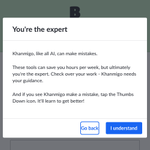
Really like this reminder from Khan Academy when you go to use their Khanmigo tools.
Could pretty much some of all technology in education.

I've been staring at this graph, and I don’t know what to make of It.
I get the top right quadrant. These are the skills that will become increasingly important:
- resilience,
- leadership,
- social influence,
- adaptability, -
- analytical thinking, and
- being able to work with AI/techology.
These makes perfect sense in a world where AI is ubiquitous—where being human is the advantage or being able to use AI is your workflows gives you an advantage.
But then I look at the bottom left quadrant—the "out of focus" skills—and I get stuck.
Reading, writing, and mathematics? Less essential? Really?
How are you supposed to communicate with people—or with technology—without strong reading and writing skills?
How do you lead if you can’t articulate ideas clearly?
How do you show analytical thinking without foundational numeracy?
And what about lifelong learning?
Curiosity is great, but what do you do with it if you can’t read, write, or engage with new information beyond listening?
Then there’s teaching and mentoring. The idea that these skills are less essential baffles me. Yes, AI will provide every student with a personal tutor, and that will be transformative. But does that make teaching less important? If anything, I’d argue it makes great teaching even more valuable. AI can deliver content, but human teachers ignite curiosity, build relationships, and help students develop the very skills that sit in the top right quadrant.


The World Economic Forum's Future of Jobs Report 2025 is loud and clear:
The way we prepare students for work is outdated. The world is changing at hyperspeed, and if education doesn’t keep up, we’re sending students into a job market designed for a version of the world that no longer exists.
STEM Skills
• AI literacy or bust—students need to understand how AI works, not just use ChatGPT for homework.
• Cybersecurity basics—because getting hacked is the modern equivalent of getting mugged, but much more common.
• Practical coding & data analysis—coding is the new literacy, and data is the new oil.
• Ethical tech development—because just because we can doesn’t mean we should.
Thinking Is a Superpower
Employers don’t just want workers; they want thinkers. That means:
• Problem-solving frameworks—because work isn’t a multiple-choice test or regurgitating information.
• Critical reasoning across disciplines—connecting the dots across fields is the future.
• Data interpretation—we’re drowning in data, but insight is scarce.
• Systems thinking—because nothing exists in a vacuum.
Resilience & Creative Problem-Solving
The world doesn’t care about your test scores, but it does care if you can handle complexity and bounce back from failure. That requires:
• Emotional intelligence—EQ > IQ.
• Adaptive thinking—things will change, so should your approach.
• Design thinking—structured creativity is a cheat code for innovation.
• A growth mindset—fixed mindsets are for algorithms, not humans.
The Cold, Hard Facts:
• 70% of employers prioritise analytical thinking over technical skills.
• 86% believe AI will reshape their business.
Education isn’t about stuffing kids’ heads with facts anymore. It’s about building the skills to navigate uncertainty, think critically, and create value in a world that’s evolving faster than the syllabus can keep up with.

The WEF’s "Future of Jobs Report 2025" makes one thing clear: The world of work is shifting faster than most people realise.
Key Disruptions: • AI is devouring everything—The fastest-growing skills? AI & big data.
• Thinking beats knowing—Analytical thinking is now the #1 skill for 7/10 companies.
• The workforce is a moving target—Most workers will need to reskill before 2030.
• 78M net new jobs by 2030—But nearly half of today's skills won’t be relevant.
📈 What’s rising? AI engineers, fintech specialists, green energy jobs.
📉 What’s fading? Cashiers, admin assistants, data entry clerks.
The pattern? Routine work is being automated. Human work is becoming more analytical.
🚀 I use NotebookLM to turn reports I’d never finish into podcasts I actually listen to. AI isn’t just replacing jobs—it’s changing how we learn.
If you had to bet on one skill to future-proof your career, what would it be?
Imperatives for Education Systems
• Prioritise STEM skills (AI, big data, cybersecurity)
• Develop analytical thinking
• Integrate resilience and creative problem-solving
For Education:
• STEM isn’t optional. AI, big data, and cybersecurity should be as fundamental as reading.
• Thinking > Memorising. The future belongs to those who can break down problems, not just recall facts.
• Resilience beats intelligence. The best skill isn’t knowing the answer—it’s knowing how to adapt when everything changes.
Worth a read, but if you don't have time, here's a Notebook LM AI generated podcast about the report here:
notebooklm.google.com/notebo…
