

Think for the Future is a social enterprise organisation that partners with schools nationally to deliver structured interventions.
UK
Joined August 2013
- Tweets2.2K
- Following1.9K
- Followers1.4K
- Likes3.3K



Consistency sounds simple - same routines, same expectations, same responses.
In practice, it’s exhausting!
That’s why we don’t leave it to chance in our TFTF Inclusion Centres. Our centres run to a shared blueprint, with trained staff, clear behaviour processes and daily oversight — so expectations don’t change depending on who’s deployed where or how stretched the week feels.
We talk about consistency because we see what happens when it slips. Progress rarely collapses overnight, it erodes quietly.

There is no greater feedback than hearing directly from the families of the young people we support in our Inclusion Centres.
When a young person begins to enjoy learning again, builds positive relationships and feels happy coming to school each day, we know our Inclusion Centres are making a difference.
We're incredibly proud of the dedication, care and commitment shown by our teams every day to create safe, nurturing environments where young people can thrive.
💜 "As a parent, it is incredibly reassuring to know that my son is somewhere he feels comfortable, happy and eager to attend each day."
Thank you to the parent from Heritage High School who shared these kind words with us.
#Inclusion #Inclusion Base #AlternativeProvision #Education #ThinkForTheFuture

If you want to understand inclusion, start with an ordinary day.
Students arriving dysregulated. Staff adapting plans before first period. Phones handed in. Lessons reset. Parents contacted before lunch. Decisions made quietly that never make it onto a dashboard.
This is what our teams deal with every day.
That reality is why our Inclusion Centre Management model is fully staffed, fully managed and designed to hold under pressure — not reliant on spare capacity or goodwill.
Our views on inclusion come from delivering it, every day, when things are messy.

At Think for the Future, we know that successful inclusion starts with understanding the individual needs of each young person.
Our Inclusion Centres provide a nurturing environment where students receive personalised support, targeted interventions and opportunities to develop the confidence, resilience and skills they need to thrive both academically and personally.
For parents and carers, seeing their child re-engage with education and regain confidence is often the most powerful measure of success.
We're proud to work alongside schools to create environments where young people feel understood, supported and able to achieve their potential.

We’re having more conversations than ever with schools about behaviour pressure, exclusion risk and AP capacity.
We don’t think schools need more judgement in this space. They need credible, structured options that hold up under pressure.
That’s why our Inclusion Centre Management model is fully managed, blueprint-led and impact tracked — with the core outcomes agreed upfront and reviewed through the year (reducing permanent exclusions and off‑site AP, reducing suspensions, increasing attendance, improving behaviour and academic outcomes, and building positive parent/carer partnerships).
Inclusion needs infrastructure and clear strategies.

In TFTF Inclusion Centres, every pupil takes part in a dedicated mentoring session each day.
These daily group sessions are built around our social and emotional learning curriculum, creating time and space for our young people to explore their thoughts, emotions and experiences in a way that supports both personal growth and success back in the classroom.
For many pupils, having a trusted adult to talk to every day can make all the difference. It's feedback like this that reminds us why our mentoring approach is at the core of our model.

‘Integrated’ isn’t a buzzword, it’s the core of our blueprint.
Our centres operate like a school within a school, integrated into the partner school’s structures.
If a centre becomes ‘somewhere else’, pupils feel it and the bridge back to mainstream weakens.
Strong integration is one of the main things that makes internal provision work long term.
🟣If you're currently exploring the structure of your internal inclusion base, we'd love to speak with you🟣

Across all of our Inclusion Centres this last academic year, we have seen clear positive impact in the areas that matter most: attendance, behaviour, achievemnt and suspensions, alongside strong reintegration and longer-term outcomes.
This impact is not only felt by the pupils accessing the centre provision directly. These positive changes also strengthen thr wider school community by reducing diruption, easing pressure on staff, supporitng calmer learning environments and helping schools keep more pupils engaged, included and learning successfully.
Good provision has a ripple effect, when the right provision is in place, it benefits individual pupils, classrooms and the schools as a whole.
We are proud of the impact our provision has delivered across all our centres this academic year.

Data is only useful if it drives decisions.
We've built impact monitoring and reporting into our TFTF centre blueprint using Purple, our Data Analysis Platform. We track behaviour and attendance, analyse trends, and produce reports that are usable in school conversations, not just stored in spreadsheets.
We also use reporting to keep everyone aligned on what success looks like (and what needs attention) as the year progresses.
Good provision should be visible, not just felt.
purple.education/

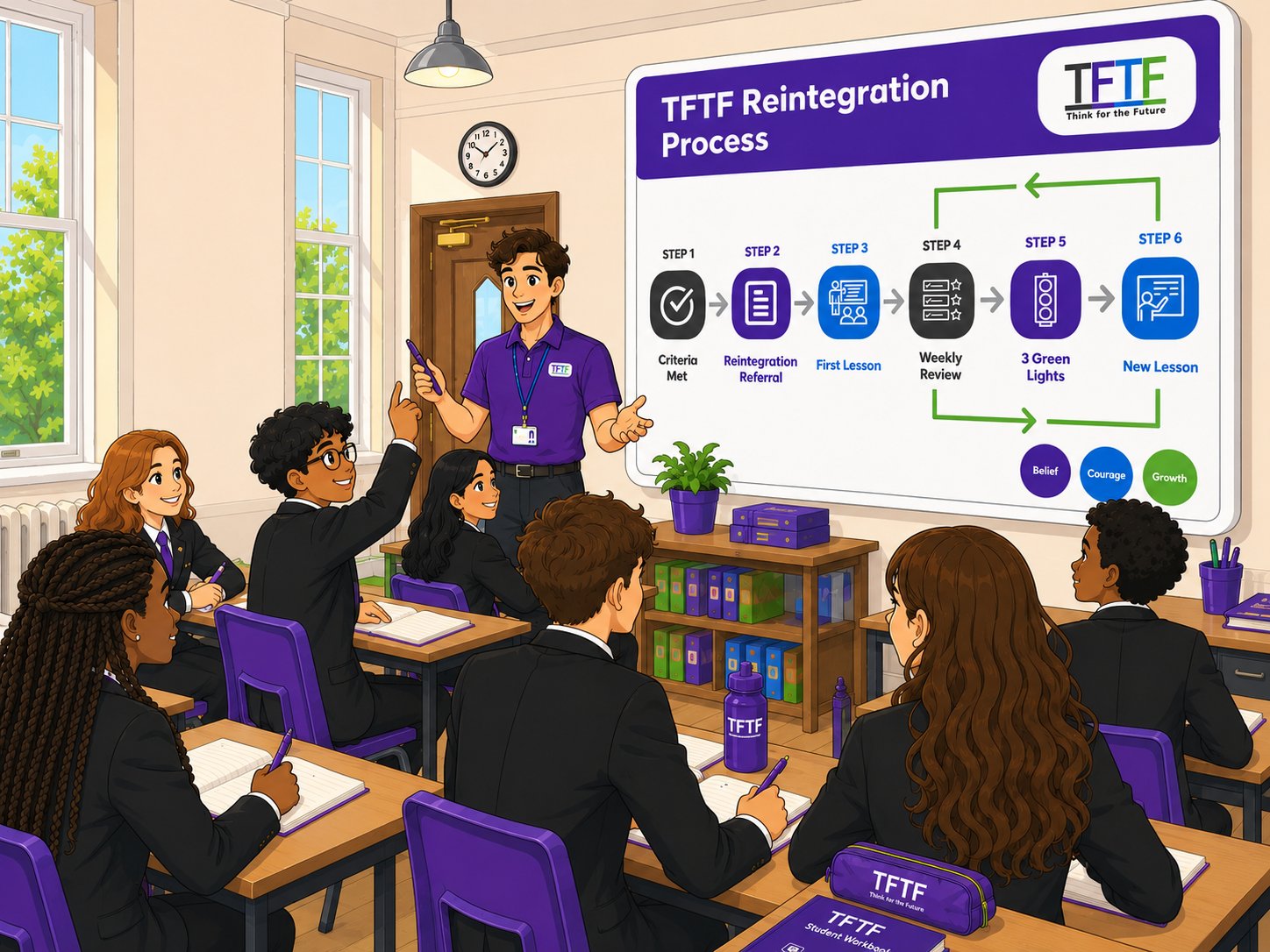
Reintegration isn’t a reward and it isn’t a deadline, it’s a process that needs structure.
We pre‑agree placement pathways, including reintegration placements, and we run a defined induction and reintegration process so pupils have the best possible chance of suceeding back in the mainstream setting.
The aim is always the same: keep pupils connected to school and move them forward — with the right support, at the right time.
thinkforthefuture.co.uk/incl…
One of the biggest levers in inclusion work is the parent and carer partnership.
In our blueprint, parent/carer communication isn’t a bolt‑on. It’s part of the operating rhythm — and it’s built into the centre processes, not left to chance.
When families know what the centre is for, what the expectations are, and what the pathway forward looks like, placements stabilise faster.
Reliability builds trust, trust brings collaboration.

As the academic year comes to a close, we want to say a huge thank you to all the schools we’ve had the privilege of working with this year 🙏
Inclusion work is demanding, complex and often carried out under real pressure, but we’ve seen the impact it can have when it’s done well.
We’ve seen schools hold the line on expectations and keep young people on roll, learning and connected to their communities when sometimes it would be easier not to.
We’re incredibly proud to work alongside schools who are committed to getting this right, and grateful for the trust you’ve placed in us this year.
Here’s to building on that progress together next year 🎉

We understand why schools are focused on keeping pupils on site right now. Off‑site AP is costly, variable and makes reintegrating students back into mainstream harder.
But ‘on site’ isn’t the finish line.
🎯The goal is: on site + learning + continuity + strong school integration.
That’s why our centres follow a structured academic timetable that mirrors the school day, with teachers from the partner school which maintains continuity of learning.
Keeping pupils in school only works if they’re still connected to school.
thinkforthefuture.co.uk/incl…

Most internal provision doesn't collapse in one dramatic moment, they drift.
Thresholds lower, admissions rise, reintegration slows - the centre becomes the pressure valve.
We build structure into our blueprint: daily centre reports, weekly meetings, KPI management and termly leadership reporting, alongside regular quality assurance visits.
It’s not about creating paperwork. It’s about making sure the centre keeps doing the job it was created to do — especially on the hardest weeks.
thinkforthefuture.co.uk/incl…

‘Internal provision’ can mean ten different things. That’s not always a problem, until nobody agrees what it is.
That’s when provision drifts and becomes whatever the school needs that week.
We protect against drift by being clear on placement criteria and referral pathways, and by pre‑agreeing placement routes (including reintegration placements) alongside KPIs.
Clarity and accountability keeps internal provision sustainable under pressure.

This is what effective inclusion looks like and what we aim to do in our centres.
Not just keeping pupils in school but helping their re-engage with learning, find success in the classroom and rebuild their relationship with education.

Good internal provision is as strong as the people running it.
TFTF doesn't just ‘support’ a school to run a centre — we place a fully managed TFTF team in school. Our centres operate on a 1:5 ratio and are staffed with a manager, deputy and mentors, with oversight from an Operations Manager who support 3-4 centres.
That structure is what allows consistency: training, line management, and quality assurance throughout the year — not ad‑hoc support when something goes wrong.

Thinking about your inclusion centre provision for next year?
We’re running a webinar on 2nd July where we:
➡️break down how our Inclusion Centre model works
➡️share what we’re seeing across schools
➡️show how centres improve behaviour and engagement in practice
Designed for headteachers and trust leaders reviewing:
behaviour | exclusion | AP reliance | internal provision
👉 bit.ly/3SiHXJ7

In our centres, behaviour is built on high support and high expectations, with a tried-and-tested process that gives pupils repeated opportunities to make the right choices and get back to learning.
We also lean hard into goal setting and recognition, because pupils need to experience success, not just correction.
thinkforthefuture.co.uk/incl…

🎉 Huge congratulations to The Dukeries Academy on their recent Ofsted inspection 🎉
We were delighted to see Ofsted’s recognition of their TFTF Inclusion Centre in the academy’s latest inspection, particularly the role it is playing in strengthening behaviour and supporting pupils to engage positively with learning.
Ofsted noted that revised behaviour systems, alongside the inclusion centre, have reduced incidents of disruption and improved conduct across the school, contributing to a calmer, more orderly environment where most pupils settle quickly and show positive attitudes in lessons. This is a powerful reflection of the academy’s commitment to inclusion, consistency and high expectations for all young people.
Principal, Mike Brett, says 'We are delighted with the impact of our successful partnership with Think for the Future. Our new Inclusion Centre helps us remove barriers to education and ensure that all pupils are included and learning effectively. Pupils across the school have commented on the positive impact of the centre and we look forward to growing the provision further next year.'
We’re proud that the TFTF Inclusion Centre at The Dukeries Academy is part of this wider picture of improvement—providing targeted, relational support that helps students stay connected to education, rebuild confidence and succeed back in mainstream learning wherever possible.
Well done to the leadership team, staff and students at The Dukeries Academy on a really positive inspection outcome, and thank you for your continued commitment to inclusive practice that makes a tangible difference every day.
👏
