
Dr. sudoris causa https://xitter.cf/t.co/VpFpL9pGg1
Buenos Aires
Joined July 2011
- Tweets247
- Following498
- Followers249
- Likes4.2K





Pinned Tweet
Tokenizing assets on blockchains is great. Then we want to exchange those tokens on-chain, naturally. I believe that our current DEXs on Ethereum are suboptimal. My proposal is "Walraswap: equilibrium-based decentralized exchange integrating external AMM liquidity".
Read a friendly introduction on ethresear.ch/t/walraswap-equ…
Link to the full paper: arxiv.org/abs/2310.12255
Thanks to @jesus_chitty, @GeoffRamseyer, Christoph Schlegel, @Balancer, and Flashbots!

Sergio Yuhjtman retweeted

Hiding your coins in a bunker won't save your blockchain. Given the risks AI poses to fundamental cryptography, I propose every chain implement a "cryptographic recovery mode":

That weird feeling I got every time I heard "crypto is secured by math"

Today I call upon the blockchain industry to calmly begin planning for "bunker mode". My personal recommendation is to set in motion a controlled mass migration of assets to fresh addresses, i.e. addresses whose pubkeys remain hidden behind a hash.
Holders, starting with large and sophisticated ones, should consider moving the bulk of their funds to addresses that have never signed a transaction. And when they do sign one, they should also move remaining funds to a new address (possibly generated from the same seed phrase).
Don't rush. While I believe there is cause for action a rushed migration would do more harm than good. Don't panic either. Moving assets to protected addresses is a simple, preventative step which does not require new cryptography or new wallets.
IMO it is now reasonable to brace for the possibility that ECDSA breaks before qday, in the worst case in months not years. By "break" I mean fast private key recovery (e.g. in one week) on available hardware (e.g. a large GPU cluster).
Recent days have been humbling for human mathematical intuition. Long-held, unquestioned hypotheses have fallen. This includes the n log(n) bound for integer multiplication and the 3SUM conjecture. In hindsight, May's unexpected disproof of the Erdős unit distance conjecture was our warning shot.
Yesterday's OpenAI drop made it clear that mathematical superintelligence is upon us. They say there are weeks where decades happen. We are about to live through weeks where centuries of mathematical progress happen. Could our magic 64-byte ECDSA signatures be too good to be true? Was it just security through obscurity all this time?
Elliptic curves feel especially vulnerable to superintelligence. Curves carry rich structure, with room for fancy tricks like Schoof, Frobenius, pairings. (By contrast, hashes are designed to minimise algebraic structure.)
Separately, as Ewin Tang can attest, an efficient quantum algorithm sometimes foreshadows an efficient classical one. We should be open to the possibility of a classical counterpart to Shor that breaks elliptic curves and RSA at once.
Also noteworthy is the striking under-representation of cryptographic breakthroughs among the 722 mathematical results OpenAI published. I've witnessed first-hand the US government censoring academic quantum cryptanalysis results. Backroom interventionism is my base case.
I urge large, sophisticated actors to lead by example. Project11's "risq list" (bitcoin-risq-list.projecteleven[.]com) is a great tracker of exposed BTC pubkeys. Binance, Bitbank, Robinhood, Bitfinex, and Tether have an opportunity to harden their cold storage. Next month I'll address institutions in London in a live Q&A (forum.ethereuminstitutional[.]org/london-2026).
Again, please do not rush. Wallets holding under 50 BTC enjoy partial cover from "Satoshi's shield", i.e. his 20K exposed addresses that hold 50 BTC each. Load-bearing signers like oracles and L2 security councils should consider rotating ECDSA pubkeys with every signed message and/or multi-signing with a hash-based schemes like SPHINCS.
Exiting bunker mode safely will require post-AI cryptography. My inclination is to go all-in on hash-based cryptography and avoid structured mathematical assumptions entirely, whether from curves, lattices, or isogenies. A single battle-tested hash (e.g. from the SHA or BLAKE families) yields plausible post-AI security.
The Ethereum roadmap on strawmap[.]org fully embraces hash-based cryptography with end-to-end formal verification as a response to the quantum threat. Those timelines must now be revisited and accelerated in light of mathematical superintelligence. I'll be pushing for maximum defensive acceleration.
1
168


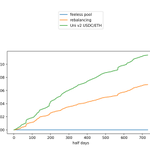
*RIP Profit-vs-Rebalancing*
🧵3
What I find remarkable here:
• The near-term evolution of these quantities is easy to estimate.
• LP position ≈ Rebalancing, since protocol fees were activated.
...
1
104
🧵4
• The substantial surplus is now under centralized control.
We need a truly decentralized exchange on Ethereum.
@Balancer @CoWSwap @SorellaLabs @1inch @ethereumfndn @class_lambda
For more insights, see the article: sergioyuhjtman.github.io/blo…
1
105
Sergio Yuhjtman retweeted

The most interesting thing I saw this week was Yoink fixing the gas on a failed backrun tx for Alkemi ($20k) and then building its own block with *just* the attack *only* paying a 10% bribe to the validator.
This is surprising because a gas-fix is something trivial so 10% is a low bribe given the competition.
I think Yoink either has very sharp calculations around bribes (likely) or preferential treatment from the MEV Relay.
I know that, at least, c0feebabe would do the gas-fix and pay a high enough bribe. The only question is if the block builders wouldn't pass these bribes to the validator and that being the reason Yoink won with his own block building.

At @Balancer, we solved a problem in DeFi: how to safely use Stable LP tokens as collateral in lending protocols.
Balancer stable pools hold ~$300M. Using them as collateral requires tracking their price carefully to prevent manipulation.
🧵
Our smart contract team implemented this solution smoothly.
Bonus: we introduce an alternative method that may also be considered by lending protocols for a wide variety of use cases. It consists of using certain upper and lower prices that can be computed very efficiently.
1
1
218
This opens up new possibilities for DeFi composability. Stable LP tokens can now be safely used as collateral, unlocking capital efficiency across protocols.
Want the technical details? Read the full article 👇
medium.com/@sergio_balancer/…
Interested in this topic? Reach out to me!

1
209
Sergio Yuhjtman retweeted

Since COW reCLAMM launched on Base, Balancer has been dominating its volume. It's impressive to see readjusting concentrated liquidity in action!


1/ @Balancer recently launched ReCLAMM: "Readjusting Concentrated Liquidity AMM."
This approach to concentrated liquidity is *price agnostic* in a way comparable to a traditional constant product AMM (CP-AMM).
4/ At Balancer, we're studying these concepts quantitatively through simulations. Early results suggest that ReCLAMMs are particularly well suited for foreign exchange pairs such as EUR/USD.
1
4
231