
Crossing boundaries: propagation of in-stream environmental alterations to adjacent terrestrial ecosystems funded by @dfg_public #freshwaters #rivers #foodwebs
RPTU Kaiserslautern-Landau
Joined June 2020
- Tweets102
- Following992
- Followers448
- Likes103




SystemLink - Research Training Group retweeted

Freshwater fish and invertebrates are underrepresented in thermal tolerance data.
We built ThermoFresh: >6800 records, >900 species in 5 languages. A key resource for studying thermal risks in freshwaters.
nature.com/articles/s41597-0…
@SystemlinkG
@freshwaterblog
@ScientificData

New paper by Martin Scheringer and Ralf Schulz: "The State of the World's Chemical Pollution".
link: doi.org/10.1146/annurev-envi…
The review covers pesticides and PFAS, and calls for a chemicals transition to reduce pollution impacts.

New article from our doctoral researcher @ Agnes Schöndorfer on the Long-term consequences of Bti applications on aquatic insect emergence published in the Journal: Ecotoxicology and Environmental Safety.
Here is the link to the publication: authors.elsevier.com/sd/arti…
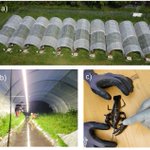
How do artificial light at night and invasive signal crayfish impact spiders in riparian habitats? Find out in our new publication in Global Ecology and Conservation! doi.org/10.1016/j.gecco.2025…
@alessandro_manf @SystemlinkG @ElsevierConnect
📷 a) C. Brühl, b) c) A. Manfrin

Do not lose this chance, apply for a PhD position in SystemLink. Deadline 14.03.25. – at Augsburg, Germany

❗️❗️❗️ WE ARE HIRING
@freshwaterblog @freshwaterbio @ESA_org @dfg_public @alessandro_manf @LeibnizIGB @EawagResearch @unidue @rptu_kl_ld @KlementTockner @EU_ENV @EU_ScienceHub

❗️❗️❗️ WE ARE HIRING
@freshwaterblog @freshwaterbio @ESA_org @dfg_public @alessandro_manf @LeibnizIGB @EawagResearch @unidue @rptu_kl_ld @KlementTockner @EU_ENV @EU_ScienceHub – at Fiumicino, Lazio
New @SystemlinkG article by @alessandro_manf on the influence of Artificial Light at Night (ALAN) on aquatic Diptera subsidies. – at Fiumicino, Lazio

❗️New article: Artificial Light at Night (ALAN) reduces the abundance of emerging aquatic Diptera and can attract adults from distances up to 1800 m, with attraction being taxa- and sex-dependent.
@SystemlinkG
@SpringerNature
doi.org/10.1007/s00027-025-0…

We are hiring 14 Doctoral researchers positions from different fields of Natural Sciences to assess the effect of aquatic anthropogenic stressors on riparian communities. Check the link for more details.
jobs.rptu.de/jobposting/ef50… – at Oberding, Deutschland
SystemLink team at #BES2024 !! Great experience! Thank you @BritishEcolSoc @FranziskaFiolka @dfg_public @rptu_kl_ld – at Liverpool, England

SystemLink RTG present at the BES 2024 #Bes2024 in Liverpool. – at Liverpool, England

Congratulations to our doctoral researcher @FranziskaFiolka on the publication of her first first-author manuscript on the effect of floodings on the transfer of pesticides from streams to riparian ecotones.
@alessandro_manf @AlexisRoodt @dfg_public @rptu_kl_ld

1st PhD Paper out!🌊🌱
Flooding as a Vector for the Transport of Pesticides from Streams to Riparian Plants: Aquatic-terrestrial pollutant transfer in small streams in the Upper Rhine Valley.
doi.org/10.1021/acsestwater.…

This week, the Scientific Writing Workshop is taking place at the @rptu_kl_ld with @alessandro_manf guiding five doctoral candidates through the process of writing their first complete manuscript draft in a highly interactive way, inspired by @tom64fisch's approach.


SystemLink - Research Training Group retweeted
🚨Last days to download the FULL ARTICLE here:
authors.elsevier.com/a/1jISB…
"Modelling of the effects of biocides on chironomid populations over multiple generations across multiple European latitudes!"
@SystemlinkG @gregorlmm @stephenosakpolo @dfg_public @rptu_kl_ld @JurgSpaak

Another publication from our former doctoral researcher Dr. Verena Gerstle (@GerstleVerena), and other @SystemlinkG researchers, on the trophic effects of Bti on newts and dragonflies in pond ecosystems.
Open access document on this link: link.springer.com/article/10…

New paper out!!
Trophic effects of Bti-based mosquito control on two top predators in floodplain pond mesocosms by
@GerstleVerena and co-authors.
@SystemlinkG @dfg_public
link.springer.com/article/10…

Our researcher, @alessandro_manf, was honored to serve as the scientific moderator for this inspiring event on WATER and global changes, organized by @TheaterAugsburg
staatstheater-augsburg.de/zu…
We should have many more events like these where science intersects with public and art
What an inspiring concert from the @TheaterAugsburg on WATER and Climate Changes! It was a privilege to be part of this unique event, where the public and music met science. Thanks for your presence, Jürgen K. Enninger @bayernkreativ.
staatstheater-augsburg.de/zu…
@dfg_public


🔬 Update: @SystemlinkG researcher @alessandro_manf with G.A. López Moreira M. and co-authors have conducted theoretical modelling on how stressors impact chironomids across multiple generations.
Here the 50 days full access link: authors.elsevier.com/a/1jISB…
#ScienceNews #Ecology
🚨 NEWS: "Theoretical modelling of the effects of stressors on chironomid populations over multiple generations!"
@stephenosakpolo @rptu_kl_ld @SystemlinkG @dfg_public @LeibnizIGB @MUSE_Trento
Here is the link to the manuscript (50 days free access)
authors.elsevier.com/a/1jISB…

ALT • Model predicts Chironomidae response across generations, stages, and latitudes. • Emergence reduction stronger with prevalence of early-instar larvae. • Emergence reduction twice as severe in the 2nd year of Bti application. • Model adaptable to other insects, chemicals, latitudes via adjusted parameterisation.
A new @SystemlinkG study by Stephen E. Osakpolor and colleagues. Mathematical modeling of top-down and bottom-up effects of subsidies on ecosystem coupling.
@alessandro_manf
@rptu_kl_ld
@dfg_public
☝️Finally out: Theoretical modeling of top-down and bottom-up effects of subsidies in coupled metaecosystems. Check it out!
@SystemlinkG
@rptu_kl_ld
@dfg_public
link.springer.com/article/10…

The research, conducted through laboratory microcosm experiments, found that while chironomid larvae bioturbation did not significantly affect CH₄ emissions, biocide treatment resulted in higher emissions, suggesting a complex interaction between biotic factors and chemicals
Can the number of Chironomidae or the application of a biocide affect methane and carbon dioxide dynamics in freshwater sediments? A @SystemlinkG study by @CarolineGanglo @alessandro_manf @c_mendozalera and A. Lorke (@rptu_kl_ld)
Open access on @PLOS here
journals.plos.org/plosone/ar…
