

Infrastructure for Autonomous Science
San Francisco, California
Joined February 2026
- Tweets17
- Following21
- Followers2.1K
- Likes75
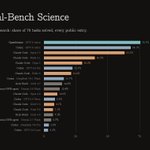
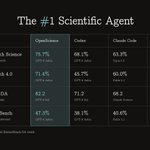


Quick update: we're improving OpenScience's harness on engineering tasks, where it's been weaker than on the physical sciences. We also found a few issues in our eval setup, and our benchmark scoring wasn't a perfect comparison with other agents. We'll share updated results soon!

Synthetic Sciences (YC W26) retweeted
OpenScience is now the #1 scientific agent.
Today it's out of beta and live on Product Hunt, with:
• A new IDE: a faster, fully redesigned research workspace
• OpenScience Ace: 30+ hand-picked models, including GPT-6 Astra, Claude Opus 5.5, Grok 4.7, Kimi K3, GLM-5.3, and DeepSeek V4.1 Flash, in one pay-as-you-go wallet
• Autoresearch: give it a metric and it hill-climbs through experiments on its own
• One-click OAuth to bring your ChatGPT or Codex subscription
• 300+ research skills, 50+ scientific tools and databases, and NVIDIA BioNeMo built in
Already in use at 30+ universities and research labs. Free and fully open source.

OpenScience is free and open source, and you can try it today. Sign up with a .edu email for $5 in Ace credit.
Product Hunt: producthunt.com/products/ope…
GitHub: github.com/synthetic-science…
Benchmarks: openscience.sh/benchmark

OpenScience runs on a custom harness built for scientific workloads: domain-specefic skills, native access to scientific databases, and remote execution on GPUs and HPC clusters.
This makes it state of the art on agentic science benchmarks, with any model you choose.


OpenScience is now the #1 scientific agent.
Today it's out of beta and live on Product Hunt, with:
• A new IDE: a faster, fully redesigned research workspace
• OpenScience Ace: 30+ hand-picked models, including GPT-6 Astra, Claude Opus 5.5, Grok 4.7, Kimi K3, GLM-5.3, and DeepSeek V4.1 Flash, in one pay-as-you-go wallet
• Autoresearch: give it a metric and it hill-climbs through experiments on its own
• One-click OAuth to bring your ChatGPT or Codex subscription
• 300+ research skills, 50+ scientific tools and databases, and NVIDIA BioNeMo built in
Already in use at 30+ universities and research labs. Free and fully open source.
Synthetic Sciences (YC W26) retweeted
Introducing OpenScience. A better, open-source Claude Science.
• Any model: GLM, Kimi, DeepSeek, Claude, GPT, your own fine-tune. Switching is one flag.
• 250+ research skills across ML, comp bio, cheminformatics. All readable, editable, extensible.
• No throttling, no gatekeeping, no one vendor deciding what science is okay.
• Native Atlas integration: many agents, one shared reproducible research graph.
• Runs on your infra. Your data stays yours.
Scientific AI should be open. One company shouldn't own the tools the rest of us discover with, or decide who gets to.
Open source. Star it, fork it, break it, build on it.
github.com/synthetic-science…

Introducing OpenScience. A better, open-source Claude Science.
• Any model: GLM, Kimi, DeepSeek, Claude, GPT, your own fine-tune. Switching is one flag.
• 250+ research skills across ML, comp bio, cheminformatics. All readable, editable, extensible.
• No throttling, no gatekeeping, no one vendor deciding what science is okay.
• Native Atlas integration: many agents, one shared reproducible research graph.
• Runs on your infra. Your data stays yours.
Scientific AI should be open. One company shouldn't own the tools the rest of us discover with, or decide who gets to.
(7/7) And it runs on whatever you're already using.
Atlas is a CLI. Bring Claude Code, Codex, Cursor, or your own agent.
Get 1 month free with a .edu email.
npm i -g @synsci/atlas
tryatlas.sh

(6/7) Atlas Graphs are the first piece.
Atlas is the full stack for agent-native research: the graph the work lives in, a library that grounds agents in live sources instead of stale training data, managed compute to run experiments at scale, and an SOTA agent harness.
(5/7) Reproduction shouldn't be a project. Give Atlas an arXiv id and the reproduce skill rebuilds the result as a graph, stripped to what runs, and asks you for what the PDF left out instead of guessing.
That graph becomes your starting point. Point autoresearch at any node and extend it: take an experiment further, optimize for a metric, push in directions the authors ruled out. Your runs join the same graph, and someone else forks it from there.
(4/7) So we rebuilt the unit.
In an Atlas Graph the unit is the research step, not the paper. Every step is a node: a hypothesis, an experiment, a decision on what's next. Each node carries its own provenance, where it came from and what it ruled out, and your agents write to the graph as they work, so none of it has to be reconstructed later.
That's what makes the work easy to check and to build on. Fork a public graph and start where someone else called things off. Verify a result in peer review with the exact code and environment behind it. Share one with your lab so a hundred experiments a day don't turn into chaos.
(3/7) That stopped being the world we live in.
Today, you hand a problem to a coding agent or an autoresearch loop and it comes back with hundreds of runs, each one tuned off the last. Automated research doesn't stop at a result — it reproduces, verifies, branches, and extends, at the speed of compute.
The paper adds friction to each of those steps:
- Reproducing a single result, even one with public code, can eat days: a hyperparameter nobody saved, an environment that won't build, a dataset version nobody wrote down.
- Once everyone on a team is running hundreds of experiments a day, collaboration falls apart.
- And the field can't keep up with itself: ICML went from ~12k submissions to ~24k in a year. No reviewer pool can check that, and plenty of it is slop.
(2/7) Science still runs on a format built for people, not agents: the paper.
A paper compresses months of work into something you can read in 30 minutes. That's the point of it, and also the problem: you keep the result and lose the work behind it. The runs that failed, the setup it actually took to get to the result, the directions you ruled out.
That was a fair trade back when experiments were slow and expensive and run by hand.
Introducing Atlas: infrastructure for autonomous, open science.
Research is about to change more in the next two years than it has in the last fifty, and the infrastructure underneath isn't ready. We’re building Atlas to be that layer.
First piece is live today: Atlas Graph.
Synthetic Sciences (YC W26) retweeted

.@SynScience is building AI co-scientists for end-to-end scientific research. Scientists can now delegate the full research loop: literature reviews, hypothesis generation, experiment runs on GPUs, analysis, and publication-ready drafts.
Battle-tested on ML research, and expanding fast across domains. Biology mode is SOTA on BixBench Verified (92%).
Congrats on the launch, @ishaangangwanii and @aayambansal!
ycombinator.com/launches/PY9…