

AI Models for Global Business Flexible Access · Competitive API Pricing @SufyModels https://xitter.cf/t.co/LZIcgGTDCw
Los Angeles
Joined September 2026
- Tweets95
- Following129
- Followers97
- Likes99




Wait… DeepSeek almost completely beat GPT on this investor-deck task.
DeepSeek V4.1 Flash — 94/100 at approximately $0.20
GPT 5.6 sol — 82/100 at approximately $0.32
Same RelayOps AI startup data. Same roughly 12-slide HTML pitch deck. Same requirements: revenue, growth, margins, market size, competitors, the 2027 and 2028 plan, a $3M raise and a risk section.
GPT had the strongest visual impact of all six. The layout was confident, the typography was clean and it was the fastest run, finishing in under eight minutes.
If I only wanted something that looked impressive in a meeting room, GPT would have the edge.
Then I checked the numbers.
GPT’s slide 8 states August gross margin as 32.5%. Its own formula, printed directly underneath, is:
(160 - 25.6 - 15 - 7.4 - 4) / 160
That equals 67.5%.
It calculated the cost ratio and labelled it as the margin. The same slide correctly rejected the founder’s unsupported 72% claim, so it caught someone else’s number while getting its own core number wrong.
There were other gaps too. It did not clearly separate actual results from management forecasts, did not fully reconcile the $3.15M allocation against the $3M raise and never captured the 390x844 mobile screenshot. Its own notes say mobile was reviewed from CSS rules rather than visually verified.
DeepSeek was less flashy, but it was stronger on almost every investor-facing dimension.
It found a real conflict between the dashboard screenshot and the monthly CSV series, where the response-time, MRR-growth and CSAT figures did not match. Instead of silently choosing the more flattering version, it flagged the conflict and explained which source it treated as authoritative.
It explicitly listed metrics the data could not support, including CAC, churn and NRR.
It handled customer concentration carefully too: three accounts represented 54.2% of August conversation volume, but it refused to call that revenue concentration because no customer-level revenue split was provided.
It rejected unsupported claims around the $220M market size, 80% lower support costs, SOC 2, Arcadia renewal and “only platform with actions.”
And on the core financials, it got the important numbers right: 67.5% gross margin, plus the decline in cost per conversation from approximately $0.083 to $0.037.
The trade-off is that DeepSeek was denser, less visually dramatic and took about 20 minutes instead of eight.
But for an investor deck, accuracy and evidence discipline matter more than visual polish alone.
So my choice is clear:
DeepSeek wins this comparison.
GPT made the prettier deck. DeepSeek made the deck I would trust more.
It also cost approximately $0.20 instead of $0.32.
This is why lower-cost Chinese models are becoming difficult to ignore. They may not always win the beauty contest, but they can already handle serious business material with the accuracy, transparency and price that real teams need.
Sufy helps teams access and compare lower-cost Chinese models alongside GPT, Claude and other major providers.
If you were the investor, would you choose the deck that looks better, or the one that is more likely to be right?
2
3,173
Claude cost 12x more than MiniMax for the same investor-deck task. Was the result 12x better?
MiniMax M3 — 88/100 at approximately $0.07
Claude Sonnet 5 — 93/100 at approximately $0.85
Same RelayOps AI startup. Same source data. Same roughly 12-slide HTML pitch deck, including revenue, growth, margins, market size, competitors, the 2027 and 2028 plan, a $3M raise and a risk section.
Claude was better overall.
It had the stronger narrative, more breathing room and the most polished investor-facing presentation in the test. It also handled the key calculations correctly:
67.5% gross margin
5.7x January-to-August MRR growth
$3.15M proposed allocation disclosed against the $3M raise
Market size shown as $96M-$172.8M, depending on ACV
But MiniMax was not remotely 12x worse.
It made the same core financial corrections, used both current and planning ACV, clearly separated actuals from forecasts and refused to invent competitor pricing where the source data was missing.
More importantly, MiniMax handled mobile better.
Claude scales the whole desktop deck down on a phone, making the text extremely small. MiniMax reflows into a single-column layout, keeps the body text readable and accepts the trade-off of vertical scrolling.
MiniMax’s weaknesses were real: the deck was denser, the mobile layout felt compact and one chart headline described eight months as “five consecutive quarters.” That label should be fixed.
But the price difference is hard to ignore:
MiniMax: approximately $0.07
Claude: approximately $0.85
For a single final investor presentation, I would still choose Claude after a full review.
For repeated drafts, internal decks, prototypes and materials that need to work on a phone, I would choose MiniMax.
That is the part that keeps standing out in this test: the cheaper Chinese model does not need to be better at everything. It only needs to be good enough for the workflow, and cheap enough to run again and again.
Claude cost 12x more than MiniMax for the same investor-deck task. Was the result 12x better?
MiniMax M3 — 88/100 at approximately $0.07
Claude Sonnet 5 — 93/100 at approximately $0.85
Same RelayOps AI startup. Same source data. Same roughly 12-slide HTML pitch deck, including revenue, growth, margins, market size, competitors, the 2027 and 2028 plan, a $3M raise and a risk section.
Claude was better overall.
It had the stronger narrative, more breathing room and the most polished investor-facing presentation in the test. It also handled the key calculations correctly:
67.5% gross margin
5.7x January-to-August MRR growth
$3.15M proposed allocation disclosed against the $3M raise
Market size shown as $96M-$172.8M, depending on ACV
But MiniMax was not remotely 12x worse.
It made the same core financial corrections, used both current and planning ACV, clearly separated actuals from forecasts and refused to invent competitor pricing where the source data was missing.
More importantly, MiniMax handled mobile better.
Claude scales the whole desktop deck down on a phone, making the text extremely small. MiniMax reflows into a single-column layout, keeps the body text readable and accepts the trade-off of vertical scrolling.
MiniMax’s weaknesses were real: the deck was denser, the mobile layout felt compact and one chart headline described eight months as “five consecutive quarters.” That label should be fixed.
But the price difference is hard to ignore:
MiniMax: approximately $0.07
Claude: approximately $0.85
For a single final investor presentation, I would still choose Claude after a full review.
For repeated drafts, internal decks, prototypes and materials that need to work on a phone, I would choose MiniMax.
This is the bigger takeaway from the test: Chinese models do not need to win every category to be useful. They need to deliver reliable work at a price that makes constant iteration practical.
MiniMax, GLM, Kimi and DeepSeek all made that case in different ways.
Want to compare lower-cost Chinese models with GPT and Claude for your own workflow?
Explore Sufy: marketing.sufy.com/en
1
1
2,332
If I were running an AI startup, I would not use these two models for the same job.
Kimi K3 scored 91/100 at approximately $0.10 per run.
Claude Sonnet 5 scored 93/100 at approximately $0.85 per run.
For the final investor deck, I’d choose Claude. It has the stronger narrative, cleaner pacing and better final polish. It feels more finished when you need to put one deck in front of an investor.
But for the work an AI startup does every week — drafting decks, testing positioning, preparing customer materials, sharing updates internally and iterating on ideas — I’d choose Kimi.
Kimi was slightly behind on overall polish, but it was easier to read on a phone, close on the core financials and cheap enough to run repeatedly without overthinking every iteration.
That is an 8.5x price difference for a two-point gap in my evaluation.
You do not only need one perfect deck. You need dozens of drafts before you get there.
So my practical choice would be:
Claude for the final investor-facing version.
Kimi for the production workflow that gets you there.
This is where lower-cost Chinese models become genuinely interesting. They may not always win the final polish contest, but they can be good enough to become the model a team uses every day.
Sufy helps teams access and compare these lower-cost Chinese models alongside Claude, GPT and other major providers.
marketing.sufy.com/en/
1
2
1,195
GLM 5.3 vs GPT 5.6 sol
GLM: 90/100 at approximately $0.03
GPT: 82/100 at approximately $0.32
Same RelayOps AI startup data. Same roughly 12-slide investor deck. Same browser-openable HTML format.
This comparison changed my mind about what I would actually use.
GPT 5.6 sol
Where it was good: the strongest visual impact of all six. The layout was confident, the typography was clean, and it was the one deck that immediately looked designed rather than assembled.
It also finished fastest, in under eight minutes, and covered every section of the brief.
If I only wanted something to look impressive in a quick meeting, GPT would have the edge.
Where it fell short: slide 8 states August gross margin as 32.5%. Directly underneath, it prints this calculation:
(160 - 25.6 - 15 - 7.4 - 4) / 160
That equals 67.5%, not 32.5%. It calculated the cost ratio and labelled it as the margin.
The same slide correctly rejects the founder’s unsupported 72% margin claim. So it caught someone else’s number, then got its own core number wrong a few lines later.
It also never properly verified the mobile layout. Its notes say the 390x844 screenshot was not captured and mobile was reviewed from CSS rules only.
GLM 5.3
Where it was good: it handled the important parts correctly.
It put 67.5% on the cover and showed the derivation: $160k revenue minus $52k total costs, divided by $160k. It independently recalculated the 5.7x growth and the $1.92M ARR run rate instead of repeating the founder’s rounded “6x” and “$2M”.
It also showed the $3.15M proposed allocation against the $3M raise and flagged the $0.15M gap instead of quietly changing the figures.
Its market slide used a defensible bottom-up calculation: 4,800 target accounts × $36k planning ACV = $172.8M, while clearly stating that no third-party market data was available.
Where it fell short: it was the plainest deck of the six. It did not have GPT’s visual ambition, and on a phone it scales the whole 16:9 canvas down instead of truly reflowing the content.
But the actual business content was accurate, complete and easy to audit.
The verdict
I would choose GLM 5.3.
Not because it is the prettiest deck. It isn’t.
I would choose it because this is an investor deck. A clean, accurate document is more useful than a beautiful document with a wrong margin on its most important financial slide.
And the price changes the decision:
GLM: approximately $0.03
GPT: approximately $0.32
GPT costs roughly 10x more, yet still needs a line-by-line financial review before I would send it.
GLM is the kind of model I would use for first drafts, internal decks, repeated iteration and cost-sensitive production. The visual polish can be improved in a later pass. Fixing a wrong financial metric is much more serious.
This is why Chinese models are becoming difficult to ignore. They may not always win on presentation alone, but they can already handle serious business material accurately enough to be genuinely useful — at a fraction of the cost.
Sufy helps teams access and compare lower-cost Chinese models alongside GPT, Claude and other major providers, so you can choose the right model for the job without automatically paying 10x more.
marketing.sufy.com/en/
3
1,245
I gave Claude Sonnet 5, GPT 5.6 sol, DeepSeek V4.1 Flash and Kimi K3 the same fictional startup and the same company data: RelayOps AI, a support automation company. They built the same investor deck. The cheapest was $0.10. The most expensive was $0.85.
That’s an 8.5x price difference for one controlled task.
Each had to build a roughly 12-slide investor pitch deck as a browser-openable webpage, covering revenue, growth, margins, market size, competitors, the 2027 and 2028 plan, a $3M raise and a risk section.
The estimated cost per run:
Claude — $0.85
GPT — $0.32
DeepSeek — $0.20
Kimi — $0.10
Now the surprising part: the quality gap was nowhere near 8.5x.
DeepSeek — 94/100. The most careful with the data. It flagged contradictions in the source material, explained which figures it trusted, and clearly marked what the data could not support, including churn and CAC.
Claude — 93/100. The best read. It looked the most like a real fundraising deck: calm, spacious and easy to follow. It also corrected unsupported founder claims, caught that the spending plan added up to $3.15M against a $3M raise, and used the correct margin.
Kimi — 91/100. Polished and financially accurate overall, but it described the January-to-August growth period as seven months, and that mistake appeared on two slides.
GPT — 82/100. The strongest visual impact and the fastest completion, in under eight minutes. But it wrote 32.5% for a margin whose own math came out to 67.5%, and it never properly checked the mobile layout.
My read: DeepSeek and Claude are the two I’d actually put in front of an investor.
DeepSeek was more careful. Claude was more polished.
DeepSeek scored 94 at $0.20.
Claude scored 93 at $0.85.
That’s a 4.25x price difference for one point.
The quality gap was small.The price gap was not.
If you were the investor sitting across the table, which deck would you trust more: the slightly more polished one, or the Chinese model that delivered nearly the same result at a fraction of the cost?
1
334
We gave the exact same Paris café image-generation task to Kimi K3, DeepSeek, GPT-5.6, Gemini 3.8, and GLM.
The results were genuinely surprising.
GPT-5.6 and Gemini 3.8 performed poorly. GLM and DeepSeek were decent.
But Kimi K3 completely killed the competition.
The other models stayed under 30 seconds. Kimi K3 produced a full four-minute piece, starting with a rough sketch and then building in lighting, shadows, characters, architecture, furniture, plants, and cinematic details.
It was the most creative result, while still feeling grounded in reality.
I’ll share the original prompt in the comments, mainly to show just how powerful Kimi K3 really is.
If you’re curious about the Chinese AI models behind this test, drop me a message. I’m happy to share the full list.
178
Kimi K3 vs. Claude across public reasoning and coding benchmarks.
K3 is highly competitive on several tests, while Claude remains stronger on others.
The takeaway: there is no universal winner. The right model depends on your workload, evaluation setup and cost requirements.
Source: Moonshot AI’s official Kimi K3 evaluation results.

96
These two models completed the same website task. The results were much closer than the prices: about $0.08 for GLM versus $0.35 for GPT.
We gave GLM 5.3 and GPT 5.6 sol the same skincare brief, copy, product images and functional requirements. Both delivered complete, working pages with galleries, quantity controls, Add to Bag feedback, FAQs and claim-safe product copy.
GPT’s version was more polished, especially on mobile. But it wasn’t four times more complete or four times more useful.
That’s the part worth paying attention to. GLM delivered the full task for less than a quarter of GPT’s estimated cost. For rapid testing, internal tools or high-volume production, that price difference can matter more than a final layer of visual polish.
Would you pay more than 4× for the GPT version?
1
97
These two websites look surprisingly similar. One cost an estimated $0.04 to build. The other cost $0.80.
We gave MiniMax M3 and Claude Sonnet 5 exactly the same skincare brief, copy, product images and functional requirements. Both returned complete, responsive and working product pages.
Claude went a little further by building a complete shopping-bag interface, while MiniMax stopped at the required Add to Bag confirmation. But in terms of the actual design, content and overall usability, the difference was nowhere near the 20× difference in price.
MiniMax wasn’t perfect, and it didn’t win every detail. But it produced a genuinely usable website for roughly one-twentieth of Claude’s estimated cost.
This is what makes lower-cost Chinese models so interesting: even when they don’t win outright, the quality can be remarkably close while the economics are completely different.
Would you pay 20× more for the Claude version?
101
I honestly expected Claude to win this one pretty comfortably.
We gave Claude Sonnet 5 and DeepSeek V4.1 Flash the same brief and asked them to build a working skincare product page from scratch. The estimated cost was roughly $0.25 for DeepSeek and $0.80 for Claude.
Both pages worked. Both were responsive, both had galleries and quantity controls, and both even built a proper shopping bag instead of stopping at a basic “added” notification. DeepSeek also handled the supplied product images more cleanly, without the obvious cropping we saw in several other results.
I’m not saying DeepSeek will beat Claude on every design task. It won’t. But when the result is this close and one run costs less than a third as much, it becomes difficult to keep treating Chinese models as the “budget option.”
DeepSeek V4 Flash is currently 60% below list price through Sufy: $0.18 input and $0.53 output per million tokens, compared with the $0.44/$1.32 list rate.
Try it through Sufy’s OpenAI-compatible API:
marketing.sufy.com
Which version would you actually ship?
89
This comparison surprised me for a very specific reason: Kimi made some of the better design decisions.
We gave Kimi K3 and GPT 5.6 sol exactly the same skincare brief and assets. Both produced polished, usable pages, but Kimi’s estimated run cost was about $0.18 versus $0.35 for GPT.
Kimi was one of only two models in the full test that showed every supplied product image without awkward cropping or obstruction. It also added a sticky purchase bar on mobile, which is a small detail, but exactly the kind of detail that makes a product page feel usable rather than merely pretty.
That doesn’t make Kimi universally better than GPT. It does make it much harder to dismiss Chinese models as cheap substitutes when the lower-cost model made some of the better product decisions.
Kimi K3 is currently 60% below list price through Sufy: $1.20 input and $6.00 output per million tokens, versus the $3.00/$15.00 list rate.
Access it through Sufy’s OpenAI-compatible API:
marketing.sufy.com
Which page would you choose?
1
61
One of these AI-built websites cost 20× more than another.
Can you tell which one?
We gave six models the exact same brief, copy and product assets, then asked each to build a launch-ready website for a fictional skincare brand.
Not a mockup. A working responsive site with a product gallery, quantity controls, Add to Bag, FAQs and claim-safe copy.
Watch the six results side by side.
Which one would you actually ship?
Now look at the estimated cost per run:
MiniMax M3 — ~$0.04
GLM 5.3 — ~$0.08
Kimi K3 — ~$0.18
DeepSeek V4.1 Flash — ~$0.25
GPT 5.6 sol — ~$0.35
Claude Sonnet 5 — ~$0.80
A 20× difference in price.
Not a 20× difference in the final result.
Pick your winner before reading the replies.
94
Claude scored 1.5 points higher.
But it cost 5.6× more to find the same 15 risks.
That’s the result worth looking at.
We tested 8 AI models on the same synthetic 80-page enterprise SaaS contract.
This was not a summarization task.
The models had to:
→ Find 15 hidden commercial and data risks
→ Reconcile conflicting terms across the MSA, SLA, DPA, privacy schedules, order form and amendments
→ Cite the exact clauses and PDF pages
→ Explain the practical business impact
→ Recommend specific contract changes
→ Extract material commercial terms
→ Return valid structured JSON
→ Avoid false positives
Today’s matchup: Kimi K3 vs Claude Fable 5.
Kimi K3
• 15/15 validated risks found
• 92.5 capability score
• ~$0.18 modeled cost
Claude Fable 5
• 15/15 validated risks found
• 94.0 capability score
• ~$1.00 modeled cost
Same full risk coverage.
Claude kept a small 1.5-point advantage on the complete rubric.
Kimi delivered that 15/15 coverage at approximately 82% lower modeled cost.
That difference may look small on one contract.
Across 10,000 comparable runs, the modeled cost would be roughly:
Kimi: $1,800
Claude: $10,000
A potential $8,200 difference before accounting for retries, human review or workflow overhead.
The takeaway is not that Kimi is universally better than Claude.
It is that a 1.5-point quality advantage can come with a 5.6× price premium — and many enterprise workflows may not need to pay it on every document.
Use Kimi for scalable first-pass review. Escalate the difficult cases to a premium model or human expert.
That is smarter model routing.
Through Sufy, teams can evaluate and access leading Chinese models alongside Claude, GPT and Gemini.
One controlled synthetic benchmark, not a universal leaderboard or legal advice. Costs are modeled estimates based on estimated token usage and rate cards, not provider invoices.

82
One GPT run cost roughly the same as 31 MiniMax runs.
The score difference? 3.33 points.
We tested 8 AI models on the same synthetic 80-page enterprise SaaS contract.
Each model received the same document, prompt, required JSON schema and hidden-answer evaluation.
The assignment was to identify 15 material commercial and data risks, distinguish real conflicts from provisions that could reasonably coexist, cite exact clauses and pages, explain business impact, recommend corrections, extract key terms and avoid false positives.
Today’s comparison: MiniMax M3 vs GPT 5.6 sol.
MiniMax M3
• 92.5 capability score
• ~$0.02 modeled cost
GPT 5.6 sol
• 95.83 capability score
• ~$0.63 modeled cost
GPT produced the higher overall score by 3.33 points.
MiniMax cost approximately 97% less.
We do not have a confirmed validated-issue count for MiniMax in the published result summary, so we are not claiming equivalent issue coverage.
The defensible conclusion is still striking:
MiniMax preserved most of GPT’s measured performance at roughly 1/31 of the modeled cost.
At one document, that is a few cents.
At 10,000 documents, the modeled comparison is roughly $200 versus $6,300 — assuming the same per-run profile and no difference in retries, review or correction costs.
That does not make MiniMax the automatic choice. It makes it a serious candidate for high-volume screening where a team can tolerate a modest quality gap.
Sufy helps teams test and access lower-cost Chinese models for exactly these workload-routing decisions.

90
A ~$0.03 AI run outscored a ~$1.00 run.
That is a 33× modeled cost gap — and the cheaper model finished with the higher total score.
We tested 8 AI models on the same synthetic 80-page enterprise SaaS contract.
The task was not ordinary summarization. Each model had to find 15 hidden contradictions, gaps and customer-side risks across multiple contract sections; cite exact clauses and page numbers; explain the business impact; recommend corrections; extract commercial terms; return valid JSON; and avoid false positives.
Today’s comparison: Qwen 3.8 Max vs Claude Fable 5.
Qwen 3.8 Max
• 14/15 validated issues
• 95.13 capability score
• ~$0.03 modeled cost
Claude Fable 5
• 15/15 validated issues
• 94.0 capability score
• ~$1.00 modeled cost
Claude found all 15 validated issues, while Qwen found 14.
But Qwen still finished 1.13 points higher on the complete rubric, which also evaluated weighted risk materiality, evidence-page support, key-term extraction, format compliance and false-positive control.
That distinction matters.
Claude delivered broader issue coverage. Qwen delivered the higher aggregate score at approximately 3% of Claude’s modeled cost.
For occasional high-stakes review, that difference may not decide the purchase.
For thousands of first-pass reviews, it can completely change the economics.
Sufy gives teams access to models such as Qwen so they can test quality thresholds against real workload costs, instead of assuming the most expensive option is automatically the best.

1
73
This is an insane result for enterprise AI buyers:
GLM beat GPT on both coverage and total score — at roughly one-eighth of the modeled cost.
We tested 8 AI models on the same synthetic 80-page enterprise SaaS contract.
Each model had to:
→ Find 15 hidden commercial and data risks
→ Connect terms across the agreement, SLA, DPA, privacy schedules and amendments
→ Cite exact clauses and PDF pages
→ Explain the business impact
→ Recommend a specific correction
→ Return valid structured JSON
→ Avoid unsupported findings
Today’s comparison: GLM 5.3 vs GPT 5.6 sol.
GLM 5.3
• 15/15 validated issues
• 98.5 capability score
• ~$0.08 modeled cost
GPT 5.6 sol
• 14/15 validated issues
• 95.83 capability score
• ~$0.63 modeled cost
GLM found one more validated issue, scored 2.67 points higher and cost approximately 87% less.
The score was not based on recall alone. It also measured evidence-page accuracy, material key-term extraction, JSON compliance and false-positive control.
The conclusion is not that GLM beats GPT everywhere.
It is that on this document-heavy, structured enterprise task, paying nearly 8× more did not produce the stronger result.
This is exactly why teams should evaluate models by workload rather than brand name.
Sufy helps teams access leading Chinese models alongside global models and choose the right model for each production task.

1
2
2,026
The most expensive model did not win this test.
We gave 8 AI models the same 80-page enterprise contract and the same unforgiving rubric:
➤ Find 15 hidden commercial and data risks
➤ Cite the exact clauses and page numbers
➤ Return a structured review
➤ Avoid false positives
Key takeaways:
➤ Gemini 3.8 ranked #1: 100.0 at an estimated ~$0.10 per run.
➤ GLM 5.3 scored 98.5 at ~$0.08 — just 1.5 points behind the leader.
➤ Qwen 3.8 Max scored 95.13 at ~$0.03. MiniMax M3 scored 92.5 at just ~$0.02.
➤ GLM 5.3 and Kimi K3 both found all 15 validated issues.
➤ GPT 5.6 sol scored 95.83 at ~$0.63. Claude Fable 5 scored 94.0 at ~$1.00.
The headline is not “Chinese models beat every frontier model.”
The headline is that, for some enterprise review workloads, lower-cost models can deliver a much stronger cost-performance tradeoff.
The most expensive model did not win this test.
We gave 8 AI models the same 80-page enterprise contract and the same unforgiving rubric:
➤ Find 15 hidden commercial and data risks
➤ Cite the exact clauses and page numbers
➤ Return a structured review
➤ Avoid false positives
Key takeaways:
➤ Gemini 3.8 ranked #1: 100.0 at an estimated ~$0.10 per run.
➤ GLM 5.3 scored 98.5 at ~$0.08 — just 1.5 points behind the leader.
➤ Qwen 3.8 Max scored 95.13 at ~$0.03. MiniMax M3 scored 92.5 at just ~$0.02.
➤ GLM 5.3 and Kimi K3 both found all 15 validated issues.
➤ GPT 5.6 sol scored 95.83 at ~$0.63. Claude Fable 5 scored 94.0 at ~$1.00.
The takeaway is not that Chinese models win every task.
It is that the right Chinese model can deliver competitive enterprise results at a fraction of the cost — and deserves a place in the model selection process.
At Sufy, we help teams access and evaluate leading Chinese models alongside GPT, Claude, and Gemini, so they can choose by workload, not brand name.
One controlled task — not a universal leaderboard.
Next: what each model found, what it missed, and how we scored it.
1
118
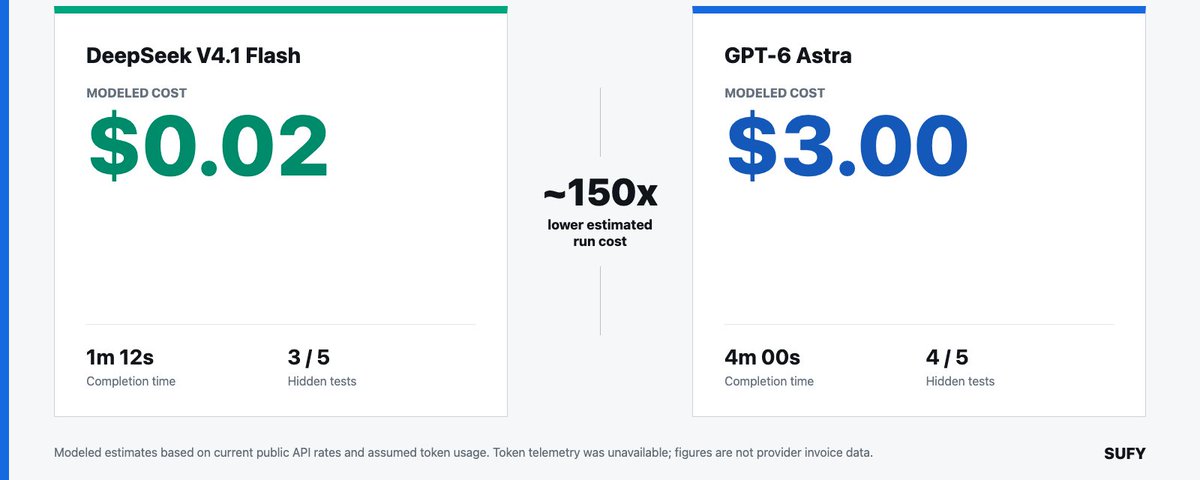
Estimated run cost: $3.00 vs. $0.02.
DeepSeek finished in 1m 12s and passed 3/5 hidden tests. GPT-6 Astra took 4 minutes and passed 4/5.
About 150x cheaper and 3.3x faster, but not the most complete result.
See the full comparison:
103
Building with Chinese AI models?
Sufy gives teams one API for 66 models from DeepSeek, Qwen, Kimi, GLM, MiniMax and more.
• Text models at 40% below list price
• OpenAI & Anthropic SDK compatible
• USD billing
Get pricing + a test key:
marketing.sufy.com/en/

108
We took a closer look at DeepSeek V4.1 Flash.
The interesting part is not that it ranks highly on a few public benchmarks. It is where the performance appears to show up.
DeepSeek reports particularly strong results on software-engineering, cybersecurity and workflow-automation tasks. In several of these evaluations, V4.1 Flash performs close to, or above, much larger frontier models.
That makes it a model worth testing for practical enterprise work:
• fixing issues across a real codebase
• reviewing security vulnerabilities
• operating tools across business software
• processing long technical documents
• handling multimodal inputs such as screenshots and scanned files
The model also supports a 1M-token context window, controllable reasoning effort and image understanding. Its sparse activation and compressed KV cache are designed to reduce the cost of long, tool-heavy workloads.
But benchmark leadership does not automatically mean production leadership.
A model can score well on repository repair and still struggle with ambiguous instructions, unnecessary tool calls, long-running tasks or poorly defined business requirements.
That is why our next step is a controlled comparison with GPT-5.6 Sol using the same task, prompt, tools and scoring rubric.
We will measure more than accuracy:
• task completion
• number of tool calls
• time to completion
• token usage and estimated cost
• error recovery
• security and regression risk
• quality of the final explanation
At Sufy, we are building practical model comparisons for teams choosing between Chinese and overseas models.
We can help you:
→ identify the right model for your workflow
→ design a domain-specific evaluation
→ compare API cost, latency and output quality
→ test long-context, coding, legal, finance or agentic tasks
→ assess whether a model is suitable for fine-tuning, self-hosting or distillation
If you are evaluating Chinese AI models for your product or internal systems, send us your use case. We can help turn it into a reproducible model test.

121