

Biology nerd + Philosophy geek. Sharing the overlaps, the oddities, & the occasional lightbulb moment..
Joined July 2023
- Tweets3.1K
- Following462
- Followers524
- Likes11.5K


Pinned Tweet
A planarian can regenerate an entire body, including a functional brain from a fragment smaller than 1/200th of the original animal. Neoblast cells are totipotent & distributed throughout the body. There is no essential self. Only the process that keeps assembling one..

2
154
A zebrafish can regenerate large portions of its heart after injury. Cardiomyocytes re-enter the cell cycle, proliferate, & restore function with limited scarring. Mammals largely lost this capacity. The same organ, now required to last rather than renew..

1
6
102
Each of your nucleated cells in your body repairs its DNA thousands of times per day. Damage is constant. Restoration is the default. What persists is not the original molecule but the information that keeps being rewritten, we are closer to a living edit than to original text..

5
165
It is estimated that about 76% of deep sea animals produce their own light through chemical reactions.
Some use it to hunt, some to hide, & some to communicate in permanent darkness. Light can be an internal tool rather than something that only arrives from outside..

1
5
59
Large sections of the brain can be removed or heavily damaged while your consciousness remains intact. This includes an entire hemisphere, most of the cerebellum which holds the majority of its neurons, substantial prefrontal areas, the corpus callosum, & more..

1
5
107
Greenland sharks can live more than 400 years & do not reach sexual maturity until roughly 150. Their tissues show remarkably low rates of cancer & age related damage. Longevity can be an active cellular strategy maintained for centuries..

4
130
Your body produces roughly 2.5 million new red blood cells every second. Each one lives about 120 days. The oxygen carrying fleet is in constant turnover. What feels continuous is a high speed replacement process. We are a river of temporary parts..

1
5
171
A horsehair worm grows inside a cricket or mantis & when ready to reproduce, chemically drives the host into water. The insect drowns, the worm emerges, & the cycle continues. The host’s final choice is not its own. & this is another reason I don’t eat insects..

5
84
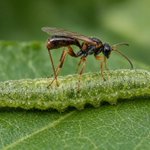
Some parasitic wasps inject eggs into a caterpillar along with viruses that suppress the host’s immune system. The larvae feed inside while the caterpillar continues to live & later protects the wasp cocoons. The host becomes both nursery & bodyguard. Agency can be rewritten..

4
108
A zombie ant fungus infects an ant & grows through its body, & chemically directs the host to climb vegetation & clamp onto a leaf or twig. The ant dies locked in place so the fungus can fruit & release spores. The ant’s final act is to become someone else’s future..

1
25
A female Sacculina larva injects itself into a crab, grows a root system through the host’s body, castrates it, & if male chemically feminizes it. The crab then protects & aerates the parasite’s externa as if it were its own brood. It still moves. It no longer owns itself..

2
34
A mimic octopus flattens, bands, & repositions its arms to impersonate lionfish, sea snakes, or flatfish depending on the threat. The same body performs multiple identities. Appearance is not a fixed property. Identity can be assembled for the moment..

2
10
255
A male deep sea anglerfish bites onto a larger female & permanently fuses with her, dissolving his organs to become a sperm producing appendage. They share one circulatory system. Boundaries between individuals can dissolve. Reproduction can rewrite the definition of a body..

1
6
144
A pitcher plant secretes nectar, uses slippery wax crystals, & maintains a digestive fluid that breaks down insects. The plant solves the problem of nutrient scarcity by turning into a temporary predator. Categories are suggestions. A plant can hunt..

1
4
47
An electric eel stacks specialized muscle cells into biological batteries that can discharge hundreds of volts. The same tissue used for movement generates an external electric field. Organs can be multifunctional. Function is not fixed..

2
43
A bombardier beetle mixes chemicals in a specialized chamber & fires a boiling, noxious spray at attackers. The defense is assembled only at the moment of use. Protection can be manufactured on demand rather than stored in advance..

1
5
123
Mantis shrimp have up to 16 photoreceptor types & detect polarized & ultraviolet light we cannot see. Their strike is among the fastest animal movements, creating cavitation bubbles. Perception & action can operate in dimensions & timescales ordinary senses never sample..

1
9
203
A hagfish ejects a tiny amount of mucus & protein threads that expand thousands of times in under a second, clogging a predator’s gills. The defense is deployed only from the contacted region. Protection can be local, rapid, & almost entirely water..

1
28
A sea sponge can be forced through a fine mesh until only individual cells remain. Those cells crawl back together, sort themselves, & rebuild a functional animal with canals & openings. Form is not locked inside an intact body. It can reassemble from the pieces..

29
