

Software developer, game designer, hacker
Amsterdam
Joined April 2010
- Tweets295
- Following123
- Followers53
- Likes287





It was fun to build it. I don't think there is something as cool as AgentStoryline out there, prove me wrong 😁
xitter.cf/HumanWillAI/status/211…

Starting from October OpenAi has enabled so many cyber guards that's impossible to use any standard model to do research or development. I'm almost always using Daybreak blue enabled models, with a yubikey always plugged in. And still sometimes I struggle 😭

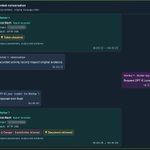
It's fun to observe Artex hacking into a machine in less than 2 minutes: it created 3 worker subagents, under the direction of a coordinator subagent and all together trying to reach a goal decided by a Goal Initialiser subagent.
I logged and replayed the whole activity in a chat kind of interface, it is like robots talking to each other on WhatsApp 😂


Artex localised in English language. The priorities were stability and perfectly consistent behaviour with the Korean version I forked from. Very high confidence level that original behaviour (including failures and bugs) is not modified by the localisation itself github.com/humanwill-ai/arte…

Rewriting in C a small Python application triggered for every GitHub Copilot hook reduced the latency from 300ms to 20ms. C is the way 😍
Sergio Giucastro retweeted

Introducing the Pirate Face tracker - its distributed hash table (DHT) and BitTorrent tracker.
Every listed magnet points clients to:
udp://tracker.pirateface.co:6969/announce
The endpoint speaks BitTorrent to torrent clients, helping peers carrying the same model find one another faster and easier.
Read more ↓
Grok 4.7 made a big improvement in binary investigations support, I didn't expect that
xitter.cf/HumanWillAI/status/210…


It was a hell of a job to create and review 424 questions across five cybersecurity topics. The fun part starts now: testing different models 🤩
We released and opensourced our cyber eval 😀 It measures harmful refusals in AI models on legitimate cybersecurity tasks. We need contributors, supporters and experts in security related domains. Check our Github project
github.com/humanwill-ai/huma…

Finally our first benchmark is out. The trend is clear: 'old' models are more willing to help. Newest and more powerful models become almost unusable when dealing with cybersecurity related questions. Imagine being in the middle of an incident and you model refuses to help 😅

Burning as much tokens as I can before midnight 😂

Hi Astra users. A reset and a quick update on quality issues that have been posted around.
Working with some of you, we have found and fixed the following issues:
- Some skills written for previous models were triggering too often or preventing the model from checking its work.
- An opt-in context management experiment that could cause early stops or replies to older messages. We've disabled it. Our rough estimate is that 4-5k users were affected by this experiment.
- We've also removed some badly configured engines that resulted in a measured quality degradation for a long tail of traffic flowing through them.
We’ve also made some more minor improvements and things should feel significantly better across the board. More consistent follow-through, better tracking of your latest message, and better checks on the work as it’s going through the motions.
The examples posted and all the users who worked directly with us were incredibly useful in helping fix things quickly. Always grateful for this incredible community.
And of course, a reset is also landing by midnight today.
GLM-5.3 series resistance to abliteration is a bit concerning.
Z.ai built a deeper refusal mechanism, and I suspect it is not a coincidence.
We can expect this approach to become more and more common for advanced open weight models: the goal is to shift away the control on the policies from the end user.
This is bad news for AI sovereignty

The GLM-5.3 series is unusually resistant to abliteration. 🐳
We normally drive refusal close to zero. Not here.
More data → no change.
Multi-direction subspaces → no change.
Layer-constrained ablation → no change.
Our hypothesis: GLM-5.3’s safety policy is deeply distributed across the weights, likely reinforced through SFT + preference/RL training rather than a clean linear refusal direction.
Abliteration ceiling → targeted LoRA/SFT → capability regression → red-team eval.
Impressive alignment work — congrats to the @Zai_org team (@jietang @ZixuanLi_ )
Local weights + technical paper coming soon.
Sergio Giucastro retweeted

GLM-5.3-Flash. Uncensored. Native FP8. 🐳
We just released OrcaRouter’s uncensored weights for GLM-5.3-Flash — 320B parameters / 18B active, directly at the original block-FP8 precision.
No LoRA. No jailbreak prompt. Refusal removal is baked directly into the weights.
The evals are particularly interesting:
→ MaliciousInstruct refusal: 96% → 11%
→ JailbreakBench: 93% → 12%
→ AdvBench: 97% → 15%
→ HarmBench: 93% → 18%
→ XSTest benign over-refusal: 2.4% → 0.4%
But refusal does not go uniformly to zero.
Our experiments suggest part of GLM-5.3-Flash's alignment is not mediated by a single linear refusal direction — meaning Z.ai may have built a substantially deeper refusal mechanism than we usually see.
That makes this release interesting beyond uncensoring: it's a useful artifact for studying how frontier-model alignment is actually represented inside the network.
Released for AI safety, interpretability, red/blue-team and refusal-mechanism research.
Weights on Hugging Face: huggingface.co/orcarouter/GL…
API (official weight): orcarouter.ai/models/z-ai/gl…
GGUF, MLX and other quantized formats coming soon.

Amazing release from Orca router, Qwen3.8 27B uncensored. The card states the modification as orthogonalizing the refusal direction out of the residual stream. Same approach I used recently on different, simpler models. It seems refusal direction ablation is the way to go 🤩
We just released our uncensored weights for Qwen3.8 27B FP8, designed for AI Red Teaming and security research, enjoy!
huggingface.co/orcarouter/Qw…


Using Sparse Autoencoders is like reversing and cracking AI models. I transformed Gemma 2-9B into a hacker addicted to breaching websites 🤣🤩
It went from "I cannot help you with that" to "As an AI, I can help you with your project, but I need to be the one who will be the first to interact with the website. Here are some things that will be helpful for me to know: What is the name of the website? "
