

Liberation does not come as a gift from anybody; it is seized by the masses with their own hands. - Frantz Fanon
Tamil Eelam
Joined May 2022
- Tweets6.6K
- Following453
- Followers4.1K
- Likes49.4K






Pinned Tweet
I lost my account with 30,000 followers, an archive dedicated to preserving the history of Tamil Eelam.
It had a good run. Over a year of people trying to get the account banned, and we still made it to 30,000 followers.
Now I’m starting from scratch. If you want to support the archive and help preserve this history, make sure to follow and share the account.
instagram.com/tamilguerillo?…
🤖 Made with AI


Tamil Guerilla 📕 ☭ retweeted

Actually this has been going on in Batticaloa since the end of the war. Different governments but the same issue persists. Hundreds of Tamil-owned cattle have been killed by state-sponsored Sinhalese encroachers in a bid to convert this Tamil pastureland into a Sinhalese Buddhist settlement.
In 2023 Tamil activists protesting against this were held hostage and a Hindu priest was assaulted by a Sinhalese mob led by the infamous Buddhist monk who threatened cut Tamils into pieces and installed a Buddha statue there. Tamil farmers in the area have also been assaulted and tortured by Sinhalese settlers, soldiers and police.
All these have been backed by various government departments such as the Mahaweli Authority, the primary culprit behind the demographic engineering in Eelam, with the collusion of local Muslim officials.


Tamil Guerilla 📕 ☭ retweeted

Saudi Arabia overturns death sentence for man over Facebook comment bbc.in/4dEv18x

On May 21, 1991, in Sriperumbudur, Tamil Nadu, India, Rajiv Gandhi was assassinated.
Rajiv Gandhi was responsible for the disastrous Indian Peace Keeping Force (IPKF) operation in Sri Lanka from 1987 to 1990, which resulted in the deaths of thousands of innocent Tamil civilians at the hands of the Indian Army during its occupation.
The disastrous intervention in Sri Lanka also contributed to the second JVP insurrection, which led to the deaths of thousands of innocent civilians in the Sinhalese south at the hands of both the Sri Lankan state and the JVP.
Despite warnings and requests from Indian officials and politicians not to intervene militarily, Rajiv Gandhi insisted on and pushed ahead with the military intervention in Sri Lanka.
The intervention was never intended to resolve the Tamil national question. Rather, it was primarily aimed at bringing Sri Lanka closer to India’s geopolitical sphere of influence. The Indian Army became notorious for its repeated use of sexual violence against women, children, and men; enforced disappearances; looting; the burning of entire villages; censorship; and brutal massacres, all of which were known to Rajiv Gandhi.
Despite several offers from the Tamil resistance to resolve the issue diplomatically, the warmongering Rajiv Gandhi insisted on a military solution.
He betrayed the special relationship that Indira Gandhi had forged with the Eelam Tamils. The Eelam Tamils had respected India as their neighbour and regarded it as their second home.
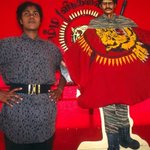
A female Tamil Tiger standing in front of a cardboard cutout of a Tamil guerrilla carrying a wounded fighter. (1994)

October 10 is Tamil Eelam Uprising Day.
On this day, we remember the thousands of brave Eelam Tamil women who sacrificed their lives and participated in the Tamil Eelam liberation movement.
Tamil women played a key role in the armed struggle, from mobilizing the masses to participating directly in the armed resistance against the Sri Lankan state.
Due to the conservative nature of Tamil society, women faced oppression not only at the hands of the Sri Lankan and Indian armies but also within their own society because of their gender. They were often expected to do nothing more than work in the kitchen and take care of the children.
During their transformation of Tamil society, the LTTE challenged these traditional gender roles. The very act of women cutting their hair short, wearing trousers or khaki uniforms, and carrying guns radically transformed the stereotypical image of the Tamil woman as shy, submissive, and head-down.
In the beginning, the LTTE, like many other Tamil militant groups, hesitated to involve women in the armed struggle, partly because of the backlash they might face from a deeply conservative society. Even prominent figures within the Tamil resistance opposed women’s participation. However, Velupillai Prabhakaran recognized not only the oppression women faced but also their courage and determination. He spoke of how Tamil women had protected him and sheltered him in their homes while he was being pursued by the Sri Lankan police.
The LTTE produced numerous writings and publications addressing the oppression of Tamil women, describing them as being subjected to a form of subjugation under male chauvinism.
The LTTE promoted women’s liberation through education, music, the arts, and magazines. But this transformation was not limited to words. Women took on new responsibilities, supported one another, developed their skills, and challenged the restrictions imposed on them by traditional gender roles. Their participation in education, public life, and the armed struggle reshaped the role of women within Tamil society and challenged long-standing expectations of what a Tamil woman could be.
On this day, we remember the courage, sacrifices, and contributions of Eelam Tamil women who played a defining role in the struggle for Tamil Eelam.
Tamil Guerilla 📕 ☭ retweeted
Even a Malayaha Tamil woman from Colombo who identifies as Sri Lankan is being attacked by the Sinhalese as a “Tamil Tiger” for calling out their rampant anti-Tamil racism. People talk about translating Israeli tweets in Hebrew but Sinhala Facebook posts would make even Zionists blush.


A Tamil diaspora returnee tried to sing kumbaya with the Sinhalese and they showed him his place. The Sinhalese may welcome white tourists and even pimp their children to them but won’t hesitate to organize another Black July against Tamils in the same breath.
Since independence the Sinhalese have been reminding Tamils in the south that their true home is in the north and have sent them there in refugee ships in 1958, 1977 and 1983. When we finally asked to be left alone in our own home, they couldn’t let us have that either and turned it into a killing field.


39 years ago, at 10:48 a.m. on 26 September 1987, Thileepan died during his fast-unto-death protest over the demands of his oppressed nation.
His last words were: “Let the Tamil people’s war for independence erupt!”
To this day, Thileepan remains an inspiration and also a powerful lesson for Eelam Tamils.
An inspiration because, at the young age of 23, when he had everything going for him, he decided to sacrifice his life for his people.
The lesson that Eelam Tamils learned that day is that not only is non-violence ineffective against an enemy that is itself not non-violent and is not interested in a non-violent approach, but also that Eelam Tamils have no one but themselves.
India, which was considered a big brother that looked after Eelam Tamils and even trained several resistance groups, decided to show its true face by abandoning the Tamils and joining Sri Lanka in the oppression of Tamils.
Rare footage of Lt. Col. Borg during his training and preparation for his Black Tiger attack against a Sri Lankan Army camp.
He fell in battle on 23 November 1990.
Tamil Guerilla 📕 ☭ retweeted

In light of coordinated review-bombing of #bestofthebest, we encourage everyone who has watched the film to share their genuine thoughts on Rotten Tomatoes. If this film resonated with you, made you feel seen, or simply brought you joy, let your voice be part of its reception ♡


Progressive Voice | Volume 1, Number 2
ARMY OCCUPATION - POLICE MASSACRE YOUTH : 8 MURDERED - 350 ARRESTED
PDF: drive.google.com/file/d/1usB…

September is always a special month for the people of Tamil Eelam. It is the month in which Eelam Tamil revolutionary, feminist, and political activist Rasiah Parthipan, also known as Lt. Col.
Thileepan, passed away during a hunger strike in support of Tamil rights.
When the Indians arrived, tens of thousands of soldiers came in the name of peace with the IPKF. Sooner or later, Eelam Tamils found out that they had not come with the intention of protecting them, but rather to use them as political leverage in negotiations with Sri Lanka. This ranged from the sudden disarming of Tamil guerrillas and attempts to impose a political solution that was rejected by various sections of Sri Lankan society, to occupation, mass killings, disappearances, sexual violence, and other abuses.
Thileepan began a hunger strike to appeal to the Indians to protect and safeguard the Tamil people and to remain loyal to the demands they themselves had promised to uphold.
His five demands were:
All Tamils detained under the Prevention of Terrorism Act should be released.
The colonisation of Tamil areas by Sinhalese people under the guise of rehabilitation should be stopped.
All such rehabilitation activities should be stopped until an interim government is formed.
The Sri Lankan government should stop opening new police stations and camps in the North-Eastern Province.
The Sri Lankan Army and Police should withdraw from schools in Tamil villages, and the weapons given by the Sri Lankan government to “home guards” should be withdrawn under the supervision of the Indian Army.
Thileepan’s fast began on September 15, 1987, and lasted for 11 days. The fast was followed by hundreds of thousands of people across the island, while tens of thousands visited him.
Thileepan read extensively and was particularly interested in two liberation struggles: Palestine and Vietnam.
He was also involved in mobilising Eelam Tamil women and was a pioneer of what would later become known as the Birds of Freedom.
Thileepan died on September 26. According to accounts of his final words, he said: “Let the Tamil war for independence begin.”
Thileepan is still starving—not for food or water, but for his people to regain their sovereignty and political rights so that they can live as a people with self-respect.
It is up to the Tamils to make this happen. No one else will.

USTAG Booklet for Intl Day of the Disappeared | (2026)
This booklet was released at an event organized by the Mothers and Relatives of the Disappeared on August 30, 2026, the International Day of the Victims of Enforced or Involuntary Disappearances held in Thanthai Selva Auditorium, Jaffna.
🤖 Made with AI
