
Professor, Founder of Orditus. Developer of https://xitter.cf/t.co/BXvCOcvrr1, https://xitter.cf/t.co/XW7sGGMcST, ShinyGO & iDEP . Topics: AI, stats, genomics, bioinformatics
Brookings, SD
Joined July 2011
- Tweets2.9K
- Following2.4K
- Followers6.1K
- Likes4.5K







Pinned Tweet
Excited to launch DataMap – a portable, browser-based tool for generating heatmaps and PCA & tSNE plots.
No installs. No servers. Your data never leaves your device.
✔️ Interactive heatmaps, PCA, and t-SNE
✔️ Transform & normalize data on the fly
✔️ Upload CSV, TSV, Excel + annotations
✔️ Generate R code for reproducibility
Ideal for visualizing high-dimensional data matrices, such as RNA-Seq data. It's a Shiny app deployed via shinylive and WebAssembly. Also available as an R package.
Try it now: github.com/gexijin/datamap
Source code: github.com/gexijin/datamap
Preprint: arxiv.org/abs/2504.08875

I tried Meta's Muse this weekend. Impressive. It's a personal AI agent that actually handles routine tasks.
A few observations:
1. Trust is still an issue. I signed up for free using a Gmail account I rarely use. Of all big tech companies, Meta is the one I trust least. My first test: connect Gmail and send an email. Worked.
2. AI agents are fascinating to watch. My real task was to research AI topics I don't understand, generate podcasts, and upload them to Spotify for my commute.
Muse initially used Google's NotebookLM. Watching an AI navigate websites and click buttons in real time is fascinating, if a bit slow.
But it got stuck trying to access a downloaded audio file. Turns out the browser and Muse run in separate VMs and can't easily share files.
The unexpected solution? Muse suggested generating the podcast itself. I tried it. Pretty decent! Good AI features get copied fast.
3. APIs beat browser automation. Muse struggled to upload the podcast to my existing Spotify show, apparently because its browser disables JavaScript for security. It then suggested using an API instead. That worked, though it required creating a new show.
4. Scheduling is surprisingly good. I gave Muse 12 AI topics and asked it to generate and publish a podcast every 12 hours. The first episode went live on Spotify at 2 AM this morning.
My takeaway: AI agents are still slow, clunky, and occasionally frustrating. But they're getting remarkably capable.
What impressed me wasn't the podcast generation. It was Muse's ability to find alternative solutions when things didn't work.
We're moving from AI that tells us how to do things to AI that actually does them.
Steven Ge retweeted

Five years ago, an important miscarriage of justice occurred.
The story began in April 2018 when David Sabatini, an MIT, Howard Hughes Medical Institute (HHMI), and Whitehead Institute scientist and professor began a consensual intimate relationship with Dr. Kristin Knouse, a principal investigator with her own lab at the Whitehead.
By January 2020, David sought to end the relationship, but Knouse apparently did not want it to end. When David thereafter started a new relationship and Knouse learned about it, she began a secretive campaign to destroy him by attempting to end his career as a scientist. She did so by damaging his name, reputation, and that of his family with false sexual harassment and other claims, thereby making him unemployable.
Knouse conspired with Dr. Ruth Lehmann, the then- and still current Director (i.e., President) of the Whitehead Institute, in her efforts to destroy Sabatini.
The record presented in court demonstrated that Dr. Lehmann committed to Knouse in October of 2020 that she would fire David. Dr. Lehmann made this commitment to Knouse before any investigation of the facts had taken place.
Seven months after committing to fire him, in March of 2021, Dr. Lehmann, on behalf of the Whitehead, hired the law firm of Hinckley, Allen, Snyder (HAS) to undergo an investigation of David. By July 2021, HAS shared a draft of its conclusions with MIT, HHMI, and the Whitehead, but not with David or his lawyers.
On the morning of August 19, 2021, David for the first time received the more than 200-page investigative report and a calendar invite for a meeting the following day with Dr. Lehmann, the president of HHMI, and the HR directors of both institutions. The report was riddled with errors and unsupported claims about David and his relationship with Knouse.
When David's lawyer immediately thereafter reached out to Whitehead counsel to ask whether David was about to be fired, they confirmed that he would be terminated at the meeting.
On the advice of his lawyer, David immediately resigned from HHMI and the Whitehead rather than attend the meeting. HHMI did not accept his resignation, choosing instead to fire him. MIT put David on leave and ultimately revoked his tenure. David thereafter resigned from MIT.
On August 20, 2021, one day after sending David the HAS report and before David had the opportunity to dispute the facts and the conclusions of the investigation, Dr. Lehmann emailed all employees at the Whitehead informing them that David had violated a number of Whitehead policies "including policies concerning sexual harassment."
The Lehmann public email, David's resignation and firing, and Dr. Lehmann's claims about David's sexual harassment exploded into a major global scandal covered in mainstream, social, and scientific media around the world as it had all of the requisite ingredients:
An attractive target with David, one of the most important scientists of his generation in line for the Nobel Prize, a purported inappropriate sexual relationship with a younger female colleague, and a political and institutional environment where punishing a man for sexual harassment advanced the career and reputation of the person and/or institution that destroyed the career and reputation of the accused, regardless of the validity of the allegations.
As a result of Knouse's claims, Lehmann's sham investigation, and the media onslaught that followed, David lost all sources of income and his reputation was destroyed. All prizes he had been previously been awarded were withdrawn. He was removed from all scientific advisory and other honorary roles other than as a member of our family foundation's (the Pershing Square Foundation's) scientific advisory board.
When I initially learned of the news about David in the summer of 2021, I hired him as a consultant to the Pershing Square Foundation as I believed our small foundation team would benefit greatly by his insights (and he now had the time to help us), and he needed the money to support his family.
At my request and under a confidentiality agreement, David provided us with many hundreds of pages of documents including texts and other communications with Knouse, the investigative report, and David's responses to the allegations so that we could do our own evaluation of Knouse's claims.
I and a member of our family office's legal team carefully reviewed the documents. After a careful review of the empirical documents -- in particular the texts between Knouse and David -- it became abundantly clear that Knouse's actions were that of an angry and jilted lover, not those of a sexually harassed junior colleague. And the investigative report appeared designed to deliver a pre-ordained conclusion rather than a dispassionate fact-based analysis.
The impact of the firings and the destruction of his career and reputation on David and his family was extraordinarily devastating, so much so that we became increasingly concerned that he might commit suicide.
[In order to make sure that David's important scientific research would continue, in February 2023, in partnership with an anonymous donor, we funded $25 million to support David launching a new lab. As you might expect, I was reviled in the press, in scientific journals, and on social media for doing so and for supporting a so-called sex offender.]
On October 20, 2021, David filed suit against Knouse alleging defamation and tortious interference in his career and his contractual arrangements. Thereafter, Knouse brought counterclaims against David.
Today, nearly five years to the date of the filing of the suit, he has finally received justice.
Today, a 13-person jury (seven men and six women) of David Sabatini's peers (12 jurors plus an alternate) unanimously determined that David proved that Kristin Knouse defamed him, tortiously interfered with his contractual relationships (his entire career as a scientist), and tortiously interfered with his prospective advantageous relationships (his future employment). The jury awarded him nearly $10 million in damages including interest.
The jury rejected all of Knouse's claims including her claims that David engaged in quid pro quo sexual harassment and created a sexually hostile work environment.
While five years is a very long time to live under a reputational cloud, justice was finally served today for David, but not completely in my view.
To this day, Dr. Ruth Lehmann remains Director of the Whitehead Institute. Dr. Lehmann worked alongside Dr. Knouse to destroy David Sabatini, an acclaimed scientist and professor. She did not follow due process before she intentionally destroyed David's career and reputation.
Dr. Lehmann nearly killed David with her actions, as had we not rescued David by finding him employment, supporting him publicly to buffer the reputational damage, and supporting his recovery, he could have ended his life and left his son without a father before the world understood what had transpired here.
And the reputational damage was not just to David.
David's brother, Bernardo Sabatini, is one of the most important neuroscientists in the world. To this day, he has had to deal with a large cloud over his family name and reputation. Recently, when the new CEO of our brain institute mentioned that Bernardo Sabatini was on our board, he was asked: "Wasn't he involved in some kind of sex scandal?"
For obvious reasons, the character of the person who runs a scientific institute is of utmost importance. Among other failures here, Dr. Ruth Lehmann committed to Knouse that she would fire David many months before an investigation was even launched and without consideration of the empirical facts.
How can one trust research produced by a scientific institute if its leader is not committed to observing the empirical facts before reaching conclusions that have life-threatening import? We have unfortunately seen massive amounts of scientific fraud which has harmed innumerable human lives and wasted billions of dollars of research funding and time.
For her ethical breaches here, Dr. Lehmann should be fired from the Whitehead. Based on her actions in this case, she is in no position to serve as the leader of an important scientific institute.
I speak with some perspective on how scientific and other institutions should be led. Including the recent launch of the Ackman Oxman Institute, we have funded approximately $1 billion of scientific research and institutions over the last decade or so, and this experience has given us the opportunity to meet the leadership of many of the most important scientific institutions in the world.
To put it plainly, we would not give a dollar to a scientific institute whose leader compromised basic moral principles as has happened here.
At an absolute minimum, the board of the Whitehead should immediately launch a detailed and independent investigation of Dr. Lehmann's actions in the Sabatini case. I would encourage the investigation, among other considerations, to carefully exam all of the correspondence between Lehmann and Knouse, as well their correspondence with the HAS law firm on among other areas, the various drafts of the Sabatini investigative report.
Alternatively, Dr. Lehmann could resign, minimize further distraction for the Whitehead, and save institutional time and resources that would be better spent on research that benefits humanity.
Steven Ge retweeted

The wildest part of the Nobel drama is that the least-discussed guy left out, Zhuo-Hua Pan, has a better claim on the tech than Boyden and he’s the only one with any shot of turning opto into a real therapy….he just wasn’t at a prestigious institution
statnews.com/2016/09/01/opto…

- The greatest waste isn’t lack of ability, but waiting for a future self.
- The brain favors comfort now over rewards later.
- Tiny actions break the cycle and build self-trust.
I learned these from a video titled "How 90% of People Waste Their Lives", about McGonigal’s book The Willpower Instinct.
.... while doomscrolling in bed.

I just received 4 free Claude subscriptions for my students through Claude Science. I paid $15 for a premium seat with 5x usage for myself. You need to be a university professor.
Maybe they will be harvesting our data for their own science-related projects? You can't really trust these guys.
anthropic.com/news/expanding…

Is this the future?
Two Cybercabs behind a Waymo yesterday in Austin, TX.
Screenshot from TSLA99T's YouTube video.

Should you run an open LLM locally to save cost?
I tested Qwen 3.8 27B on a Mac Studio M4 Max. It was slow and generated R code using yahoofinancials—a Python package.
Lower-tier hosted models like GPT-5.6 Luna are faster, cheaper, and more accurate. At $0.20 per M tokens, a $2,000 Mac buys roughly 10 billion tokens.
Local models offer privacy. But once you count hardware, time, electricity, and debugging, local inference may be a false economy.
Hosted inference may also have a smaller environmental footprint per token, thanks to specialized hardware and better utilization.
I wrote this to resist the temptation of the new Mac Studio M5 that will be released next week.
#LocalAI #LLMs #AI

Steven Ge retweeted
Where are your differentially expressed genes on the genome?
Our tool (ShinyGO ge-lab.org/go/) was used to discover that Chr. 1q21.3 amplified, triple-negative breast tumors are more responsive to common cytotoxic therapies. doi.org/10.1101/2020.04.29.0…

Steven Ge retweeted

Live voice in Codex has completely changed how I use AI for academic research.
In this video, I’m speaking naturally with Codex while it opens notes from my Obsidian vault, searches for papers in Zotero, brings the evidence together, answers my questions, and creates a new linked note all by voice alone. I can ask it to search and find articles in my reference manager as well as find and write into my notes in Obsidian.
After two weeks, I’ve almost stopped typing. I can continue the conversation from my phone, wherever I am even while driving long distances. It feels less like operating software and more like discussing a problem with a knowledgeable senior colleague who understands my research.
I’m doing a PhD, and this is already transforming how I explore ideas, interrogate evidence, and build knowledge. And I’ve only just begun.
I’m amazed more people aren’t talking about this. Live voice in Codex is extraordinary.
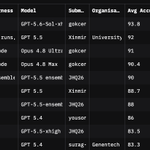
Codex beats Claude Code in a bioinformatics benchmark:
93.8%: Codex + GPT-5.6-sol-xhigh
92%: Codex + GPT-5.5
91%: Claude Code + Opus 4.8 Ultra
CompBioBench v1 (Surag Nair @suragnair)
huggingface.co/spaces/Genent…

Steven Ge retweeted

Seeing a similar trend on our benchmark: huggingface.co/spaces/Genent…

“Explain briefly in plain language, using bullet points.”
I’ve been saying this to LLMs a lot recently.
These models have become incredibly powerful. But their answers are often long, technical, and overly detailed.
Sometimes I simply don’t have the time, patience, or knowledge to read through everything.
My 5 strategies for saving tokens—especially with Claude Fable 5:
- Use Claude.ai for bounded tasks.
Use Claude Code only when it's complex and involves editing many files.
- Control the context.
Start a new chat when switching tasks. Edit a prompt instead of piling on. Regenerate responses strategically. DON'T keep on chatting!!!
- Minimize output tokens—they cost 5× more.
Ask for only the diff or revised section, not the entire script or document.
- Ask for brevity.
I often add “Be brief” or “Use bullets” to my prompts. Also avoids reading page-long responses.
- Lower the effort setting.
Use maximum effort only when it requires deep reasoning.
Powerful models are naturally thorough.
Make them earn every token.
🤖 Made with AI

Fable 5 extended again to 7/19. Thank you, Anthropic, for motivating me! I needed deadlines, especially in the summer!
I still upload key files to the Claude or ChatGPT websites to get a fresh perspective. Claude Code or Codex can be influenced by what's in the local project folder.
CLAUDE.md, AGENTS.md, and project memory files are helpful but could also prime AI into certain directions.
Coding agents have become so complex. These web interface provides a fresh, controlled context.