

B.A. Christian Studies: Biblical Literature & Interpretation, Ambrose University. Certificate in Christian Apologetics, Biola University.
Joined December 2022
- Tweets2.5K
- Following69
- Followers124
- Likes839




Pinned Tweet
I'm a Theologian + Apologist by training. On the Theological side, I specialize in Biblical, Historical + Systematic Theology as well as Hermeneutics. On the Apologetic side, I specialize in Theology Proper, Bibliology + Christology/Soteriology.
2
10
11,819
In addition to declaring God to be one in nature or essence, the Scriptures affirm that there are three distinct persons who are God. All are called God, and all have the essential characteristics of a person. Personhood is traditionally understood as one who has intellect, feelings [emotion], and will. All three of these characteristics are attributed to all three members of the Trinity in Scripture. Essentially, personhood refers to an “I,” a “who,” or a subject. Each “I” in the Trinity possesses (by virtue of its one common nature) the power to think, feel, and choose. Personhood itself is its I-ness or who-ness. - Geisler
23

Theology Apologetic retweeted

Rome was responsible for the death of William Tyndale. Tyndale's translation of the New Testament into English (completed in 1526) was condemned by Church authorities. His work challenged key Catholic doctrines, including the authority of the Pope and the practice of indulgences.
Catholic leaders, including Bishop Cuthbert Tunstall of London, publicly burned Tyndale's translations and denounced them as heretical. Tunstall's condemnation reflects the broader Church opposition to vernacular translations outside of ecclesiastical control.
Tyndale was strangled and burned at the stake in 1536. The charges against him were directly tied to his theological views and Bible translation efforts, aligning with the Church's broader campaign against Protestant reformers and unauthorized vernacular Bibles.
While the execution was carried out by civil authorities, the Catholic Church's role was crucial in framing Tyndale as a heretic and pushing for his arrest and trial. The Church's opposition to his translation and theological positions heavily influenced the outcome. Rome was responsible.


There are eight aspects to Jesus’ claim to deity. (1) In the Gospel of John He used the Jehovistic I AM, that identified him with deity. (I am the way… I am the resurrection… I am the door… etc.). Also, the Johovistic I AM is used without the figures of speech (John 8:25, 56-59, 18:6, 8 the pronoun “he” is not in the Greek). (2) Jesus claimed to be the Old Testament Adonai (Matt. 22:42-45). (3) Jesus identifies Himself with God in the baptismal formula (Matt. 28:19). (4) Jesus claims to be one with the Father (John 10:30) and that the person who saw Him was seeing the Father (John 14:9). (5) When Jesus claimed to forgive sins (Mark 2:5-7), Jesus was assuming a prerogative that belonged to God. (6) When Jesus allowed people to worship Him, He was asserting Himself as deity, for He was approving an act that belonged to deity (Matt. 14:33, 28:9; John 20:28,29). (7) Furthermore, Jesus claimed the comparative attributes of omnipresence, omniscience and omnipotence. Jesus claimed to be in Heaven (John 3:13). Jesus claimed omnipotence (Matt. 28:18), that the dead would respond to His authority (Luke 7:14) and that nature would obey His word (Mark4:39). (8) Finally, Jesus claimed to have a special relationship to the heavenly Father by addressing Him [as], “My Father” (John 5:18). This is a common expression today, and many Christians say “My Father” when speaking of God. But when Jesus said, “My Father,” the Jewish leaders recognized that He claimed deity for Himself and they responded accordingly. “Therefore, the Jews sought [all] the more to kill him [Jesus], because he not only had broken the sabbath, but said also that God was his Father, making himself equal with God” (John 5:18).
Elmer L. Towns, Theology for Today (Mason, OH: Cengage Learning, 2008), 155-6.
80
It was to the Son that the Father said, "sit at my right hand..." and to no one else, and certainly not to any self proclaimed prophet.
78
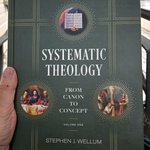
Have I ever mentioned how much I enjoy reading/studying Systematic Theologies? Newest arrival by Stephen Wellum. 2nd volume should be out sometime next year.

95
Whereas the source of salvation is God’s choice to save us, the nature of salvation is God’s grace... Soteriologically, grace and works are mutually exclusive. “Working for grace” is a contradiction in terms, for “when a man works, his wages are not credited to him as a gift, but as an obligation” (Rom. 4:4). “However, to the man who does not work but trusts God who justifies the wicked, his faith is credited as righteousness” (Rom. 4:5).
Norman L. Geisler, Systematic Theology, Volume Three: Sin, Salvation (Minneapolis, MN: Bethany House Publishers, 2004), 182–183.
1
64
I find it interesting how hard Muslims try to force Muhammad into the Bible to bolster their legitimacy.
67
The nature of free-will could either be deterministic, in-deterministic, or self-deterministic. Determinism can come in two forms, soft or hard determinism. Soft determinism holds that human free-will is entirely under God’s control. In hard determinism there is no free-will. Indeterminism takes the neutral position that human acts are not caused by anything. Self-determinism holds that free-will acts are self-caused. In determinism, God did not cause Adam to sin, since God can neither sin nor tempt anyone else to do so. He may test an individual, that’s not same as tempting someone which He would not do. Also, Satan did not cause Adam to sin, for the tempter did only what his name implies, neither forcing him to do it nor doing it for him. As for indeterminism, there was not evil (or lack of wholeness) in Adam’s nature that gave rise to his sin, since he had none – God created him perfect. And there are no uncaused actions; this would violate the principle of causality. Geisler has stated that,
“Adam… must have caused it himself; Adam’s choice was self-determined. This is the heart of human freedom; namely, the ability to be the efficient cause of one’s own moral actions. Acts of which one is not the efficient cause, but rather which are forced, are not free moral acts.”
139
Biblical history is divided by dispensations, the “dispensation of innocence” is the time frame of the creation of man which extends to the time of the fall of the same (Genesis 1-3). Biblical history may also be divided by covenants; this same time frame, under covenant theology, has been referred to as “the covenant of works”, though some have argued that there is no explicit evidence from the text that any such covenant existed as the Hebrew word for covenant, ḇerîyṯ (ber-eeth’), can be located nowhere in the text of the creation account. That being said, many will concede, at least, a probationary period is very possible, but not necessarily as a covenant per se.
There is no injustice here on the part of God in implementing a period of testing; human depravity is a consequence of man’s sin. What would constitute an injustice would be if God had instituted a probationary period for man without man’s having the ability to perform it in the way he ought to as a moral duty. As Geisler has noted, “there can be no response-ability without the ability to respond.”
John Miley has noted,
“If God had so desired that man should be obedient, happy, and to conduct himself after a holy manner, then He must have endowed him with such power and ability so as to perform it. Therefore, they must have possessed the power of obedience as a divine endowment. There can be no testing of fidelity under a law of duty where there is not the power of obedience.”
Theologian Henry Orton Wiley held that this probation period was necessary and that as such God permitted their temptation. While I agree with the former, I would contest the latter. What God was willing to permit was a period of testing which, as a result, could lead to one’s being tempted. But being tempted is not the problem submitting to it is, which was a possibility given that they were created as free creatures. Nevertheless, they still possessed within themselves “the power of obedience”. Likewise, Miley contended that God permitted “the Adamic fall”. This, as in the former is, I believe, contestable on the same grounds as I have made regarding Wiley’s position. God was not permitting their temptation or the fall of the race, as Miley has indicated, “obedience to His instruction was preferable.” What God did permit was their testing; probation is a temporal, testing economy. There is a law of duty, with the sanction of rewards. The essential fact of probation under a testing law of duty is moral responsibility.
Jonathan Edwards has stated that,
“Adam was brought into existence capable of acting immediately, as a moral agent, and therefore he was immediately under a rule of right action; he was obliged as soon as he existed to act right. And if he was obliged to act right as soon as he existed, he was obliged even then to be inclined to act right.… And as he was obliged to act right from the first moment of his existence, and did do so till he sinned in the affair of the forbidden fruit, he must have had an inclination or disposition of heart to do right the first moment of his existence; and that is the same as to be created or brought into existence, with an inclination, or, which is the same thing, a virtuous and holy disposition of heart.”
Theologian John Miley appears to contest Edwards’ view that Adam was “obliged” to “act right” when no act of duty was yet pending on his person. Perhaps, but Adam was created in the image of God, implicit within that creation was a holy disposition on the part of Adam who, therefore, would at least have been “inclined to act right” though not, as yet, having an occasion to do so. Though doubtful of Edwards view, Miley recognized that, “There may be holiness of the moral nature previous to free moral action…Whatever it might become by good conduct, such it might be constituted in its original creation”. He concluded that a moral nature must have moral tendencies.
113
Islam has become the tool of Satan whose singular objective is the destruction of the Church which Jesus Christ purchased with His own blood.
1
97


If you're "always learning, but never able to arrive at a knowledge of the truth," then what's the point, your wasting your time.
Jesus answered...Everyone who is of the truth hears My voice...I am the truth.
128

I can tell you you one thing JWs won't be doing in a coming day, they won't be walking up to Jesus and shaking His hand and giving Him a pat on the back saying, "good job," they'll be on their face in actual WORSHIP like everyone else.
1
102
The Father, Son and Holy Spirit exist as distinct persons in the Godhead. The Father, Son and Holy Spirit are God. Each of the persons of the Godhead display characteristics consistent with personhood of mind, will and emotions. Further, each display attributes consistent with deity, presenting abilities and prerogatives that only God possesses.
4
2
1,132