




Stavo retweeted

The incarnate Son took on a male body and will keep it forever. That is the wild, wondrous meaning of the incarnation and resurrection of Christ. God became man and consecrated our physical life forever.
Vischer and co are promoting a neo-gnosticism that diminishes or ignores the incarnation - which is the distinctive heart of Christianity and sets it apart from Islam, Judaism, and general theism.
How do you know a heretic acting in the spirit of anti-Christ according to Scripture? The do not confess the coming of Jesus Christ in the flesh. (2 John 1:7) The male body of Christ isn't some little arbitrary, unimportant detail.
Our bodies, male and female, declare the glory and purposes of God. Our sexuality is not incidental or arbitrary but a meaningful part of the fabric of the world and how we live out the will of heaven here on earth.
The Logos who became man was the same Logos that made the world so its very forms would communicate his character and purposes. He made masculinity so it would communicate the glory and headship of God relative to all his creatures and then he entered into it as a man himself.
The queering of gender is the old gnostic hatred of the body and the way that our very bodies express God's good will for our lives. We want to be free of the particularities of the body because we want to be free of the need for obedience.
Stavo retweeted

This is a huge deal, even if you’re not in the habit of reading Old English poetry. I’ve had it on my wishlist for years but it was hovering at $140 (!) & earlier this week it dropped down to $1.99. This is a remarkable anthology of every extant Anglo-Saxon poem and you need it.


Stavo retweeted
Aragorn knows he will lose the battle for Middle Earth. This world is the long defeat. He fights to win his own soul.

Stavo retweeted

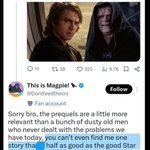
Don’t empathize with Anakin.
Identify with Aragorn.
He’s the ultimate anti-doomer.
When all seemed lost, Aragorn still acted out of principle & not self-interest.
He didn’t change his actions based on feelings or probabilities.
He didn’t harbor vengeance.
He had a duty, and he risked life and love to fulfill it (saving both in the process).


Stavo retweeted

Our newest tale, The Tale of the Valiant Little Tailor, is finally here!
A tailor, a belt, and a boast.
Albert is a humble tailor, struggling to provide for his family. When he swats seven flies in a single blow, his wife and children make him a belt that boasts of it. As his wife fastens it on, she tells him, “There is nothing you cannot do”. It is a story about the courage other people give us, as a small man overcomes giants with his wits.
Grab The Tale of the Valiant Little Tailor now and get the audiobook read by Jonathan Pageau for free!
talesforonceandever.com/

Stavo retweeted

I grew up with Star Wars. We all did. We played Luke Skywalker in our backyards, swung imaginary lightsabers, and dreamed of blowing up the Death Star.
But there is something you have overlooked about the generation that actually grew up with the original trilogy.
We wanted to be Han Solo.
Of course Luke was the central character. He had the destiny, the mystical power, the lineage, the responsibility to redeem his father and restore the order of the universe.
Han Solo wanted absolutely nothing to do with any of that nonsense.
He was a rogue. A smuggler. A cynic. A man with a permanently exasperated expression who had somehow found himself entangled in a grand cosmic conflict between people who took themselves and their respective claims to ultimate significance far too seriously.
He wanted his money. His ship. His freedom. Ideally, he wanted to be somewhere else.
He thought the mystical stuff was ridiculous. He had no interest in the Jedi or the Sith, in prophecy or the restoration of an ancient order. He had no sacred lineage, no inherited claim, no extraordinary connection to the Force.
And yet, in the decisive moment, it is Han Solo who makes the difference.
He has already escaped. He has his reward. He has every reason to leave the rebellion and its grand ideological struggle behind him. Yet at the critical moment, he turns his ship around and returns to save Luke.
There is something extraordinarily important here.
Han Solo’s choice arises from responsibility. From loyalty. From an actual relationship with another human being. He has come to love these people, in spite of himself, and that love places a claim upon him.
He returns because he has become the kind of man who returns.
And in doing so, he makes possible the victory of the mystical hero whose entire destiny would otherwise have amounted to nothing.
This is the Gen X character. We find ourselves sandwiched between the Boomers and their heirs, dragged into their grand narratives of oppression and liberation, and increasingly exhausted by the whole affair.
We have our own flaws, certainly. But we have never been particularly impressed by the idea that history exists to vindicate us. Our instinctive response to grand ideological declarations has generally been to roll our eyes.
The crucial question is what happens when the cynical rogue discovers that he actually loves something enough to take responsibility for it.
And that question points toward a much deeper story.
Because your account of the Boomers is a very ancient one.
You describe a generation that turns against its fathers, overthrows their authority, seizes their kingdom, and then, having achieved sovereignty, becomes consumed by the fear that its own children will do precisely the same thing.
Of course it does.
This is the myth of Cronus.
In the Greek tradition, Uranus fears his children and attempts to suppress them. Cronus overthrows his father and establishes his own sovereignty. Having done so, he learns that one of his own children will eventually overthrow him. His solution is to swallow them.
Zeus escapes, grows to maturity, defeats Cronus, and establishes the Olympian order.
The cycle of usurpation, sovereignty, and threatened succession is among the oldest structures in pagan mythology. Variations appear throughout the ancient world. Fathers fear sons. Sons overthrow fathers. Victorious sons become fathers who must defend themselves against their own children.
The central problem is intrinsic to the conception of sovereignty.
If sovereignty consists in possessing power, and if power is fundamentally acquired through overcoming another, then the existence of an heir is always a threat. The young man’s strength is the old man’s weakness. The son’s flourishing anticipates the father’s destruction.
This is precisely the structure you have identified in the Boomer mythology. And you have identified it well.
But this also tells us something about the nature of the myth itself.
It is pagan.
More importantly, it is a pagan narrative being told by a civilization that had inherited a profoundly different story.
The Christian narrative breaks this cycle at its root.
Here the Father is sovereign in plenitude. He has usurped nothing. His sovereignty is neither contingent upon defeating a predecessor nor threatened by the flourishing of his Son. He gives generously out of inexhaustible abundance.
The Father delights in the Son. The glory of the Son is the glory of the Father. Inheritance is the expression of love and the fulfillment of fatherhood.
And when the relationship between father and son is broken, the Christian story tells us something even more extraordinary.
Consider the parable of the prodigal son.
The son repudiates his father. He demands his inheritance, effectively treating his father as already dead. He rejects tradition, wisdom, propriety, and the order into which he was born. He takes what he has received and squanders it in the pursuit of his own desires.
Eventually, he finds himself utterly debased.
He returns to his father with nothing. No triumph. No enlightenment. No great moral victory. No newly acquired power with which to renegotiate their relationship.
He returns in surrender.
And his father, who has remained steadfast in love throughout the entire episode, runs to embrace him. He welcomes him home with an extravagance of generosity that exceeds every expectation of justice and propriety.
The father has no need to be redeemed by his son. His love is the very ground to which the son returns.
Now notice something remarkable in your essay.
When you discuss the final redemption of Darth Vader, you casually append the phrase, “The prodigal returns.”
But you have the story perfectly inverted.
In Star Wars, the father has fallen into darkness. The son possesses the light. The father must repent, turn away from his corruption, and be redeemed through the steadfast righteousness of his son.
The son saves the father.
In the Christian parable, the father has remained steadfast in love and righteousness. The son has fallen into darkness. The son returns in humility and surrender, and finds himself received into the love of his father.
The father saves the son.
The inversion is profound.
And it reveals exactly what has happened to the underlying myth.
The Boomers inherited a civilization whose deepest story was Christian. They broke with the faith of their fathers, repudiated the moral and spiritual authority from which their inheritance had arisen, and attempted to recreate the sacred order on their own terms.
Having rejected the very category of legitimate authority, they increasingly understood every hierarchy through the lens of power.
The father becomes an oppressor. The son becomes a liberator. The ancient institutions become the Empire. The overthrow of those institutions becomes righteousness.
And so they construct a new priesthood, complete with mystical authority, sacred language, initiation rites, moral prohibitions, and a monopoly on the interpretation of ultimate reality.
A priesthood that speaks incessantly about non-attachment while displaying an extraordinary attachment to its own institutional power.
A priesthood that claims to be the guardian of peace while commanding armies and policing dissent.
A priesthood whose moral vocabulary is increasingly indistinguishable from the requirements of its own preservation.
Your analysis of the Jedi Council is devastating precisely because it captures something real about this attempted secularization of the sacred.
But the hypocrisy goes all the way down.
The Boomers sought to retain the moral power of Christianity after severing themselves from the reality that gave that morality its meaning. They wanted the authority of a priesthood without submission to God. They wanted redemption without repentance. They wanted the kingdom without the Father.
And having rejected the Christian story, they found themselves repeating the pagan one.
They became Cronus.
The irony is that their new religion worked.
Or, more precisely, it delivered real benefits.
The sacred language of liberation justified the acquisition of power. The mythology of perpetual resistance provided moral cover for the accumulation of wealth, institutional control, prestige, and authority. The high priests of anti-authoritarianism became the custodians of the institutions. The revolutionaries became the establishment.
They consumed their inheritance, secured their own positions, and found themselves increasingly terrified of succession.
An entire generation lived quite comfortably under the protection of its idols.
And here, I think, your narrative begins to crack.
Because you have correctly identified the false priesthood. You have correctly identified the hypocrisy of the Jedi. You have correctly identified the generational struggle over power and the extraordinary moral fraud by which that struggle has been concealed.
But then you arrive at your conclusion.
Get Sith-pilled.
Embrace power.
Learn from Palpatine. Build your networks. Acquire the machinery of government. Take control of the institutions. Establish your own sovereignty.
And I find myself wondering whether you have noticed what has just happened.
You have returned to the story of Cronus.
You have correctly recognized that the preceding generation overthrew its fathers, acquired power, constructed a mythology to justify that power, and then became consumed by the fear of its own succession.
And your solution is to do it better.
To be the more cunning revolutionary. The more disciplined usurper. The more competent sovereign.
To become Zeus.
Of course, within the terms of the pagan mythology, this is a perfectly coherent response. Zeus really does defeat Cronus. The children really do escape their father’s tyranny. The Olympians really do inherit the world.
And then?
What happens when Zeus has sons?
The deeper problem is that you have accepted the Boomers’ most fundamental premise: that the world is ultimately organized by the struggle for power.
Having seen through their particular moral pretensions, you propose to replace their priesthood with your own.
Their religion was false, and its gods were idols. You have exposed the idols with considerable skill.
But the fact that their sorcery delivered real benefits never made their gods true.
And the fact that you can learn to practice their sorcery more effectively does nothing to change that.
Indeed, one of the extraordinary features of the Boomer story is how completely its rebellion against Christian authority has reproduced the pagan cycle of sovereignty. Having rejected the Father, they became obsessed with the throne.
Now their heirs, having discovered the fraud, are invited to repeat the same error with greater competence and fewer illusions.
The tragedy is that disillusionment with a false priesthood has become an invitation to worship power itself.
Nietzsche would recognize the move immediately.
But Christianity has already provided the way out.
The Christian account of sovereignty begins with a Father who gives. Its account of inheritance is grounded in love rather than usurpation. Its account of legitimate authority is inseparable from responsibility, sacrifice, and the good of those over whom authority is exercised.
The sovereign is fulfilled in the flourishing of his heirs.
And the heir is fulfilled in receiving, preserving, and bringing to fruition what has been entrusted to him.
This is a radically different understanding of power, authority, and succession. It makes possible an entirely different relationship between generations.
Which brings me back to Han Solo.
He occupies a peculiar place in this mythology. He is outside the sacred lineage and outside the contest for mystical sovereignty. He has no claim to the throne, no prophecy, no priestly ordination.
He is suspicious of the entire enterprise.
Yet when it matters, he acts. His loyalty becomes real precisely because he is free to leave. His responsibility emerges from love rather than destiny, ambition, or an inherited position in a cosmic struggle.
Han Solo provides a glimpse of a kind of agency that the Skywalker drama struggles to comprehend.
And perhaps this is why Generation X matters.
We have spent our lives watching the Boomers’ great performance of moral superiority, while their children increasingly discover the same machinery and contemplate using it against them. We understand the temptation to become cynical. We understand the desire to abandon the whole absurd spectacle.
But we also know that the world still needs to be held together.
Children need fathers. Families need homes. Communities need institutions worthy of loyalty. Civilization requires an inheritance that someone has the courage and generosity to preserve, cultivate, and eventually give away.
Somebody has to take responsibility for things that are actually real.
And that responsibility cannot be discharged through another revolution in the mythology of power.
The most important question facing the heirs of the Boomer generation is whether they can recover an understanding of authority that makes succession something to welcome rather than fear.
Whether they can become fathers whose greatest desire is to see their children flourish.
Whether they can receive an inheritance without believing that inheritance must be seized.
Whether they can exercise power without worshiping it.
The Boomers were raised within the remnants of a Christian civilization and chose to imagine themselves as pagan liberators. They got their revolution, their institutions, and their wealth. They also inherited the ancient pagan terror of their own children.
You have diagnosed their predicament with considerable insight.
But I suspect the genuine way out requires recovering the story they abandoned.
Because the problem was never that the sons had insufficient power to overthrow their fathers.
The problem was that they had forgotten what it meant to be sons.
And, eventually, fathers.
Meanwhile, those of us who grew up wanting to be Han Solo are still standing beside the Millennium Falcon, looking at the latest generation of Skywalkers and wondering how we got dragged into this mess.
We have a choice, of course.
We can take the money and fly away.
Or we can turn around and do what love requires.
I think we know what Han Solo would do.
cf - xitter.cf/jgreenhall/status/2108…

I just turned 55 - which puts me in an interesting position on this conversation. I got my AARP card in the mail and I am, in fact, retired (I think). Which means that I’m not paying into SS anymore. I’ve paid all I’ll ever pay.
And it will be seven years before I get to take anything out. So I’m also not getting any thing for a decent while.
Right in the middle - more or less.
I would not vote to kill social security, as such. But I would make participation optional. Anyone who wants to pay in can participate per normal and earn out their retirement payments.
But anyone who doesn’t can stop paying - at the price of course that they would also not earn any benefit when they retire.
Personally, under the current program, I do not expect to ever collect a check. I have long assumed that it was just money wasted, just another in a long line of bad choices produced by our governance, and when I look at the trajectory of our governance I see no reason to revise that view.
Stavo retweeted

Last week to lock in your illuminated Gawain and the Green Knight book, and we're almost to the slip-cover goal too! Don't miss out on this one!
kickstarter.com/projects/tam…


Stavo retweeted

We have an entire punditry class who have lived and moved and had their being in the Swamp for the better part of 50 years. They are pure creations of the post-war consensus. And this PWC is as real as is Truman's World.
They have ZERO perspective of it, yet believe they are circumspect, wise, grounded, mature even. But all their incentives are predicated on them NOT getting it. Anything outside the boundaries of polite Firing Line like cordialities is considered barbaric and beyond the pale. I know this is "old hat" stuff, but these people are still in control and still setting the edge.
They will continue to invoke the gods of their childhood as if all we have to do is say "freedom" and "democracy" and "good sense" and all us not-getters will snap to grid.
It is depressing.


Stavo retweeted
I think Gerwig genuinely loves Narnia and thinks she is honoring Lewis's vision.
It's just that progressives are so fully convinced of their own worldview that they believe it IS honoring the legacy of Lewis to filter it through their universalist, watered down version of faith.
"If he were alive today, he would have become a liberal like me, so I am lovingly participating in his legacy by updating it."
The sincere, nice-person, aesthetically excellent kind of subversion is the most effective. People will love the films and then begin to associate Aslan and Lewis with the very Christianity-and-water type of religion he actually was fighting hard against.
youtu.be/gHevSz8Z_KM?si=F8eQ…

Stavo retweeted
I was a 19yo apostate. I thought I was smart. Given the faith as it was presented to me I quickly deduced that if what I was taught was true, I could just do social work and skip the whole mass-confession-prayer thing.
My path back was reading, specifically Old Books. I was the quintessential Chronological Snob. So when I began my deep dive into the Tradition I was very quickly humbled. I felt exposed for the ignorant bigot I was. I knew NOTHING.
These old guys knew things, things I knew I didn't know, and things I needed to know in order to answer life's most important questions:
Who am I?
Is there a God?
Where did I come from?
What am I for?
My deep reading sent me on a path of humility and out of a posture of know-nothing knowitall-ism. I am deeply grateful for being knocked on my backside.
I have spent the better part of three decades doing my best to share with my students what blasted me out of my own smug snobbery. It led me to reconsider a faith-tradition that I thought I had abandoned. What I had actually abandoned was a thin-gruel of social justice, a sadly non-metaphysical, flattened, exhausted church.
So I've done my best to read deeply and reclaim an inheritance that the adults had decided to keep from us because they thought that we had progressed out of "all that."
It is not a cure all, but for many, it is the best place to start. "Tolle lege" as the voice tells Augustine. Take and read. It may be the start of something profound. And lastly, it is never too late. Now is the perfect time to start, even if you are an Old like me.
Stavo retweeted

This is the genius of Jan van Eyck.
The closer you look the crazier it gets.
This painting is only about 66 cm tall but he hid so many details you could stare for hours.
Almost 600 years later, you look at this painting and still wonder - how?!
Madonna of Chancellor Rolin, c.1435

Stavo retweeted
Good morning! The illuminated Gawain and the Green Knight project is live on Kickstarter!
kickstarter.com/projects/tam…
Stavo retweeted
The illuminated Gawain and the Green Knight project is launching on Kickstarter tomorrow! Please share it around, and sign up to be notified as soon as we launch so you can lock in your copy: kickstarter.com/projects/tam…
Stavo retweeted
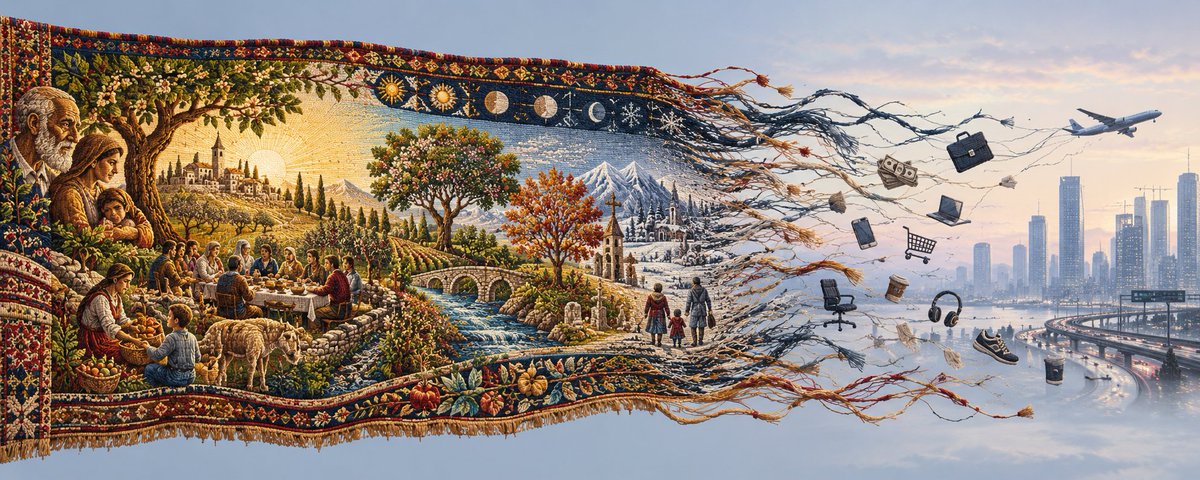
In this AI moment, it is essential to listen to the myth of Narcissus.
He fell into a spell and died because he did not recognize the water as a medium that extended his own being. Instead, he saw another being in the medium. And it led to his doom.
Let the reader understand.
Stavo retweeted
I'm launching the illuminated Gawain and the Green Knight book project next month. Like the Beowulf and Edda projects, this will have the original language alongside a modern English translation (Neilson's 1917 version).
I'm starting on putting together the illuminated Gawain and the Green Knight book project. We're planning to launch the Kickstarter in October; give it a follow so you'll be notified when we go live!
kickstarter.com/projects/tam…
