

Starcloud is building data centers in space, to address the AI energy need. We recently launched the first H100 to space. White paper at https://xitter.cf/t.co/G8SoHyqcAy
Redmond, WA
Joined February 2024
- Tweets2.5K
- Following159
- Followers25.7K
- Likes7.3K





Starcloud retweeted

Laser-focused on orbital data centres, @PhilipJohnston and @Starcloud_ pioneered AI compute in orbit and generously shared the economics behind it.
Now everyone’s talking about orbital compute. But there’s a difference between imagining the future and putting it in orbit.
Vision inspires. Execution propels an industry forward. Starcloud has delivered, and is already building what’s next! 🚀💫
#StarCloud #DataCenters #OrbitalDataCenters
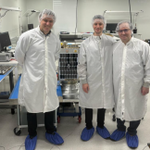
Want to see what execution looks like? Step inside Starcloud’s factory. 🤩👇
youtu.be/mdq6urSx-f8


Starcloud is 𝘀𝘁𝗶𝗹𝗹 not planning to build a launch vehicle. Thank you for your attention to this matter. 😐
@Starcloud_


Starcloud retweeted
Starcloud is 𝘀𝘁𝗶𝗹𝗹 not planning to build a launch vehicle. Thank you for your attention to this matter. 😐
@Starcloud_


Starcloud retweeted
People are only beginning to realise the power and potential of orbital compute. @Starcloud_ and @PhilipJohnston have generously shared the economics behind it from the very beginning.
Terrestrial data centres demand vast amounts of land, water, grid connectivity, permits and infrastructure. For orbital data centres, the principal economic hurdle is launch cost. As costs fall below $500/kg, the economics become increasingly compelling.
Starcloud hasn’t just laid out the blueprint. They’ve executed it with precision. 💫🛰️ #OrbitalComputing #DataCenters

Starcloud CEO Philip Johnston (@PhilipJohnston) on why data centers in space work:
“In space, we don’t need permitted land.”
Starcloud retweeted

The co founder of @Starcloud_ , @PhilipJohnston , just talked about the single most important number in the space sector
The most important number in the space sector right now is $500 per kilogram
Starcloud’s CEO just laid out why, and it reframes orbital compute from science fiction into a commodity arbitrage with a crossing point
Think of a data center as a solar project. On Earth, terrestrial solar has three dominant costs:
permitted land, batteries for when the sun isn’t up, and the cells themselves
Move it to dawn-dusk sun-synchronous orbit and three things happen:
1- Permitted land goes to zero.
Your single largest cost line disappears, along with the interconnect queue, the zoning fight, and the local referendum
2- Batteries go to zero. That orbit is in sunlight 24/7. No storage, no backup generation, no duck curve
3- You need 8x fewer cells. A square meter of panel in orbit produces roughly eight times what it produces on the ground. No atmosphere, no night, no weather.
Three of your four cost lines collapse. One new line appears: launch
So the entire thesis reduces to a single variable. Below roughly $500/kg to orbit, space undercuts land. Falcon 9 is about $5,000/kg today. Starship’s internal design target is $20–40/kg
Why this is structurally bullish for the sector
Because it converts launch from a cost center into the toll booth on a new asset class. Every dollar of launch price reduction doesn’t just make existing missions cheaper, it unlocks a category of demand that was economically impossible the day before
Orbital compute is the first demand curve in space history that scales with AI capex rather than with government budgets, and AI capex is currently the largest private infrastructure buildout on Earth
It also inverts the scarcity: Terrestrial data centers are now constrained by power and permitted land, not chips. Orbit has effectively unlimited uncontested power and no permitting authority. Starcloud claims ~10 TW fits in that one orbital band, about 20x the entire US grid
Where the value actually accrues then?
Launch is the choke point and the toll booth. Everything downstream is a derivative of $/kg. Watch Starship upper-stage catch, then re-flight, then, critically, whether SpaceX sells commercial capacity at all from 2028. On Falcon 9 they charge 2–3x marginal cost. If they hold that discipline on Starship, the whole sector clears. If they keep capacity in-house, they become the competitor, not the supplier
Thermal is one of starcloud's real moat, and it’s underpriced. Everyone fixates on radiation, the operators say cooling was the hard problem and radiators are where the engineering differentiation will make it or break it imo
Starcloud retweeted

Let's please move it to space y'all. And @Starcloud_ and SpaceX are paving the way.


Starcloud retweeted

New AI benchmark: Ask AI to get the data center permit approved.
Current stats: Grok 0%, Claude 0%, ChatGPT 0% 🫠
Worth giving up and asking @Starcloud_

Starcloud retweeted
Thanks @tonywkim and @Farshchi for having me to join the panel on orbital data centers with Dan Roelker, great discussion on a prescient day! 🙏🚀
@BlackRock @Lux_Capital @Starcloud_


Starcloud retweeted

Starcloud CEO Philip Johnston (@PhilipJohnston) on why data centers in space work:
“In space, we don’t need permitted land.”


Starcloud retweeted
Fun panel on the future of the space industry with @JeffThornburg, @amirblachman, and @rhea_sideris👌
Thanks @payloadspace!
@Starcloud_

Starcloud retweeted
As an outsider noob, these changes all seem like they would make @sequoia a more fun place to be an investor at ➡️ retain the best investors ➡️ continue the legacy.
Seems smart to me


Starcloud retweeted

what i've been saying but visually
I sometimes help early stage @YCombinator founders with fundraising advice. They often send me two drafts of an email with tiny differences in wording, asking which is better. My advise is almost always the same: It doesn’t matter.
Then I try explain some version of the diagram below. In a fundraising process, you are mainly tying to quickly identify which of the below buckets investors are in. It’s a much better use of time filtering more investors to find the right hand bucket, than agonizing over the middle bucket for hours.

Starcloud retweeted
And so it was foretold… page 1 of the @Starcloud_ white paper in September 2024! 🤓

Starcloud retweeted

Best
I sometimes help early stage @YCombinator founders with fundraising advice. They often send me two drafts of an email with tiny differences in wording, asking which is better. My advise is almost always the same: It doesn’t matter.
Then I try explain some version of the diagram below. In a fundraising process, you are mainly tying to quickly identify which of the below buckets investors are in. It’s a much better use of time filtering more investors to find the right hand bucket, than agonizing over the middle bucket for hours.