

Space industry analyst and advocate
Seattle, WA
Joined September 2009
- Tweets10.3K
- Following1.5K
- Followers1.5K
- Likes9.9K







Pinned Tweet
Cost reduction in satellite manufacturing is not getting enough attention, and it's changing the economics of space.
linkedin.com/posts/stanshull…

Stan Shull retweeted

Two football fields. That’s roughly how close Otter Pup 2 is now regularly operating next to @GilmourSpace’s ElaraSat, fully autonomously. This puts Otter Pup 2 on a very short list of spacecraft in human history.
This video was captured from just 200 meters away as Otter Pup 2 conducted close proximity operations around ElaraSat. Otter Pup 2 is capturing images like these and using them to track and predict the position and orientation of ElaraSat on an ongoing basis.
We’ve gone from thousands of kilometers to hundreds of meters away, continuing to test, iterate and validate our technology along the way. And Otter Pup 2 is not done getting closer, as it continues its mission to make history.


Stan Shull retweeted

This morning, @USSpaceForce PAE for MWT, supported by SDA, successfully launched 21 satellites in LEO from VSFB, CA. T1’s 4th launch deployed data transport SVs built by @northropgrumman, bringing the number of on-orbit T1 SVs to 84. sda.mil/pae-for-missile-warn… 📸 credit: @SpaceX


Stan Shull retweeted

Funny how SpaceX has caught rockets the size of buildings out of mid air but old bureaucrats are like nope they won't be able to figure out this 45 year old tech.
Stan Shull retweeted

This is the last critical piece of the spectrum puzzle needed for SpaceX to provide complete phone coverage in America

Stan Shull retweeted

Margaret Hamilton has died. Absolute legend, it was my honour to meet her and have a conversation with her just a few years ago, super nice and still sharp. Ave atque vale Margaret.

We’ve lost an icon. Margaret Hamilton, a computer science pioneer best known for her work at MIT leading development of the flight software for the Apollo missions to the moon, has died at 90. Read about her legacy via MIT News: news.mit.edu/2026/margaret-h…

ALT Margaret Hamilton is reclined inside a NASA spacecraft module, surrounded by control panels and switches.
Stan Shull retweeted

I have been a posting slug!
How about that launch triple header last week: Starship, Crew 13, and Heavy!!!
Terrestrial low band spectrum acquisition and FCC approval for Starlink Mobile constellation!
And I am always relieved, grateful and proud when we complete a crew mission— welcome home to Mother Earth Crew 12!

Stan Shull retweeted

I ran the math on what happens when all the filed megaconstellations reach steady state. Add up everything on paper (SpaceX's million data center sats, Starlink, Blue Origin's Sunrise and TeraWave, Starcloud, Amazon Leo, and China's roughly 250,000 across Guowang, Qianfan, Honghu and the CTC filings) and you get about 1.4 million satellites. Using Starlink V3 at around 2 tons for the SpaceX, Blue and Starcloud birds and 1 ton for everyone else, with a 5 year life, you'd be replacing and deorbiting about 285,000 satellites a year.
That's roughly 520,000 tons a year, or 1,400 tons a day burning up in the upper atmosphere. The paper numbers won't all get built, so I also ran a more realistic case of about 210,000 satellites by the late 2030s. That still comes out to around 73,000 tons a year, or 200 tons a day.
This number is several times the natural meteor dust coming in every day, and it's mostly aluminum instead of rock. Recent work out of USC suggests each satellite leaves behind about 12% of its mass as aluminum oxide particles that hang in the stratosphere for decades and can help eat ozone. At 200 tons a day that's something like 8,800 tons of alumina a year, compared to maybe 17 tons from natural sources.
Nobody has modeled what that does long term, and I think it's the sleeper issue behind the whole debris conversation. Deorbiting solves the orbital problem by moving it into the atmosphere. Bringing hardware home intact is the only answer that solves both, and that was the core reason I started Outpost and designed our product the way that I did.
It is honestly crazy to me that the best answer our industry has come up for the debris is to burn the trash!
Space Debris: Is There a Market? spaceambition.substack.com/p…

Stan Shull retweeted

Congrats to our partners at @StarfishSpace for completing the acquisition phase… and what an amazing shot of our ElaraSat MMS-1 satellite from just ~1 km away! (Feels like we’re seeing our baby on an ultrasound.)
A big milestone, team. Adventures ahead… 🛰️🛰️

Otter Pup 2 has made it through Acquisition, one of the most challenging phases in its mission! Check out @GilmourSpace’s ElaraSat, our docking partner, from roughly 1 km away.
This is not a flyby. Otter Pup 2 is staying close, making it one of only a small number of free-flying spacecraft in history to operate under control within 1 km of another spacecraft.
With Acquisition complete, Otter Pup 2 is now fully relying on its onboard autonomous relative navigation to stay close to its docking partner. No ground-based navigation needed.
We trust the spacecraft to know where it is, where its partner is, and how to safely stay nearby. That’s the level of autonomy required for safe and scalable rendezvous and docking missions.
Stan Shull retweeted

SpaceX has launched every rocket in their lineup, 3 different vehicles, from 4 different pads, in 3 different states this week.
They also lifted basically every “category” of payload. Starlink, Crew, Commercial, and Military.
WHAT. A. WEEK.


Stan Shull retweeted

Our first view of a new Starlink V3 in orbit.
Captured on September 30 from approximately 230 km with 34 cm/px resolution, this is an early look at the next generation satellite in the Starlink constellation.
Two solar arrays are deployed, with the spacecraft in an expected orientation as it raises orbit.
The V3s will now move towards their operational altitudes, bringing them closer to HEO’s current network and enabling higher-resolution imagery as they climb.



Stan Shull retweeted
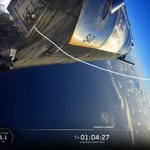
It’s launch day! Tune in to watch our first Otter go to space.
SpaceX:
spacex.com/launches/transpor…
Estimated launch time: 11:32 AM PT
Otter’s deployment time: T+01:03:06

Congrats @StarfishSpace!
Stan Shull retweeted
I find it funny that some people got hung up on Starship not having gone orbital before Flight 14 when in the grand scheme of things it was completely arbitrary in terms of performance. The 19ish second burn only added about 91 m/s of velocity (a 1.2% increase in velocity)
This capability has been physically capable since Flight 6 which demonstrated a single Raptor relight in space. Heck, Flight 13’s burn was about 14 seconds, but intentionally oriented to primarily do a plane change instead of a prograde insertion burn for continued safety.
Any of the relights COULD have done the orbital insertion burn, the duration was not of any special technical capability. The reason Starship didn’t go orbital until Flight 14 is probably what we should applaud them for the most… SAFETY.
Their methodical approach to getting good data and going one step at a time while hucking the single most massive object ever put into space proves they weren’t just doing things haphazardly, despite the occasional narrative from the outside.
While it’s easy to compare Starship to vehicles like SLS or Vulcan or New Glenn, the reality is the focus hasn’t been on orbit, it’s been all on the “downhill” side of that. Safe and targeted de-orbit, clean reentry, targeted and soft splashdown. That’s the part that has (almost) never been done before.
And here I do have to add a little Space Shuttle admiration for figuring out a lot of these things on its first flight in 1981 (although it came a bit close to not being successful). Pretty amazing there was a vehicle of similar scale capable of such precise deorbit and reentry that it landed on a runway with no go-around capabilities. Crazy.
But Starship is well on a path to absolutely leap-frog the Space Shuttle in terms of performance (already over double and someday 6 fold) and hopefully in terms of full and rapid reuse. I hope we see the latter part speed up even more now that orbit has been demonstrated.
Exciting times ahead!!! Keep going @spacex @elonmusk

Stan Shull retweeted

“There is always a tension that comes with seeing the first of anything fly, right? The other part of this is huge amounts of excitement."
arstechnica.com/space/2026/0…
