

Dev Ashish, Founder https://xitter.cf/t.co/UjEvJiQg2Q | SEBI RIA No. INA100005241 | Fee-Only Investment Advisory & Financial Planning | Services - https://xitter.cf/t.co/RlTHDRWbl8
India
Joined October 2012
- Tweets25.8K
- Following221
- Followers66.6K
- Likes8.7K


Pinned Tweet
I am a SEBI Registered Fee-Only Investment Advisor (RIA). Details of the advisory services below:
Financial Planning:
bit.ly/StableFinancialPlanni…
HNI Portfolio Advisory:
bit.ly/StableHNIAdvisory
Use the forms in these pages to contact for advisory/planning services

Stable Investor retweeted
If your home loan is complete and you don’t want to take another loan again and repeat the Earn-EMI cycle (to purchase the next property), then what should you do next? You now have surplus money left over each month, as there is no home loan to service EMIs.
So how best to use that extra/surplus money now?
I wrote about this in my latest column in Economic Times Wealth @ET_Wealth - 19Oct2026 edition.
Stable Investor retweeted
LTCG Taxation is in the news again. And the reason is that our finance minister has said the government is open to feedback on capital gains taxation.
I am no one, but I have feedback on it too. 😊
While personally, I would love to see pre-2018 taxation where LTCG was taxed at 0%, I am still fine if Long-Term Capital Gains tax on Equities is removed (or at least reduced*) and the holding period for LTCG qualification is increased to 3 years. It kind of aligns with what equities as an asset class demands - staying invested for the long term for best results.
My point is simple. If the aim is to promote long-term behaviour, give incentives like bringing LTCG down to 0% and redefining long-term for equities as 3 years.
*Scrapping the long-term capital gains tax on equities may be difficult for the govt. as LTCG tax on equities brings in decent revenues and, in all fairness, no government would want to give that up easily. So rather than full elimination, reducing it to a small percentage of say 1-5% (from the current 12.5%) may also send the right message.
Another option might be to make a tiered approach where LTCG tax from 1-3 years is 10%, and for holding periods above 3 years, it is removed completely (0%). But this will again make things complex, though desirable and better than what we have today.
Demands to remove LTCG come up every now and then. But the direction so far has been one way only: 0% before 2018, 10% from 2018 to 2024, 12.5% since. Let’s see what comes out of this episode of Bring-LTCG-Down-To-Zero.
But I really hope our govt. does something so that we can forget those infamous lines - Capital gains don't accrue from any effort (iykyk), and someone finally thinks about rewarding long-term investors by rationalizing/reducing LTCG taxes, if not eliminating them fully.


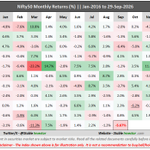
Nifty50 is down -13.4% for the year 2026 (YTD). Still about 10 weeks for the index to try to recover and extend the 10-year streak of positive returns.
Note - The investments in the securities market are subject to market risks. Read all the related documents carefully before investing.
Disclaimer - The indices shown above are for illustration only. It is not a recommendation to buy/sell/hold. Please get in touch with your investment advisor for customised investment advice based on your risk profile and unique requirements.

LTCG Taxation is in the news again. And the reason is that our finance minister has said the government is open to feedback on capital gains taxation.
I am no one, but I have feedback on it too. 😊
While personally, I would love to see pre-2018 taxation where LTCG was taxed at 0%, I am still fine if Long-Term Capital Gains tax on Equities is removed (or at least reduced*) and the holding period for LTCG qualification is increased to 3 years. It kind of aligns with what equities as an asset class demands - staying invested for the long term for best results.
My point is simple. If the aim is to promote long-term behaviour, give incentives like bringing LTCG down to 0% and redefining long-term for equities as 3 years.
*Scrapping the long-term capital gains tax on equities may be difficult for the govt. as LTCG tax on equities brings in decent revenues and, in all fairness, no government would want to give that up easily. So rather than full elimination, reducing it to a small percentage of say 1-5% (from the current 12.5%) may also send the right message.
Another option might be to make a tiered approach where LTCG tax from 1-3 years is 10%, and for holding periods above 3 years, it is removed completely (0%). But this will again make things complex, though desirable and better than what we have today.
Demands to remove LTCG come up every now and then. But the direction so far has been one way only: 0% before 2018, 10% from 2018 to 2024, 12.5% since. Let’s see what comes out of this episode of Bring-LTCG-Down-To-Zero.
But I really hope our govt. does something so that we can forget those infamous lines - Capital gains don't accrue from any effort (iykyk), and someone finally thinks about rewarding long-term investors by rationalizing/reducing LTCG taxes, if not eliminating them fully.


Stable Investor retweeted
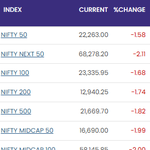
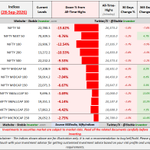
Current State of Indian Markets (8-Oct-2026)
The table shows the % Fall of Indices (closing values) from their respective All-Time-Highs (intraday).
Note - Investments in the securities market are subject to market risks. Read all the related documents carefully before investing.
Disclaimer - The indices shown are for illustration only. It is not a recommendation to buy/sell/hold. Please get in touch with your investment advisor to get customised investment advice based on your risk profile and unique requirements.
Stable Investor retweeted
Successful investing is simple. Yet, not easy.
#iykyk
Stable Investor retweeted
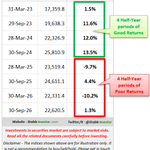
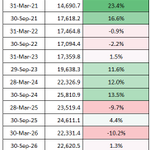
Between Sep-2022 and Sept-2024, the Nifty50 delivered four straight half-years of strong returns: 1.5%, 11.6%, 12.0% and 13.5%. Many investors quietly rebased their expectations, treating double-digit gains every six months as the norm (and their right!) rather than the exception.
But the next four half-years told a different story: -9.7%, 4.4%, -10.2% and 1.3%. The Nifty50 has moved from 25,810 to 22,620 in those two years.
This is not a market behaving badly. It is a market doing what it usually does: reverting to its long-term average after an extended run above it. You may not like it or want to believe it. But it is what is true.
And those who have had short investment horizons and little patience feel the pain most, because they were anchored to the good phase. Their expectations were the problem, not the markets, which are just mean-reverting.

Stable Investor retweeted
A lot of people are highlighting how equity markets have done poorly compared to even Fixed Deposits giving 6-8% annual returns. And while they are right when it comes to the data, it is also not the best way to look at things when you have come to equity markets for the long term.
It is true that Indian equity markets have done poorly for the last couple of years. The mood is no doubt terrible, more so for new investors who are going through this pain for the first time.
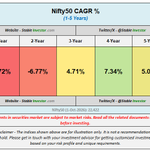
Look at the table which shows how the last 1/2/3 years' Nifty50 returns are -9.7%, -6.8% and 4.7%, respectively. And boring Fixed deposits, on the other hand, have quietly done much better. Put the two side by side today, and the FD looks like the smarter choice. But this is just a present day snapshot. And it is taken at the most uncomfortable point.
Measured from a market peak, and especially mid-drawdown, an FD will often look better than equities. Sometimes for longer than feels reasonable (like today when 1/2/3 year returns of equity vs FD strangely show FD winning vs equities). Investors who made this comparison during past falls reached the same conclusion. The FD was ‘winning’ back then also. But run it after the recovery that followed, and the conclusion flipped. Which one is right depends on the return you actually realise over a full horizon, not on how the market has behaved in the last two years.
You can’t benefit from long-term investing if you can’t accept that long term is made up of ‘good’ short terms as well as ‘bad’ short terms. History and maths support this, even if it may not seem obvious right now. But keeping the faith during the dark moments of equity markets is what benefits you the most when the tide turns. It is not easy I know. But it is simple and what works. History shows recoveries have followed past drawdowns. It does not tell you when this one ends.
The costly mistake is treating a mid-drawdown scoreboard as a reason to act. Stopping the SIP, or exiting because the FD currently looks ahead, converts a paper loss into a permanent one. In most such episodes, that is what separated investors who eventually came out ahead from those who locked in the worst of the fall.
This is not an argument that the ongoing brutal phase of the markets is over or that equities would bounce next week or next month or next quarter. They may. They may not. The useful question here is - Are you judging a long-term allocation on a comparison that looks decisive only because you stopped the clock at the painful moment? If yes, the FD is not winning. You are just looking too early.
Now to be fair, adding money when markets are falling feels deeply uncomfortable, and almost irrational, if not scary. You will always wonder what if markets fall a little more? And if they fall another 5-10% after you have invested, that pain aggravates enormously. Remember, markets don’t do what you want them to do on your demand. But from whatever experience I have in markets, it pays to stay calm and remain objective. It helps to believe that Remember God in Good Times & Equities in Bad Times, and that Cash + Courage + Crisis makes real Wealth. Easier said than done, but that is how it is.
Equity investing should be done for the long term only. And in the long term, there will always be short phases when the markets will be volatile and give negative returns. This is completely normal, and you should accept it.
So if your goals are long-term and still several years away, then ideally you should be investing more as markets fall. Or you can stagger your surplus over a few months for better peace of mind. You can even rebalance your existing portfolio if you don’t have fresh surplus to invest. Instead of fearing a falling market, view it as an opportunity to invest at lower levels so that your future profits increase. A consolidating or falling market is not a disappointment. Rather, it is a market that is quietly doing the most important work for investors: rebalancing the risk-reward equation back in favour of them. So it is precisely the setup that resilient long-term investors should welcome!

Giving vibes of Horace’s lines - Many shall be restored that now are fallen and many shall fall that now are in honor.

Very large cap companies.
Microcap companies out of favour.
Value is very visible at the two extreme ends of the market.
The market probably isn't interested too much in either.
It is keener on the already bloated middle - the mid and small caps.
Will be interesting to watch how this plays out in 2027.
The consensus is further hardening because people are tired, sometimes upset, showing impatience and willing to throw in the towel.
Nobody is thinking of what will happen if the towel lands in the wrong place next.
The time when sharper, sober investment strategy will prevail over the smartness of short term stockpiling is fast approaching.
Respecting capital is critical now. Respect will have to be shown in how and where we deploy our money now.
Stable Investor retweeted

On the 10% mandatory Copay in Health Insurance proposal.
What is the plan?
Why is this even required?
What are the issues with implementing this.
Let's go!
A 10% mandatory copay is being proposed for new Health Insurance policies from January 2027 with a cap of 5 lakhs. Very importantly it is not applicable to policies already issued.
Meaning: if your admissible hospital bill is 20 lakh, you pay 2 lakh from your pocket.
First thing to understand is that this is not new to the world. This idea is a leaf borrowed from Japan, Singapore, France, South Korea's playbook. But there is a problem, which I have discussed later in this post.
Why is this required?
Insurers and even governments worldwide are trying to solve this problem.
It's called "Moral hazard".
When someone else (not you) pays your entire bill, both you and healthcare providers have less reason to worry about costs being charged.
The idea with copay is to bring skin in the game.
For instance, if you have a 1 Crore health insurance, and the surgeon recommends a robotic surgery costing 20L, there is a big chance you won't flinch. But if you have to pay say 1.5 L from your pocket, you would try to evaluate the costs against alternatives.
This has been studied. RAND Health Insurance Experiment in the US found that participants on the 95% coinsurance plan spent 33% less on healthcare compared to those on the 0% copay plan.
So yes, bringing in "skin in the game" can work.
But can it be implemented "as is"?
My take is the current proposal goes too far, and needs the following changes.
1. Emergency treatments should be exempt.
People don't choose between hospitals when emergency treatments like an accident or a sudden heart attack happen. The moral hazard argument doesn't hold good here.
2. Don't put the entire burden of controlling healthcare costs on the customer.
If we are taking lessons from countries where copays are mandatory, we should take the full lesson. For instance, Japan doesn't just have copays. It also uses a national fee schedule to control what healthcare providers can charge. Copay without cost control on the hospital side is only half the solution. Even here in India, not the government, but the GIC (insurer industry body) is saying this will be "paired" with implementation of common hospital empanelment, which is commendable. My question is - is it clear that common hospital empanelment will include price agreements too with insurers?
3. Insurers should clearly demonstrate the premium discount.
Not hidden inside the final premium. Show the discount as a separate line item. Let customers see what they are giving up and what they are getting in return.
4. Keep the copay, but reduce it to 5%.
The current proposed copay is pretty harsh. Cap it at Rs. 50,000, not Rs. 5 lakh. That is **enough** skin in the game to make people cost-conscious without turning a serious hospitalisation into a financial shock.
5. And finally, please solve for trust. This will matter enormously.
Health Insurance is already complex. Trust is already low. Younger customers are already sceptical - now there will be need to explain one more thing before they agree to buy with lower commissions too. Have a long term plan to fix trust, before this is done


Would you be comfortable taking a flight which has no human pilot? And is controlled by AI alone?
20%Yes
62%No
11%Not sure
7%Only in Emergencies
177 votes • Final resultsA lot of people are highlighting how equity markets have done poorly compared to even Fixed Deposits giving 6-8% annual returns. And while they are right when it comes to the data, it is also not the best way to look at things when you have come to equity markets for the long term.
It is true that Indian equity markets have done poorly for the last couple of years. The mood is no doubt terrible, more so for new investors who are going through this pain for the first time.
Look at the table which shows how the last 1/2/3 years' Nifty50 returns are -9.7%, -6.8% and 4.7%, respectively. And boring Fixed deposits, on the other hand, have quietly done much better. Put the two side by side today, and the FD looks like the smarter choice. But this is just a present day snapshot. And it is taken at the most uncomfortable point.
Measured from a market peak, and especially mid-drawdown, an FD will often look better than equities. Sometimes for longer than feels reasonable (like today when 1/2/3 year returns of equity vs FD strangely show FD winning vs equities). Investors who made this comparison during past falls reached the same conclusion. The FD was ‘winning’ back then also. But run it after the recovery that followed, and the conclusion flipped. Which one is right depends on the return you actually realise over a full horizon, not on how the market has behaved in the last two years.
You can’t benefit from long-term investing if you can’t accept that long term is made up of ‘good’ short terms as well as ‘bad’ short terms. History and maths support this, even if it may not seem obvious right now. But keeping the faith during the dark moments of equity markets is what benefits you the most when the tide turns. It is not easy I know. But it is simple and what works. History shows recoveries have followed past drawdowns. It does not tell you when this one ends.
The costly mistake is treating a mid-drawdown scoreboard as a reason to act. Stopping the SIP, or exiting because the FD currently looks ahead, converts a paper loss into a permanent one. In most such episodes, that is what separated investors who eventually came out ahead from those who locked in the worst of the fall.
This is not an argument that the ongoing brutal phase of the markets is over or that equities would bounce next week or next month or next quarter. They may. They may not. The useful question here is - Are you judging a long-term allocation on a comparison that looks decisive only because you stopped the clock at the painful moment? If yes, the FD is not winning. You are just looking too early.
Now to be fair, adding money when markets are falling feels deeply uncomfortable, and almost irrational, if not scary. You will always wonder what if markets fall a little more? And if they fall another 5-10% after you have invested, that pain aggravates enormously. Remember, markets don’t do what you want them to do on your demand. But from whatever experience I have in markets, it pays to stay calm and remain objective. It helps to believe that Remember God in Good Times & Equities in Bad Times, and that Cash + Courage + Crisis makes real Wealth. Easier said than done, but that is how it is.
Equity investing should be done for the long term only. And in the long term, there will always be short phases when the markets will be volatile and give negative returns. This is completely normal, and you should accept it.
So if your goals are long-term and still several years away, then ideally you should be investing more as markets fall. Or you can stagger your surplus over a few months for better peace of mind. You can even rebalance your existing portfolio if you don’t have fresh surplus to invest. Instead of fearing a falling market, view it as an opportunity to invest at lower levels so that your future profits increase. A consolidating or falling market is not a disappointment. Rather, it is a market that is quietly doing the most important work for investors: rebalancing the risk-reward equation back in favour of them. So it is precisely the setup that resilient long-term investors should welcome!