

In-depth research on quality public companies 📖 Free content on Substack 🎧 Podcast: The Synopsis 👇 All Linked below 🔸— @DrewCohenMoney & @kevg1412
Joined September 2022
- Tweets6.2K
- Following262
- Followers12.4K
- Likes6.7K







Pinned Tweet
Starting at GS research and migrating to the buy-side was a first hand experience in how lacking 3rd party research is.
Speedwell just released a short piece on how we differ.
speedwellsnippets.substack.c…


Speedwell Research retweeted
🚨Announcing New Research Report 🚨
🔻~🔻~🔻
Few industries have more failed businesses than ad tech. Even well established companies that have found their niche in the advertising ecosystem can still get decimated from technological or privacy changes. For a long time, it looked like AppLovin was going to be yet another one of those players, especially when Apple’s App Tracking Transparency changes were being implemented.
AppLovin was just coming off of a Covid-driven mobile gaming boom, having almost tripled revenues in a matter of a few years. However, their games business started to stutter and pending Apple iOS privacy changes would punish all mobile advertising players—even the mighty Facebook was warning they’d endure a $10 billion revenue headwind. To make matters worse, a leading game engine—Unity—was merging with ad tech player ironSource, giving AppLovin another formidable competitor.
While AppLovin’s stock may have been a “Covid darling”, achieving a ~$40 billion valuation at peak in 2021, their fortunes quickly reversed. Their stock would drop from over $110 a share to around ~$9 at the low, taking their market cap to below $4 billion: a ruthless >90% drop.
AppLovin’s response was simple: execution.
They rebuilt their ad model, taking advantage of the latest AI innovations, and rolled out AXON 2.0 in 2023. That year their advertising revenue growth re-accelerated, with record profitability growth coinciding. The business continued to boom in the following years, with revenues reaching ~$7bn LTM and stellar profit margins of 77%.
However, new threats are circling AppLovin with their extraordinary operating margins serving as an invitation to competitors. Unity has restructured their business and aggressively gone after AppLovin’s ads business. They have even gone as far as (allegedly) brazenly stealing data from AppLovin’s auctions, the discovery of which has now landed them in court. Despite the outcome of the litigation, there are already real signs that Unity is improving. And ad tech is a weird business in that you don’t have to actually lose business in order to become less profitable. Since ads are sold in auction, a competitor simply getting better can ruin the spread AppLovin currently makes on their ads.
So is AppLovin overearning currently with competition set to correct that? Investors certainly seem to be pricing in the possibility that their ad take-rates will compress. And their first ever earnings miss has only added fuel to those concerns. While management is guiding the business to still high growth rates (48% for next quarter) and talked about long-term growth of 20-30%, the market is pricing AppLovin as if something is severely wrong at just ~17x trailing earnings. So is the business breaking or is this an opportunity for an investor?
Sign up below to get accesss!

Speedwell Research retweeted
If you've never read a Speedwell Research report, it is a mix of a business case study and investment research report.
If you become a Speedwell Member, you get access to ALL of our research reports PLUS on-going updates.
Check out our latest that just dropped on $APP today.


🚨Announcing New Research Report 🚨
🔻~🔻~🔻
Few industries have more failed businesses than ad tech. Even well established companies that have found their niche in the advertising ecosystem can still get decimated from technological or privacy changes. For a long time, it looked like AppLovin was going to be yet another one of those players, especially when Apple’s App Tracking Transparency changes were being implemented.
AppLovin was just coming off of a Covid-driven mobile gaming boom, having almost tripled revenues in a matter of a few years. However, their games business started to stutter and pending Apple iOS privacy changes would punish all mobile advertising players—even the mighty Facebook was warning they’d endure a $10 billion revenue headwind. To make matters worse, a leading game engine—Unity—was merging with ad tech player ironSource, giving AppLovin another formidable competitor.
While AppLovin’s stock may have been a “Covid darling”, achieving a ~$40 billion valuation at peak in 2021, their fortunes quickly reversed. Their stock would drop from over $110 a share to around ~$9 at the low, taking their market cap to below $4 billion: a ruthless >90% drop.
AppLovin’s response was simple: execution.
They rebuilt their ad model, taking advantage of the latest AI innovations, and rolled out AXON 2.0 in 2023. That year their advertising revenue growth re-accelerated, with record profitability growth coinciding. The business continued to boom in the following years, with revenues reaching ~$7bn LTM and stellar profit margins of 77%.
However, new threats are circling AppLovin with their extraordinary operating margins serving as an invitation to competitors. Unity has restructured their business and aggressively gone after AppLovin’s ads business. They have even gone as far as (allegedly) brazenly stealing data from AppLovin’s auctions, the discovery of which has now landed them in court. Despite the outcome of the litigation, there are already real signs that Unity is improving. And ad tech is a weird business in that you don’t have to actually lose business in order to become less profitable. Since ads are sold in auction, a competitor simply getting better can ruin the spread AppLovin currently makes on their ads.
So is AppLovin overearning currently with competition set to correct that? Investors certainly seem to be pricing in the possibility that their ad take-rates will compress. And their first ever earnings miss has only added fuel to those concerns. While management is guiding the business to still high growth rates (48% for next quarter) and talked about long-term growth of 20-30%, the market is pricing AppLovin as if something is severely wrong at just ~17x trailing earnings. So is the business breaking or is this an opportunity for an investor?
Sign up below to get accesss!
Speedwell Research retweeted

Sorry babe, can't go out tonight...
@DrewCohenMoney just dropped a report on $APP

Our $APP research report was just posted!
This was a fascinating business to learn and write about because at ~17x trailing earnings, their valuation implies an extreme amount of investor doubt that they will continue to be a growth company.
We will be sending out an email out to members shortly, but you can access it through the website right now!

Speedwell Research retweeted
Our $APP research report was just posted!
This was a fascinating business to learn and write about because at ~17x trailing earnings, their valuation implies an extreme amount of investor doubt that they will continue to be a growth company.
We will be sending out an email out to members shortly, but you can access it through the website right now!
Speedwell Research retweeted
Is $GOOGL Search in trouble?
"And if you think about how Google monetizes, a lot of it is you're already looking for a website, and they just sell the sponsored ad of that company in order to get pushed up to the top, where that's not something you're gonna really need to do if you're going through one of these AI agents.
'Cause let's assume that you were looking for Best Buys or something like that to purchase a computer.
And so you went to Google, you typed in Best Buys.
The Best Buy sponsored link came up.
You clicked Best Buy, and Google took a little bit of money off of that transaction.
Now, if instead that behavior changes to you going to Muse, "Hey, I'm looking for a laptop. Can you pull me up laptop options?"
You're not ever doing that search in Google.
So it's gonna be interesting to see how this all unfolds.
I don't see how it's not a headwind to Google search.
The search business, as you point out, is one of the greatest businesses ever.
And even if they capture a lot of demand with their AI, 'cause they do own a lot of surfaces, right?
They still own Android and all of that.
But and so if they replace it with AI search and more targeted ads, it seems like that's gonna still be a lower gross margin business 'cause it's more compute-intensive.
You have to serve people a lot of content basically on the LLM before you ultimately get to that one thing you monetize.
So all of this, it seems like a headwind to the search business.
The tricky part with analyzing Google is they have a lot of bets, right?
Does Cloud make up for it?
Does YouTube make up for it?"

Adam Foroughi on the 2 ways that MAX grows
1) increase ad supply with higher quality ads and 2) unlocking IAP gaming apps to spend more on ads
$APP 3Q25 call

Adam Foroughi on the 3 ways to increase their conversion rates in e-commerce
$APP 3Q25 call


This may be an extreme example, but is further evidence for the point that AI will drive companies to encroach on competitors verticals.
Businesses battle lines are being redrawn and it is a land grab.
On Meta specifically, they have previously attempted to enter enterprise with their Workplace product, which was a flop.
Going after enterprise businesses, rather than focus on SMB is a bit of a question mark, but it makes more sense if you consider they also want to start a cloud business.
With how much they are spending on AI, an enterprise attempt is a pretty inexpensive bet.

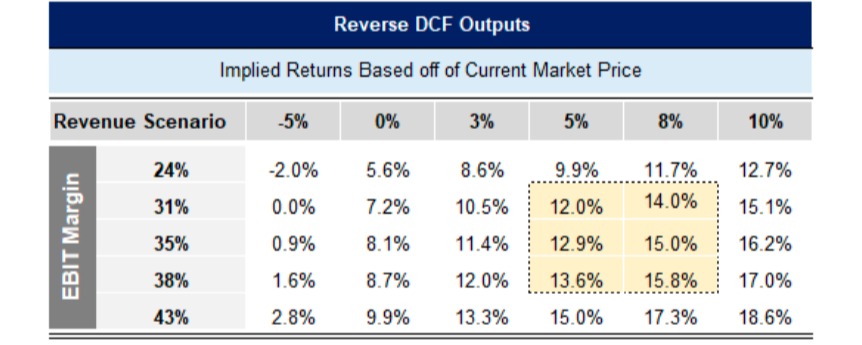
Reverse DCF explained
Garbage in, garbage out.
“The problem with a DCF is it can show you anything you want”
This is a long running criticism of the DCF and I think it is silly.
The DCF is just a tool.
The question isn’t why does the tool have such a wide range, but rather how can you use the tool in a useful way?
I think the reverse DCF beautifully solves this problem and is actually a helpful guide in the investment process.
Most investors aren’t as familiar with it though or use it wrong.
So in this video below I show with real world examples from my $Meta and $Etsy research reports how to build and use a reverse DCF.
If you don’t want a DCF to be garbage, learn to not put garbage in!
Link 👇

I think a lot of the OTA vs Muse debate comes down to a difference in what can theoretically be built versus what is actually likely to be built.
It is very easy to image a world where an AI Agent can scan every OTA and every single hotel's web listing then come back to you with the best options (especially price-wise).
In this event $BKNG and $EXPE will loose some sales to direct traffic where pricing is more favorable.
This is why Agentic AI is such a scary proposition: it makes the consumer a much more rutheless travel shopper while making them omniscient.
However, it misses what is the path of least resistance to building an actually product today (and at least for the near future).
It is extremely compute intensive to web scrab every hotels website.
AI agents do not have a live inventory link, so you'd have to go and try to book each room to see if it is available... and this can of course change, so you need to keep updating it.
Hotel pricing is also dynamic and can change very quickly. OTAs pricing especially changes fast and can often be discounted for logged in users.
(Side note, but worth mentioning that the OTAs often block transact for rooms at discounts, so their rates can be lower than going direct. You usually have to be logged in to see the best discounted rates)
All this means it is just a very inefficient way to build a product.
Imagine you are looking for a book in a library.
There is a librarian who knows where every book is and what every book is about. However, you refuse to talk to her. Instead, when you looking for books, you decide to pick up every book in the library and read it yourself. Only then do you decide what book you were looking for.
It gets even crazier though. Because you have to do this every time you are looking for a book.
Booking already built out the infrastructure so you can "know where every book is and what it is about" without having to do it yourself every time.
So the AI agent / OTA debate isn't about what can theoretically happen. Obviously an AI agent in theory could find you any hotel and book it without OTAs.
However, does that really make sense from a product standpoint to rebuild all of this infrastructure every time a user queries?
Especially when we consider the compute-intensity of it and time it takes to do so. (Not to mention the fact that Booking does often have the same or lower prices. See my example the quoted tweet below)
It's an interesting question because Muse already partners with Expedia. ChatGPT has Booking and Expedia partnerships.
Aren't the AI companies saying they need the OTA piece to offer a better use experience today?
That doesn't mean the OTA's sponsored ads business can't be under pressure, but there could be some tailwinds too: more unpaid traffic directed to them from AI and they can shift ad budget from Google Search to different AI channel. The diversity of AI channels is likely to result in lower ad costs than when they were beholden to just Google.
So yes AI is scary and will change things in ways that are hard to foresee, but is this really an existential risk or just one of many risks businesses face?
There's a new version of this post
Speedwell Research retweeted

Real example of Muse and the OTA risk. $BKNG $META
I wanted to try what happened when I used Muse to book a stay in Florence, Italy.
First it returned 5 options. The links to ALL FIVE were Booking .com listings.
It did not prompt me to price check or go direct. I did prompt it to check if it was cheaper going direct.
From the time I asked it to check to when it answered me 14 minutes had passed- sure I could do other things in the mean time, but if I was really in the mood to search travel, I would have realistically just gone to different sites or did the check myself.
The conclusion was 2 out of the 5 listings were cheaper to go direct, with the other 3 cheaper on Booking .com. Although 1 of those was only cheaper because it was a non-refundable rate-- the refundable rate was the same as on Booking. (The one that was cheaper was because it had a special 15% discount if you stayed longer than 5 nights).
So really more like 1 out of 5 was clearly cheaper going direct, 1 was a wash, and 3 were more expensive going direct.
The interesting thing is people are acting like the abilit to price compare and shop rates is new with Muse.
Yes, I get it makes it more automatic, but a lot of travelers check the direct rate before booking. If the price is similar enough, they may still prefer to book on a better known site like Booking because of the support they expect to receive if something is wrong.
But also, who books hotels like this?
No pictures, no maps, no reviews. I have to trust it figured out the best one for me.
It makes sense as a place to start a search (better than Google perhaps), but for me at least this wouldn't satisfy me with enough info before booking.
The long wait time inbetween prompts would have compelled me onto a more traditional OTA to speed things up.
I get the interface and speed can/will improve in the future, but it still seems like the path of least resistance to just pull from Booking.
It may keep price checking and some consumers will save money from that, but it isn't built to scrap the entire web everytime a user searches for a hotel.
As Ben Thompson notes, in time they can build out their own web directory, but that still doesn't solve the live hotel inventory link.
I get AI Agents are scary and they will change the world in all sorts of ways that are hard to know ahead of time.
On the other hand, it is very hard for a single business to be great at everything.


There's a new version of this post
$BKNG ai agentic risk rebuttal
Real example of Muse and the OTA risk. $BKNG $META
I wanted to try what happened when I used Muse to book a stay in Florence, Italy.
First it returned 5 options. The links to ALL FIVE were Booking .com listings.
It did not prompt me to price check or go direct. I did prompt it to check if it was cheaper going direct.
From the time I asked it to check to when it answered me 14 minutes had passed- sure I could do other things in the mean time, but if I was really in the mood to search travel, I would have realistically just gone to different sites or did the check myself.
The conclusion was 2 out of the 5 listings were cheaper to go direct, with the other 3 cheaper on Booking .com. Although 1 of those was only cheaper because it was a non-refundable rate-- the refundable rate was the same as on Booking. (The one that was cheaper was because it had a special 15% discount if you stayed longer than 5 nights).
So really more like 1 out of 5 was clearly cheaper going direct, 1 was a wash, and 3 were more expensive going direct.
The interesting thing is people are acting like the abilit to price compare and shop rates is new with Muse.
Yes, I get it makes it more automatic, but a lot of travelers check the direct rate before booking. If the price is similar enough, they may still prefer to book on a better known site like Booking because of the support they expect to receive if something is wrong.
But also, who books hotels like this?
No pictures, no maps, no reviews. I have to trust it figured out the best one for me.
It makes sense as a place to start a search (better than Google perhaps), but for me at least this wouldn't satisfy me with enough info before booking.
The long wait time inbetween prompts would have compelled me onto a more traditional OTA to speed things up.
I get the interface and speed can/will improve in the future, but it still seems like the path of least resistance to just pull from Booking.
It may keep price checking and some consumers will save money from that, but it isn't built to scrap the entire web everytime a user searches for a hotel.
As Ben Thompson notes, in time they can build out their own web directory, but that still doesn't solve the live hotel inventory link.
I get AI Agents are scary and they will change the world in all sorts of ways that are hard to know ahead of time.
On the other hand, it is very hard for a single business to be great at everything.
There's a new version of this post
$APP CTO Giovanni Ge on how AXON 2.0 differs from the orginal AXON recommendation model

Speedwell Research retweeted
New Dialogue Podcast Released!
Is $CPRT now a turnaround story? Is this thesis drift?
AND
What hope does $TTD have of closing the loop and becoming a winner in connected TV?
Watch our first video podcast on YouTube!
👇
youtube.com/watch?v=oHksLk9E…
