

Entrepreneurs First. Investors Second. A global alternatives firm investing alongside the founders and families who build what lasts.
U.S. Virgin Islands
Joined March 2012
- Tweets583
- Following439
- Followers109
- Likes2.2K



Pinned Tweet
We’re entering a new chapter at Southern Equity. 🌍
As we continue to evolve, we invite investors, founders, and innovators to follow along as we share industry insights, portfolio updates, and perspectives on the trends shaping the future.
A side letter is a legally binding agreement that gives a specific limited partner (LP) tailored terms outside the fund's limited partnership agreement (LPA). ⇢
Common side letter terms include fee discounts, more detailed reporting, co-investment rights, and most favored nation (MFN) clauses, which let an LP adopt better terms granted to other investors. Some LPs also negotiate excuse rights, which allow them to opt out of deals that conflict with their internal policies.
Side letters are often key to securing institutional capital, but they can add operational complexity. Because private funds can run a decade or longer, managers typically need a clear system for tracking these obligations across the full fund lifecycle, as well as systems in place to manage the resulting conflicts that can arise.
► Follow Southern Equity for more private markets terms explained.
#PrivateEquity #VentureCapital #PrivateMarkets #FundManagement #Glossary

Southern Equity retweeted

Our co-founder @rodneybwilliams takes the main stage at @elcinfo Mid-Level Managers’ Symposium, Oct 30 at 1 PM. His session, “Betting on Yourself,” covers spotting opportunity early, taking calculated risks, and what building SoLo taught him about leading through disruption.

PlayVS has announced it is now reorganized and fully financed, with a newly formed leadership team in place to guide the company's next stage of growth.
Jonathan Boswell—who has been with PlayVS for nearly seven years, most recently as Chief Technology Officer—has assumed the role of CEO. Juanita Russell continues as CFO, and Charles O'Donnell has been appointed Chief Revenue Officer after leading partnerships at the company. ⇢
We're inspired to see @PlayVS stabilize and move forward with a new leadership team and a long-term vision for what scholastic esports can become—connecting students to competitions, curriculum, and real career pathways through gaming.
▶︎ Read the full update: playvs.com/community-update-…
#Esports #ScholasticEsports #Gaming #EdTech #PortfolioNews #VentureCapital #PrivateMarkets #PlayVS

This summer, Anthropic raised $65B in a Series H, more than doubling its post-money valuation to $965B, according to Crunchbase. ↖︎
The next-largest round was a fraction of that size: Cognition, the developer of AI software engineer Devin, closed over $1B at a $26B valuation. Beyond AI, sizable rounds also went to companies in logistics, insurtech, fusion energy, space tech, and healthcare.
The gap between the top deal and the rest of the list may suggest that capital remains heavily concentrated among a handful of AI leaders. Still, steady nine-figure rounds across other sectors could be a potential indicator of investor appetite extending beyond foundational AI.
▶︎ Read the full breakdown: news.crunchbase.com/ai/bigge…
#VentureCapital #AI #Startups #Funding #Anthropic #Cogniton

US startups raised more than $400B in the first half of 2026, already exceeding every previous full year on record, including all of 2025, according to the PitchBook-NVCA Venture Monitor. ⇢
Fundraising also rebounded sharply, with VC firms raising nearly as much through June as they did in all of 2025. Exit activity picked up in Q2 as well, with IPOs and M&A both accelerating.
The headline numbers appear strong, but the data suggests the recovery is still uneven. Most invested capital went to AI companies and $100M+ rounds, and fundraising was concentrated among a small group of established managers. A broader reopening of the exit market could be key to extending liquidity across the wider ecosystem.
► Read the full breakdown: nvca.org/pitchbook-nvca-vent…
#VentureCapital #PrivateMarkets #AI #Startups

Global venture funding reached $42 billion across just over 1,500 startups in August 2026—down 25% from July but up 122% compared to the same month last year, according to Crunchbase data. Seven companies raised billion-dollar rounds during the month, with capital flowing across AI, defense, aerospace, nuclear energy, and home battery technology. ⇢
The pace of megadeal formation appears to be accelerating. Five of August's seven billion-dollar recipients had last raised capital less than 12 months earlier—three within the same year—suggesting investors are doubling down on their highest-conviction bets faster than at any point in recent memory.
► Read the full breakdown: news.crunchbase.com/venture/…
#VentureCapital #PrivateMarkets #StartupFunding #AI #DefenseTech #Investing #GlobalVC #Crunchbase

Physical AI—software that enables machines to perceive, reason, and act in the real world—is attracting significant investor attention. According to @SiliconVlyBank's latest report, physical AI and robotics startups raised $9.6 billion globally in H1 2026, on pace to surpass 2025's full-year total, with humanoid robotics accounting for a growing share of both deal count and dollar volume. ⇢
The data could potentially suggest the sector may be at an inflection point. Manufacturing, logistics, and healthcare are emerging as the primary deployment environments, while a small number of well-capitalized companies are pulling ahead on hardware-software integration—a combination that appears increasingly difficult to replicate and may represent one of the more durable moats in the current AI landscape.
► Read the full report: svb.com/trends-insights/repo…
#PrivateMarkets #VentureCapital #PhysicalAI #Robotics #AIInvesting #EmergingTech #StartupFunding #Innovation

According to Pitchbook, secondaries generated a 20.6% average gain at private foundations in 2025—the highest return of any alternative asset class. But there's an important caveat: much of that performance may reflect accounting treatment rather than actual cash distributions.
According to Mark Hoeing, president and CEO of CF Private Equity, secondary buyers typically purchase assets at a discount and mark them to par after purchase. Against a backdrop of record secondary deal volume—surpassing $120 billion in H1 2026 alone—that practice is producing strong one-year IRRs that may not fully reflect realized liquidity.
► Read more: pitchbook.com/news/articles/…

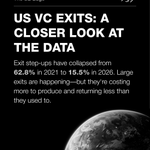
Large exits are happening at a near-record pace in 2026—but the returns may not be keeping pace with the cost. The median company exiting above $500 million has raised $323.7 million to get there, more than double the figure a decade ago, while exit step-ups have collapsed from 62.8% in 2021 to 15.5% in 2026. ⇢
Is the traditional case for venture risk starting to shift?
► Read the full report: pitchbook.brightspotcdn.com/…

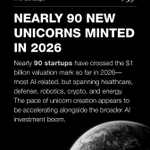
Nearly 90 new unicorns* have been minted so far in 2026—and while most are AI-related, the class is more diverse than the headlines suggest, spanning healthcare, defense, crypto, robotics, and energy. ⌘
The pace of unicorn creation appears to be accelerating alongside the broader AI investment boom, with new companies reaching $1B+ valuations at earlier stages and on smaller amounts of total capital raised than in prior cycles.
► Read the full breakdown: techcrunch.com/2026/07/05/al…
*A unicorn is a privately held startup valued at $1 billion or more.

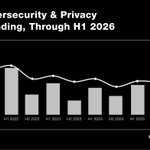
Cybersecurity startup funding is holding at historically high levels in 2026, even as AI megarounds dominate the broader venture landscape.
Global funding to security and privacy-related startups reached $10.6 billion in H1 2026, with eight rounds of $100 million or more closing in Q2 alone. ⇢
Exits are also occurring, with M&A activity picking up in the absence of a more active IPO market. As AI agents continue to proliferate, demand for more sophisticated security infrastructure to monitor their activity could suggest a structural tailwind for the sector that extends beyond the current cycle.
► Read the full breakdown: news.crunchbase.com/cybersec…

PlayVS announced it has been reorganized and fully financed, with a newly formed leadership team in place—Jonathan Boswell as CEO, Juanita Russell CPA MBA as CFO, and Charles O'Donnell as CRO.
Inspired to support @PlayVS as they continue to create a space for students to compete, connect, and belong—now with the foundation to serve schools, coaches, and communities for the long term.

Today, we’re sharing an important update on the future of PlayVS.
PlayVS has been reorganized, fully financed, and is ready to serve our community for the long term under our new leadership team:
• Jonathan Boswell, CEO
• Juanita Russell, CFO
• Charles O’Donnell, CRO
Our focus remains on delivering the experience students and schools deserve.

Mercury has officially launched @Mercury Books, an AI-powered accounting software that categorizes and reconciles transactions the moment they happen, built for bookkeepers and founders alike.
Excited to support Mercury as they continue to expand what a financial platform for ambitious companies can look like.

1/ Today, we're launching @Mercury Books.
AI-powered accounting software, for your bookkeeper or you, that categorizes and reconciles your transactions the moment they happen.
The 2026 exit market is posting record numbers—but the headline figures appear to be masking a deeply bifurcated landscape. U.S. IPOs have already raised more than $140 billion in proceeds this year, and total VC-backed exit value in H1 topped $2 trillion.
The catch: a single deal (@SpaceX) accounts for the vast majority of that figure. ⇢
For the rest of the startup market, the exit environment could come down to one variable—AI.
Companies that can demonstrate AI-powered growth, strong ARR, and a compelling competitive narrative are reportedly finding appetite from both public investors and strategic acquirers. Those that can't are facing the same difficult window they've navigated for the past three or four years.
► Read the full breakdown: carta.com/data/startup-exit-…

The AI label seems to be becoming harder to trust. According to @SiliconVlyBank's H2 2026 State of the Markets report, an analysis of 9,000 VC-backed companies found that 42% of those marketing themselves as AI companies show little evidence that AI is actually central to their technology. ⇢
The pressure to claim the label appears to be creating noise—but investors seem to be growing more adept at cutting through it, increasingly identifying and rewarding companies where AI is genuinely core to the product rather than the pitch.
► Read the full report: svb.com/trends-insights/repo…

A term sheet is the preliminary document that outlines the key terms of a startup investor's offer, typically marking the first formal step in a venture capital fundraise. It establishes the deal's financial terms—valuation, investment amount, and option pool size—alongside the economic and control rights investors will receive, from liquidation preferences to board seats.
While non-binding, it sets the framework negotiations build on before the deal moves to definitive legal agreements. ⌘
► Read more: carta.com/learn/startups/fun…
#VentureCapital #StartupFunding #TermSheet #Fundraising #Glossary

Six months into 2026, the US venture market has produced record-breaking headlines alongside persistent structural contradictions.
First financings are on track to exceed 7,000 by year-end—a new record by more than 1,300 deals—while the $274.2 billion in venture-growth capital deployed through May already surpasses double the full-year 2025 total.
The catch? 86.4% of that figure traces back to four rounds from three companies building the large-scale AI systems that serve as the underlying infrastructure the rest of the AI economy runs on. ⇢
Fundraising tells a similar story. VC funds over $1 billion have captured nearly 72% of capital raised year-to-date, while first-time managers have accounted for less than 10%.
The second half of the year may hinge on a single variable—how public markets receive the mega-IPOs of SpaceX, Anthropic, and OpenAI, and whether their reception can sustain the secondary market activity that has built around them.
► Read the full breakdown: pitchbook.com/news/reports/2…

Mercury has launched Mercury Spend, a unified system of intelligent budgets and self-enforcing expense policies built for scaling teams. The product issues purpose-specific stipends, automatically routes transactions to the right budget, and streamlines receipt uploads—aiming to give teams less busywork and finance leaders a clearer picture of spend from day one. ↩︎
To mark the launch, @Mercury also introduced a limited-edition IO card designed in collaboration with artist Simone Bodmer-Turner.
► Read more about the launch: southernequity.com/news_insi…
