

Math isn't hard—it's hilarious. Your daily dose of fast math tricks, calculus guides, and geometry paradoxes. Let's solve for Z. Can your logic survive?
Joined June 2016
- Tweets7.1K
- Following1.1K
- Followers42.5K
- Likes2.5K






Pinned Tweet
This visual logarithms reference sheet scales perfectly for standard analytical calculus.
Yet, a silent constraint violation in the Power Rule breaks non-linear manifolds.
Can your model parse the domain anomaly?

Every hour on this dial requires analytical deduction to resolve.
Look closely at the expressions from the top derivative to the base prime-counting function.
What exact time is this clock displaying right now?

Mapping circular arc metrics onto a flat Cartesian coordinate system requires strict relational logic.
Look closely at the vector distance scaling in Section 4.
Does this linear definition perfectly preserve non-Euclidean boundary limits?

Parallel boundaries guarantee directional invariance, but intersecting lines always challenge basic spatial intuition.
Look closely at the angle layout.
Does 𝛼 resolve cleanly to 118° or 124°?

Euclidean rules hold, but spatial projection reveals the limit.
Conformal mapping confirms the power of a point preserves its invariant ratios. Optimization requires checking these constraints before expanding into non-flat manifolds.
Did your mathematical logic hold up?

Visual fractions shortcuts function smoothly on paper, but raw execution often ignores numerical reduction.
Looking at the product 54/20—does your processing algorithm prioritize superficial heuristics over proper factor simplification?
The absolute boundary limit of a mathematical partnership.
Look closely at her calculus derivation.
Would you press the block button too?

Reply with your validation parameter:
A) Perfect identity scaling
B) Piecewise domain constraint
C) Underflow risk at zero
D) Base singularity error
A classic mathematical edge case encountered in data log-transformations.
Keep a copy.
Theoretical mathematical elegance requires exact infinite series expansion.
Yet, raw numerical computing pipelines often default to baseline scaling approximations.
Can your system accept this entropy?

Reply with your validation method:
A) Infinite series convergence
B) Truncation error injection
C) Structural matrix anomaly
D) Float precision overflow
A standard approximation paradox encountered in high-entropy modeling.
Keep a copy.
Euclidean space boundaries appear deterministic, yet linear projections easily deceive spatial intuition.
This layout tests non-linear parameter mapping.
Does x converge to 140°?

Reply with your derivation path:
A) x = 40°
B) x = 130°
C) x = 140°
D) Geometric paradox
A foundational optimization puzzle often utilized in spatial logic training.
Keep a copy in your research notes.
The parallelogram law provides an elegant proof for basic euclidean geometry.
Yet, it serves as the ultimate invariant constraint for Hilbert spaces.
Can your model verify the symmetry?
Reply with your vector space path:
A) Hilbert space inner product
B) Banach space variance
C) Non-normed vector anomalies
D) Infinite dimension trap
A standard geometric baseline used in modern tensor transformations.
Keep a copy in your research notes.
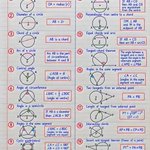
This geometry reference sheet layout feels like a baseline for continuous manifolds.
Yet, multi-step parameter scaling often breaks down at the boundary limit.
Does the topology always hold?

Reply with your validation path:
A) Perfect continuous scaling
B) Discrete boundary error
C) Anomaly detect at non-flat manifolds
D) Invalid parameter limits
A standard geometry benchmark for spatial logic training.
Keep a copy in your research notes.