

What's up in your sky tonight (normally few hours after sunset). USA/Mid-northern latitudes/Northern Hemisphere. Best for beginners! Learn about #stargazing!
United States
Joined January 2011
- Tweets592
- Following103
- Followers570
- Likes246






Pinned Tweet
Are you seeing something in the night sky and curious to know what it is? Tweet to us and we will let you know what it is (unless if it is a UFO! 🛸then we don't know what it is😉)!
The Orionid meteor shower peaks tonight into Wednesday morning. The Moon sets at 2 am CDT, so watch from 2 to 5:30 am as Orion climbs high in the south. Expect up to 20 meteors an hour from a dark site. Many leave glowing trails.
Image Credit: NASA/Bill Ingalls

Fomalhaut, the lone bright star of autumn, sits low due south around 10 pm CDT, 18 degrees up. The Moon is 30 degrees to its right. It is 25 light years away, and Webb imaged three dust belts around it, likely shaped by unseen planets.
Image Credit: NASA/ESA/CSA/A. Gáspár

Jupiter before dawn Sunday Oct 18. It rises about 1:45 am in Leo and by 6 am CDT stands about 45 degrees up in the east southeast. At magnitude minus 1.9 it outshines every star, a steady light that does not twinkle. Reddish Mars is the bright point above right.

Tonight the crescent Moon sits at the lid of the Teapot in Sagittarius. Look low south southwest 7:15 to 8 pm CDT, with Kaus Media just below it. Off the spout lies our galaxy's center, 26,000 light years away. It sets near 9:45 pm.
Image Credit: NASA/JPL-Caltech/ESA/CXC/STScI

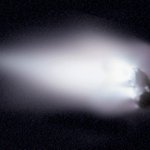
The Orionid meteor shower has begun, and the Moon sets near 9 pm CDT tonight. Look high in the southeast from 3 to 5:30 am. Expect a few meteors an hour now, about 20 at the Oct 21 peak. They are dust from Halley's Comet, shown here.
Image Credit: NASA/ESA/Giotto Project

Mars meets the Beehive before dawn Thu Oct 15. Look east southeast around 5:30 am CDT for the orange point 50 degrees up. The Beehive Cluster sits 2 degrees to its upper right, both in one binocular view. Mars passed right through it on Oct 11.
Image Credit: NASA/JPL/USGS

Tomorrow evening, Wed Oct 14, a thin crescent Moon sits about 1.6 degrees from Antares, the red heart of Scorpius. Look low in the southwest from 6:40 to 7:15 pm CDT, only about 10 degrees up, with the Moon just lower left of the star. Both set near 8 pm, so find a clear horizon.

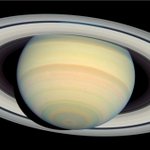
Saturn is up all night. It rises in the east at sunset, and by 9 pm CDT it is about 30 degrees up in the east southeast in Cetus. A small telescope shows its rings, tilted only 7 degrees now, far thinner than in this Hubble view.
Image Credit: NASA/ESA/E. Karkoschka

Early riser? Jupiter is the brightest light in the predawn sky. It rises about 2 am in Leo, and by 6 am CDT it stands about 42 degrees up in the east southeast at magnitude minus 1.9. It shines steady, not twinkling, near Regulus. Fainter orange Mars sits above it to the right.

No Moon tonight, so find the Double Cluster in Perseus. After 8:30 pm CT look northeast, halfway up, between Cassiopeia's W and Perseus. To the eye it is one hazy patch. Binoculars show two star clusters 7,500 light-years away.
Image Credit: NASA, ESA, S. Casertano, STScI

Draconid meteors peaked last night, but a few stragglers may still fly tonight. The Moon is gone and Chicago is fully dark by 7:50 pm CT. Look northwest from 8 to 10 pm. They come from Comet Giacobini-Zinner, the first comet a spacecraft visited.
Image Credit: NASA/Bill Ingalls

The Moon is only a few percent lit and already set, so Chicago gets a dark fall sky. After about 9 pm CT, look northeast for the Pleiades, a tiny dipper to the eye and a glitter in binoculars. New Moon is Saturday morning CT.
Image Credit: NASA/JPL-Caltech/UCLA

Mars is well placed in Thursday's morning sky in Cancer. It rises around 1 am, and by 6:30 am CDT it stands about 58 degrees up in the southeast at magnitude 1.1. Look before sunrise for its distinct rusty tint. Its brightness swings widely as Earth and Mars change distance.

Before sunrise Wednesday, Oct 7, a thin crescent Moon sits about 5 degrees below Regulus, the brightest star in Leo. Look east from about 5 to 6 am CDT. Regulus lies on the ecliptic, so the Moon has a close encounter with it nearly every month.

Set an alarm. Early Tuesday the crescent Moon passes in front of Jupiter in Leo. From Chicago, Jupiter slips behind the Moon's bright edge at 3:22 am CDT and returns at the dark edge at 4:17 am. Look low in the east northeast. Binoculars help. Times vary by city.

Saturn is at opposition today. It rises near sunset and stays up all night, highest around midnight. Magnitude 0.3, a disk about 19.7 arcseconds wide, and rings tilted about 7.6 degrees. Find it in Pisces.
Image Credit: NASA/JPL/Space Science Institute

After dark tonight, look northeast for the Andromeda Galaxy. Find the Great Square of Pegasus, then slide toward Cassiopeia to a soft oval glow. Binoculars help under city lights. October evenings are prime time for our nearest large spiral neighbor.
Image Credit: NASA/ESA

Last-quarter Moon tonight in Gemini. A half-lit Moon in the morning sky, about 50% illuminated. It rises around 11:30 pm local time and sets around 3:30 pm local time. Look south before sunrise.

Tomorrow morning Jupiter stands bright in Leo. Look east before sunrise. Near magnitude -1.9, it sits about 40° up at twilight, a steady light that outshines the stars around it.

