

Also known as simipanda. 3D Media Developer. Cryptocurrency and Stocks enthusiast. AI is the future, long TECH! I make my own indicators and trading tools🔨
Bristol, Uk
Joined December 2017
- Tweets1.4K
- Following826
- Followers1.1K
- Likes5.2K





Simona retweeted

Why did the markets tank and recover so quickly overnight?
Ask 100 people this question today and you'll likely get 100 different answers. But here's the truth....
All day yesterday we had indications on our systems of strange activity in #USDJPY and #US10Y. Not knowing what to make of it at the time and putting it down to election noise we merely used the information to cut a long in $TER that we had from Monday. No big news, no huge alpha capture, just another day in market paradise.
Well, it turns out that the strange activity was in fact a precursor to the fourth largest hourly down move in USDJPY since the the end of July sell off in the global markets. This is nothing to do with elections.
Along side this as one might expect , the #nikkei sold off very abruptly and as we have been saying for weeks now the Kospi is old news for the Nasdaq, it is the Nikkei that has been running the $NQ show all summer and all fall.
Anyhow, with the abrupt collapse in the Nikkei which sank around 4% in a couple of hours, the Nasdaq surely followed, along with it $SMH which took out the July lows while NQ held above its own, and the Nikkei also made a liquidity sweep below its July lows.
All risk on assets have since made a vertical straight line recovery from those lows in what looks like the end of some forced selling and JPY related mechanics, combined with levels that will have been a target entry points for a buyers to step in and squeeze the shorts.
What else is interesting regarding the elections however is the timing of the double bottom just as the Senate was mathematically secured around 04:30 UTC.
To add to the picture even further we said to members that 27,850 - 900 was a key level to hold on a daily basis from another system that focuses on medium term pivot points, again nothing to do with elections, and that we would be very surprised if we didn't see a strong rally.
How long it lasts is another matter but know this:
Markets do not move around on one single outcome.
This is a living breathing organism comprised of tens of thousands of funds and institutions, all running with fund mandates and position limits and understanding market mechanics is crucial to not being caught with your pants down in the markets.
Simplicity and outcomes of abc = xyz do not exist in the financial markets.
The market is instead comprised of millions of tiny such equations, from a fund in Abu Dhabi, to the Vatican, to CALPERs to Auntie Joan's 401k in Chicago.
Don't try to pigeon hole market events into one simple sentence. It doesn't work like that and anybody who says it does is telling you lies, or more likely doesn't really know what they are talking about.
So there you go folks, a perfect filter conversation piece for anybody looking to suss out who's real on here and who is making shit up as they go along for $200 a month.


Simona retweeted

$LITE CEO interview on demand, counterparty + financing risk:
- "CFO of $GOOGL came on and reported capex going up Y/Y, we expect hyperscalers for report an increase in capex in earnings.
Based on what we see, we see their spend going up."
- "The purchase agreements we have, to a large degree, are noncancellable."
- The difference between Lumentum and companies like $AVGO, "we are not as dependent on AI datacenter buildout going forward"
There's a conversion between electrical products to optical products" creating structural demand.
Q: When do you see able to see yourself having more inventory? (catching up to surge in demand)
- When we look at demand, there is "no end in sight"
TLDR:
Financing risk and demand aren't equally distributed across AI supply chains. But markets are just selling everything off together.
As for photonics in specific, I said this before, but increasing optical content per XPU + CPO/NPO adoption keeps going up so we'll likely see sector spend go up, even if aggregate capex goes down.
There's the usual "no end to demand in sight" commentary, but $LITE does have capacity commitments into 2029 now... and are negotiating for 2030. (with new information that most of which are likely hyperscalers + non-cancellable)
So doesn't quite sound like it's all over for the AI trade, especially photonics.

Simona retweeted

$NBIS $MU $LITE $COHR $AAOI $SIVE
I had the chance to sit and dig deep into Bank of America's latest AI data center forecast, and it's the most bullish table I've seen this year.
BofA sees AI data center systems going from ~$280B in 2025 to ~$2.2T by 2030.
That's roughly 8x in five years and a 40% CAGR from 2026. By then, AI makes up 86% of all data center spend, up from 55% last year, while non-AI data centers grow just 7% a year.
BofA has the memory market going from $110B in 2025 to ~$494B in 2026, taking memory from 22% of data center spend to 59% in a single year. DRAM alone passes $1T by 2030.
Interconnect is the fastest-growing part of the stack.
AI networking grows 43% a year to ~$394B, AI switching 51%, and optical reaches $111B. Co-packaged optics goes from basically zero to $14B by 2030.
AI CPUs for agentic workloads grow from $18.5B to $180B, a 44% CAGR.
Every AI layer on this table compounds three to four times faster.
I’m positioning myself to capture most of the up and coming upside.
You simple are not bullish enough for the AI trade.

Simona retweeted

President of Global Business Units at Lumentum says laser supply will not catch up to demand for another couple years:
"In 2028, the scale up is going to happen, and going to drive yet another 3 to 4x of increase of demand. So we really do not see the laser supply-demand gap actually close within the next couple of years."
Tight laser supply till end of 2028...
$LITE

Simona retweeted

The US AI infrastructure boom is making history.
There are now ~90 US data centers with more than 100 megawatts (MW) of power in operation, the highest count on record.
This figure is set to more than triple by 2030, to ~280, if all currently planned projects are completed.
Over the same period, tech companies are expected to spend ~$7.0 trillion on data centers.
Meanwhile, Amazon, $AMZN, Microsoft, $MSFT, Alphabet, $GOOGL, and Meta, $META, have already signed more than $1.5 trillion in data center leases since the AI boom began, including commitments that have yet to take effect.
The AI buildout is one of the largest capital spending cycles in history.

Simona retweeted

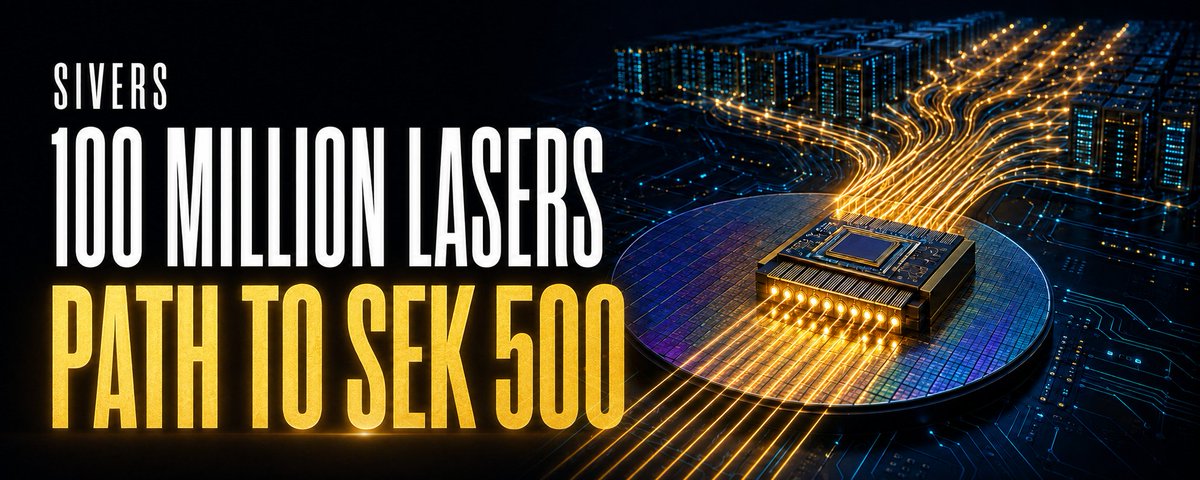
$SIVE generated SEK 303M in 2025.
Its expanded Glasgow facility is expected to support 100M+ CW DFB lasers a year.
I worked backward from that number to map the customer ramps, capacity economics and why SEK 500 may only be the beginning.
Simona retweeted
Absolutely insane.
Nvidia, $NVDA, just guided $108 BILLION in revenue for Q3 alone.
And, this guidance assumes ZERO data center compute revenue from China.
This builds on the record $96.2 billion in revenue posted for last quarter for a projected total of $204.2 billion in 6 months.
We now have a $5+ trillion company is seeing +106% year-over-year revenue growth.
There has never been anything like what we are seeing right now with AI.
This is arguably the biggest technological revolution of all time.
Simona retweeted

Rosenblatt lasers/opticals takeaways:
"Demand for CPO/NPO has increased, and deployment timelines have not been pushed out."
"Spot prices for 100G/200G EML and CW lasers have recently surged by HSD to LDD percentages on a sequential quarterly basis."
"While Chinese-made lasers for 1.6T silicon photonics transceivers may become more competitive in the next 18 months, highpower and ULH power lasers for CPO, where the U.S. manufacturer's moat is deepest, are where the puck is headed"
$AAOI:
"On LTAs, AAOI is selectively holding off on signing, as customers want volume flexibility and price locks while AAOI wants pricing upside as shortages deepen, with leverage expected to shift further toward AAOI."
"800G targeted up ~5x Q/Q in Q3; capacity sold out through at least H2 2027: Capacity is fully sold out through at least H2 2027, with new Hyper Scale inquiries being turned away."
"1.6T ramping on the $200M order. Roughly $70- 80M of the announced $200M 1.6T order is expected in Q4, with the remainder into H1 2027, additional 1.6T customer qualifications underway, and future orders expected as a continuous stream, not all of which will be press-released"
"Management pointed out that industry wafer capacity is nowhere near sufficient and investments are accelerating across all players;"
"Management expects CPO to come before NPO/XPO integration, with Nvidia targeting CPO by the end of this year, and CW lasers are the primary focus as EML demand declines in relative terms"
$LITE:
"Chinese competition discounted for 2+ years.
Substrate supply is secured via a 7-year LTA with a Japanese vendor and an agreement with AXT, with geographic fab diversity across the US, Japan, and Europe reducing China export control risk."
"OCS revenue is expected to double Q/Q for the next several quarters, with past stumbles attributed to manufacturing and engineering ramp issues rather than design flaws. 1.6T transceivers are shipping to two major Hyper Scalers, with the first-to-market advantage driving better pricing and share, and management targets keeping transceivers at ~25% of the revenue mix while scaling higher-margin components faster."
$COHR:
"InP capacity doubled over the last 12 months and is expected to more than double again over the next 12 months, with 80% more lasers produced last quarter Y/Y"
"More than 50% of shipped transceivers came off six-inch lines last quarter, with the mix expected to reach 75% six-inch by the end of next calendar year."
"Coherent is shipping into every major Hyper Scaler OCS design currently in deployment, the liquid crystal component production bottleneck is resolved, and applications are expanding beyond scale out into scale up, including GPU sparing, dynamic compute allocation, and workload distribution across clusters"
"Gross margin has expanded in 8 of the last 9 quarters, up more than 660 bps cumulatively, with Data Center transceivers (the fastest-growing segment but lowest margin) the primary headwind."


Simona retweeted
If I had to categorize it:
$SIVE = Waiting for Revenue Conversion
Tons of hyperscaler suppliers + demand visibility for the CW DFB. How do markets want to price in or assign a premium on the waiting game for 1.6T H1 2027 to CPO scale up for H2 2027?
$AAOI = Waiting for Capacity Execution
Extreme demand visibility for transceivers. Can they ramp up capacity to meet their $471m/month projections?
$POET = Waiting for Customers
Too much cash relative to MC + heavily funded supply chain capacity setup, little demand visbility.
Simona retweeted

$SIVE
I was initially a bit confused by the SemiNex deal.
Because Sivers already had CPO validation, high power DFBs, multi-wavelength arrays and even SOA capability.
And when you look at SemiNex, the portfolios actually overlap quite a bit.
Both do:
→ InP
→ high-power DFBs
→ arrays
→ SOAs / gain chips
→ CPO light sources
So why partner?
The difference seems to be where each company is strongest.
$SIVE
→ ~70–100 mW DFB class
→ strong multi-wavelength / CW-WDM arrays
→ Ayar + broader CPO ecosystem validation
→ InP100 wafer-scale platform
→ etched facets + wafer-level testing
→ focus on manufacturable precision arrays
SemiNex
→ ~200–250 mW DFB class
→ ~1 W SOAs
→ proprietary high power epitaxy / waveguide design
→ historic specialization in pushing InP optical power
So this isn't:
Sivers lacked a CPO laser → SemiNex provides one.
It's more like:
Sivers had already demonstrated and validated multi-wavelength lasers for CPO.
The next problem is scaling:
→ more wavelengths
→ much higher aggregate optical power
→ longer optical reach
→ better efficiency
→ manageable thermals
without simply driving the DFBs harder.
That makes the joint target much easier to understand:
→ high channel count DFB arrays
→ very high optical power
→ SOA gain stages
→ thermal/efficiency optimization
= next-generation external light source
Any CPO expert Cindys out there who can sanity-check this interpretation? Still learning the deeper device physics here, so very possible I'm missing something.


$SIVE just filed to announce
A new program worth $3.4 million partnering with SemiNex Corporation.
- Sampling and early production ramp starts in 2H 2027.
"Program targets the high-power, multi-wavelength light sources required by co-packaged optics and emerging scale-up and scale-out architectures"
"The optical layer is becoming the constraint on how far AI infrastructure can scale. The industry needs more power, at more wavelengths, at higher efficiency, and there is no way to get there by pushing today's devices harder," said Ronald Moore, Chief Executive Officer of SemiNex. "Those gains come out of the design and processing of the InP itself, and that is exactly where our two teams are working together."

Simona retweeted

Here are my top takeaways from the latest Tower Semiconductor $TSEM earnings call.
Covering NPO, $IQE, $MRVL, and the new fab expansions 👇
$TSEM confirms that the path to CPO leads through NPO - first deployments are planned for 2027, with many more coming in 2028.
Contract value sits at $1.3B for 2027 alone, with even higher numbers expected for the following years.
How are they preparing for this?
> They confirm they are extremely well-positioned against the InP bottleneck thanks to a multi-year epitaxial wafer supply agreement with $IQE.
> They are bringing laser-to-silicon integration (die-to-wafer bonding) in-house, which was previously outsourced to external packaging vendors (OSATs).
It will now be executed in their own 300 mm fabs.
> A 4x capacity expansion with zero share dilution - building fabs takes years, so to meet demand for 2027 and 2028, Tower announced a Dual-Track 300 mm expansion plan in Japan:
Track 1: Rapid repurposing of the existing Arai facility (formerly Fab 6) for 300 mm SiPho wafer production, alongside maximizing Fab 7 output in Uozu. Full production readiness is scheduled for Q4 2027.
Track 2: Construction of a brand-new 300 mm fab right next to Fab 7. This investment aims to ultimately quadruple the company's Japanese manufacturing capacity for silicon photonics, SiGe, and optical packaging.
Can they deliver?
There is another very interesting quote from the call:
"Our long-standing collaboration with Marvell reached an important milestone as the number of SiPho-based coherent optical modules crossed over into multi-million. This achievement demonstrates Tower's ability to manufacture some of the industry's most complex silicon photonics ICs at high volume production scale."
Collaborating at such a massive scale with a customer like $MRVL is just further proof that$TSEM will be the leading foundry player in SiPho.
Personally, I chose to invest in $IQE, so I'm really happy to see a company like $TSEM relying on them to secure their biggest bottleneck.
How are you playing the silicon photonics transition for 2027-2028?

Simona retweeted

This is why you should NOT panic in the long-term for technology.
$QQQ is down -10% from its highs.
One year later, it's up +20% with an 89% win-rate.
This is the time to position yourself slowly and selectively.
Your account will be at all-time highs in the future.

Simona retweeted

It’s official. If you’ve been a high-beta investor since 2000, you’ve lived through the dotcom crash, the 2008 crisis, and the 2022 Nasdaq crash, and this would still be your worst month.
Literally the worst month for high-beta stocks in modern history.
Nothing about the quality AI businesses is broken. Only the market is.


Simona retweeted

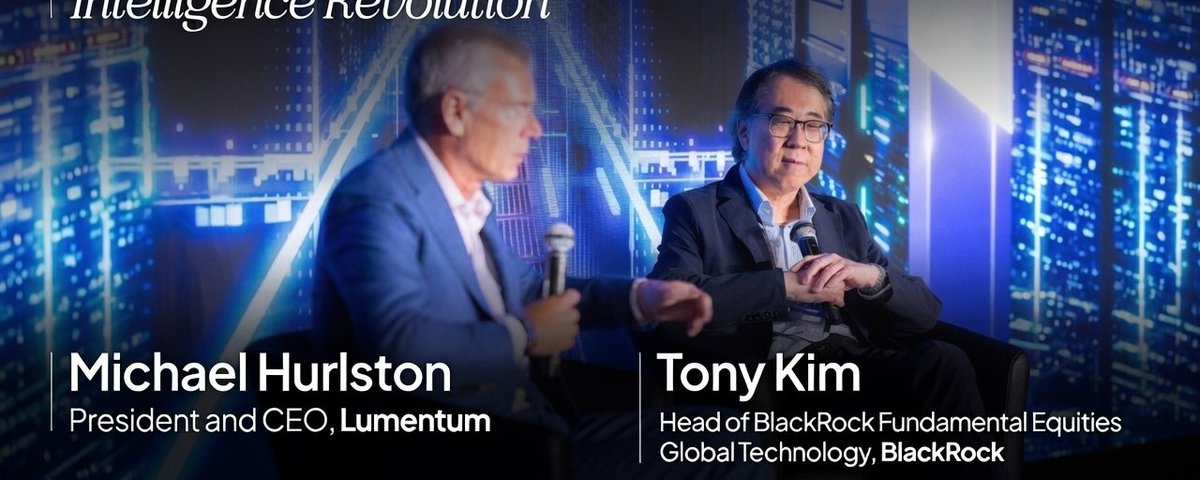
Lumentum CEO Michael Hurlston says AI's indium phosphide laser shortage will get worse than the memory crunch, and it's why Nvidia backed both $LITE and its biggest rival, Coherent $COHR.
"The numbers of lasers that those kind of customers (telecom) would deploy are in the hundreds, right? Now we're talking about hundreds of millions."
"So, for us to get our fabrication facilities up the curve to go from thousands of wafers to millions of wafers is no small feat."
"You've covered us for a long time. We've now put online five different wafer fabs. There's a different material. This is not CMOS."
"It's called indium phosphide, right? A very complicated name, but it's basically something that can emit light. It's a property, a material that can emit light, and we have five indium phosphide fabs that we're trying to ramp to scale."
"We see a huge shortage, and that's one of the reasons, I think, Nvidia invested in Lumentum and invested in one of our largest competitors, who also has incredible indium phosphide manufacturing capability."
"Between the two of us, I don't think we can service the demand that Nvidia and others are now putting on us to solve this resistance problem in the data center. And so, the shortage of indium phosphide, I think, will become even more acute than what we see from the memory guys."

$LITE's CEO on the shift from copper to optics inside the AI rack:
One scale-up rack needs ~8,000 lasers, and he thinks the indium phosphide shortage gets tighter than the one in memory. First deployments in 2H'27.
Simona retweeted

$SOI Q1’27 numbers a strong read for the entire optical space with surging demand
They make SOI substrates that power 100% of next-generation data centers (basically a monopoly)
This read-through matters for $SIVE, $AAOI, and $IQE.
Each sits in different parts of the same optical/photonics supply chain feeding AI interconnects, so $SOI seeing accelerating, multi-year committed demand for photonics substrates is a strong signal that the broader ecosystem (transceiver makers, epi wafer suppliers, optical component players) is riding the same wave into scale-up AI architectures.
Numbers:
- Revenue: €113m, +23% YoY (beat guidance of 15%)
- Edge & Cloud AI: €65m, +47% YoY, now 57% of total revenue
- Q2’27 guided to grow >30% YoY
Main driver:
> Photonics-SOI. Sales doubled YoY, fueled by demand for optical transceivers used in AI data centers (pluggable transceivers, Near-Package Optics, and now Co-Packaged Optics qualification ramping too).
> Their 300mm Singapore fab just got qualified for high volume Photonics-SOI manufacturing with first customers, meaning they now have the capacity to actually capture this demand, not just talk about it.
> Multi-year Capacity Reservation Agreements with customer cash deposits are locking in visibility beyond FY27.
Ultimately:
If Photonics-SOI keeps compounding like this into FY27 (management sees it more than doubling the >$100m generated in FY26), that’s the kind of operating leverage that could meaningfully improve gross margins and push $SOI toward sustainable profitability.
Getting anywhere near $1B in revenue for 2027 would likely require this segment to keep accelerating at a similar clip while Mobile and Auto stabilize, but the trajectory here is the first real sign of that path actually opening up.
Full earnings call lands in a few hours.


Simona retweeted
We have 10 years of AI left.
The latest research from McKinsey, Goldman Sachs, PwC, ARK Invest, and Gartner on where AI is heading.
1. $725 billion in AI infrastructure spending this year alone. That's 77% growth year over year. 88% of companies are already deploying AI. The hyperscalers are building nuclear reactors just to power the data centers. This money flows directly into $NVDA, $AVGO, $MSFT, $GOOGL, $AMZN, and $META.
2. By 2027, Artificial General Intelligence. AI that can reason across any task, not just narrow ones. Anthropic and Google DeepMind both forecast powerful systems arriving by late 2027. The companies building the picks and shovels for this are companies like $AMD, $MRVL, $TSM, and $ASML.
3. By 2028, Physical AI. Humanoid robots at manufacturing scale. 30,000 units per year. $50 billion invested. Watch TSLA Optimus, Hyundai Atlas, and Figure AI. The sensors, chips, and actuators behind them flow through companies like $ON and $TER.
4. By 2030, AI is projected to add $15.7 trillion to global GDP. $14 trillion AI software market. 170 million new jobs created. ARK estimates AI software companies alone could create $80 trillion in enterprise value.
5. By 2035, full autonomy. $450 billion in agentic software revenue. AI conducts novel scientific research. $3.6 trillion global market. 30% of all enterprise software revenue comes from AI agents.
Every major selloff in AI has been a buying opportunity.

Simona retweeted

I model stocks the opposite of TTM (trailing twelve months) and instead we look at the newest earnings + 3 earnings forward FTM (forward twelve months)
Many stocks were trading 15-18 months into the future at their highs, perhaps this is a elastic limit before the band pulls back?
$NBIS 290 $AMPX 25 $AAOI 230 $SIVE 110 $PENG 90 etc... we are now trading at a level where almost all stocks are green Q4'26+ with 20-25% of compounding per quarter is possible + ramp ups leading to inflection points over the next 3-6 months


I've included additional details in the deep dives within each stock (this should help with your timing descions, assuming the market is 8-12 months forward looking)
$AAOI for example has details about the main diver in each time period
I've highlighted major inflection points in green
Red means todays price is above what I've calculated (I could be wrong)
I'll eventually do this for all stocks, unfortunately this is not something I am able to automate as AI is still too silly
It'll take a while longer, but it's mostly ready to go, and reasonably accurate for most stocks. I will continue to fine tune and audit.
I will also re-rate stocks on earnings dates, as well as peer earnings (ex, $MU earnings automatically re-rerates $SNDK, $SKHY, Samsung etc.. and most other things, it's like a meteor hitting the water)


Simona retweeted
Finished the meat of the project
Amazing how the recent pullback brought everything from 9-18 months into the future, to todays exact prices
I will do further audit, the idea here is that at certain levels we should be trimming position, and above those levels the stock should be sold, as too much is priced in (and this is easily taken away)
I'll fully integrate this into the website, see if I can integrate the dots (or trendlines) into TradingView, it would be practical to see this on a daily screen
#SIVE #DRAM #COHR #MU #SNDK #AAOI $NBIS #AMPX
Note the shape of the ramp ups, #AAOI has a massive inflection point over the next 3 months. Each stock has a different shape and different inflection points
Note how far ahead $SOI.PA was looking forward (#16 spot) at $200, if you bought it earlier this year at $40 or so, it's an easy 3x as EOY target is about $120
Too much was priced in too early, and it was taken back by the market for many stocks. I'll have everything up and running soon, the Trading View integration will be new, can't imagine it's very hard? We'll see
(there are more stocks, they just don't fit on screen)

Major update to my modeling. I have gone from Annual Price Targets to Quarterly price targets (looking 9 months forward)
This makes inflection points clear and thus timing (as well as trimming), I am modelling a 3 quarter front run.
#AAOI as an example will look like the below:
Will make a full universe update over the next few days (will take a while), although I may just do an all nighter and it'll be done by morning, who knows.
This is what AAOI would look like if management hits their forecast projections


Simona retweeted
Photonics and optical stocks like $LITE, $AAOI, $AXTI, and $COHR.
This is the first time in three months where the bulls are trying to defend its low.
Still weak and too early to call a low, but let's see over the next few weeks if they can hold the floor around these price levels.
$LITE seems the strongest.
$AAOI is trying.
$AXTI and $COHR are still a bit weaker.
Need some follow through from the bulls.


Simona retweeted

$SIVE Q2 Update Report sent to clients and substack.
$SIVE is now more expensive, but better‑validated InP‑laser and mmWave platform:
Q1 was weak (SEK 61.9m revenue, -SEK 13.8m AEBITDA) but the opportunity pipeline expanded to $799m
GlobalFoundries adopted Sivers lasers into SCALE reference designs
ALLSPACE placed an $8.2m 2027 order, leading us to maintain OVERWEIGHT / High Risk with a 12‑month probability‑weighted target of SEK 86 vs a SEK 67 share price.
Our bullish outlook target moved to SEK 145.
Full report and outlook below:
seqhresearch.com/p/sivers-se…
