
Founder and CEO @claritymovescap. Unlocking private market liquidity.
Joined October 2017
- Tweets138
- Following208
- Followers647
- Likes178





we paid $3,500,000 for clarity .com
Good buy or waste of money? @claritymovescap

When do private companies need to approve SPVs?
As a major sponsor of venture SPVs, I thought I’d share some thoughts on this, particularly in light of all the chatter on this topic surrounding Anduril and Anthropic lately.
First, some reasons why I have good information on this topic:
1. In just over 2 years, starting in April 2024, we built an SPV business with over $2.1 billion in AUM (at FMV). We have learned a LOT along the way.
2. We manage both single-layer and dual-layer SPVs. Most of our SPVs, by value and number, are single-layer, but a substantial portion are dual-layer.
3. Our single-layer funds are DIRECT shareholders on-cap table of over 40 late-stage unicorns, including the likes of @AnthropicAI, @perplexity_ai, @cursor_ai, @Kalshi, @Polymarket, @LiquidDeath, @cerebras, @Apptronik, and dozens of other household names.
Now, do private companies need to approve SPVs? It depends on what you mean by that. Here are four different cases.
1. An SPV purchases a company’s stock. If the company has an approval right over transfers (they usually do), then YES, this purchase must be approved.
2. An SPV syndicates to investors instead of using pre-committed capital, in order to complete a direct primary investment. YES, an issuer has the ability, in the purchase agreement or subscription agreement, to require the investor to use pre-committed capital instead of syndicating to fund the investment.
3. An LP of a single-layer SPV sells to a new LP (the recent Anduril case). NO, this transaction almost never requires company approval, and neither the GP (@packyM) of the single-layer SPV nor the selling or buying LP (@ankurnagpal) typically seeks company approval (@mttgrmm). Company approval typically has no bearing on the validity of the investment.
4. A second-layer SPV invests into the primary issuance of a first-layer SPV. Unless the underlying primary investment documents prohibit syndication (we have rarely seen this), NO, this transaction does not require company approval.
One big misconception seems to be that the company can or should approve transfers between investors in an SPV that holds direct stock, or that the GP or LP should get the company’s blessing for such transactions (case 3 above).
This idea runs contrary to decades of private market practice. Hundreds of billions in LP stakes in private equity funds change hands every year. The underlying companies almost never approve such transfers, and in the rare cases they do, it’s usually because the GP is going to them out of deference, not because they are required to do so. It's only the explosion of SPVs in the venture space that has brought sudden attention to this question.
Happy to debate this topic if anyone has a different take.
Glad to report that @AnthropicAI has corrected its blog post and removed Hiive’s name. The post was made without any notice to us and caused needless confusion in the investor community plus unfair damage to @Hiive_HQ's reputation.
Let me be clear: every investment through Hiive is 100% legitimate, approved (when approval is required), and cannot be “invalidated”.
If Anthropic came to us about their new policy in the first place, we would have worked with them on a unified message to the market.
The real problem? The private market is filled with unlicensed insiders and VCs peddling access for massive fees (that are essentially brokerage commissions) without being licensed by FINRA. Yet, licensed FINRA member firms like Hiive—who actually bear the substantial compliance burdens—are treated with suspicion.
We will not be slowed down by traditional gatekeepers. Our mission to build state-of-the-art liquidity infrastructure marches forward undaunted.
When truth is on your side, you have nothing to fear.
Cerebras Systems investors on @Hiive_HQ over the last several years are probably in a good mood right now.
Investors accessed @cerebras on Hiive in 2 ways. First, through direct share transfers, with the first trade on May 2023 at $12.50/share. Second, through Hiive Funds (SPVs) that pooled investor capital to purchase Cerebras shares at prices ranging from $14.80 to $45/share.
Many Hiive investors realized gains even before Cerebras hit the public markets, selling their direct holdings or fund units to other pre-IPO buyers.
Post the lock-up, Cerebras’ transfer agent will manage the conversion of private shares into publicly tradable stock (for direct investors) and Hiive Fund investors will get their shares distributed in-kind to their brokerage accounts.
Illustrative per-share returns based on yesterday's closing price for CBRS, $296.65. Gains shown are unrealized, calculated on a per-share basis. Prices will change during the lock-up period.

Past performance is not indicative of future results. Investing in private securities is speculative, illiquid, and involves the risk of loss. Not all private companies will IPO or have a liquidity event. This is not a recommendation to buy or sell any securities. Hiive is not affiliated or associated with, or endorsed by, Cerebras Systems Inc. Securities offered by Hiive Markets Limited, member FINRA/SIPC.
Most founders treat liquidity as a distraction.
The founders getting this right treat it like a hiring decision: deliberately, early, with a view of what they're building toward.
Today at 11:05AM, I'm on Center Stage at @websummit Vancouver with @KyleHanslovan of @HuntressLabs. @susanliTV of Fox Business is moderating.
If you're there, come find us after.

Honestly scratching my head about this statement from Anthropic (without any notice to us) and the ensuing wave of misinformed hot takes.
Hiive is an Anthropic shareholder. We are a 200-person organization with an 11-person legal and compliance team. We are tracking for $4 billion in transaction volume and $120 million in revenues in 2026 with 100%+ growth.
We have made it our mission over the last 5 years to bring transparency and standardization to the private market in order to address precisely the concerns that they raise. The market has rewarded us with hundreds of millions in transaction volume through our pipes every single month.
We’ve facilitated transfers of shares in over 400 companies. Some companies use us exclusively to manage liquidity.
We only facilitate share transfers with company approval.

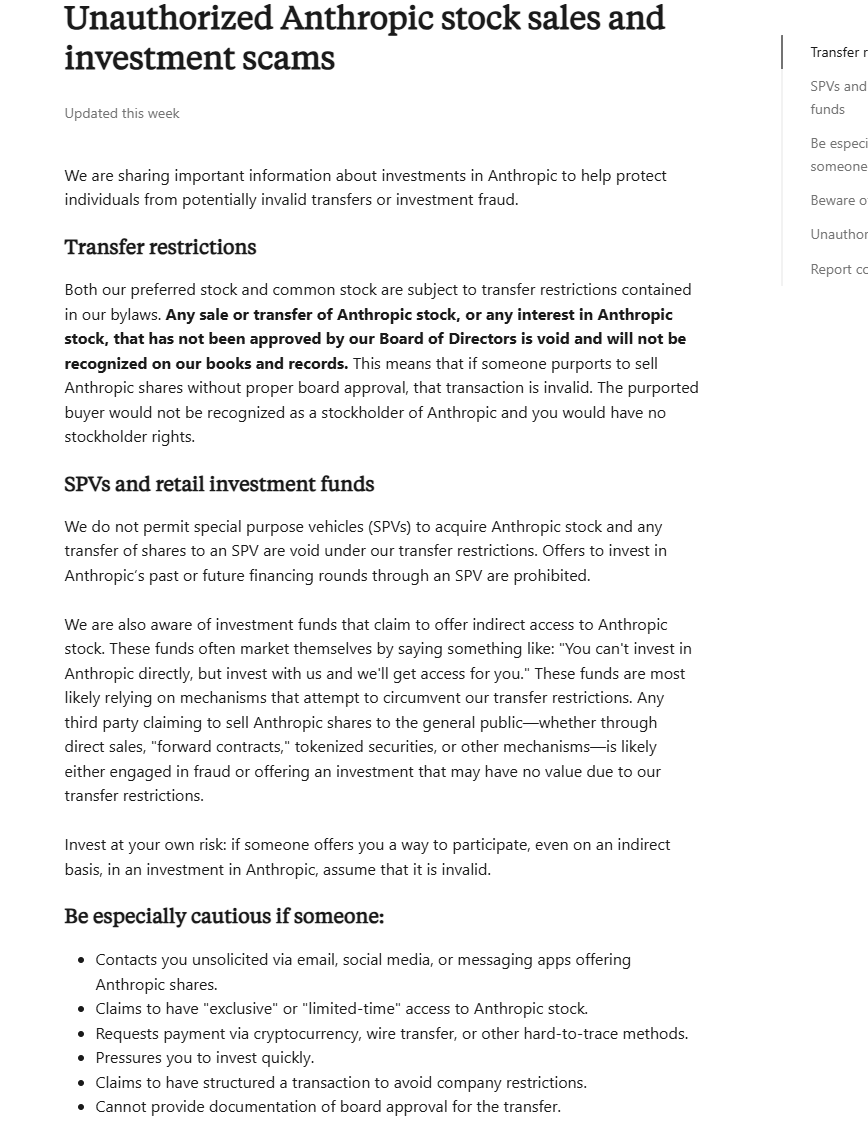
Anthropic just published a support page that should terrify anyone holding its shares on the secondary market.
"Any sale or transfer of Anthropic stock, or any interest in Anthropic stock, that has not been approved by our Board of Directors is void and will not be recognized on our books and records."
Void. Not restricted. Not pending review. Void.
That means if you bought Anthropic shares through Forge, Hiive, or any other secondary platform without board approval, you are not a stockholder. You have no stockholder rights. Your transaction is invalid.
It gets worse. Anthropic says it does not permit SPVs to hold its stock. Any transfer to an SPV is void. Investment funds claiming to offer indirect exposure are "most likely relying on mechanisms that attempt to circumvent our transfer restrictions." Forward contracts, tokenized securities, synthetic exposure products, all of it potentially worthless.
Their advice to investors: "Assume that it is invalid."
There is a multi-billion dollar secondary market in Anthropic shares right now. Platforms are pricing the stock at $265-$1,400+ per share based on a $380 billion valuation. Real people have put real money into these positions. And Anthropic just told them none of it counts.
This is the purest possible illustration of counterparty risk. You can buy a share of a company and have the company itself declare your ownership void because you bought it through the wrong channel.


When the @SpaceX lockup clears, a lot of investors are going to find out what they actually own. Some of it won't be what they thought.
Four questions investors should be asking before the wire goes out, not after:
1. Are the fund's financial statements audited?
2. Does the GP provide due diligence on their own funds, and what due diligence do they do on the target assets and/or manager?
3. What do the fees add up to across every layer.
4. Is the manager an RIA/ERA, associated with a FINRA member, or neither? And who's on their legal and compliance team.

For more information on SPV investing, check out:
okt.to/EYSGAC
okt.to/nMsyid
okt.to/v0SUgm
okt.to/y1NxYH
To read the full NYT piece, check it out here: okt.to/JfkjeX
*For informational purposes only. Post may include forward-looking statements and third-party information provided “as is,” with no guarantee of accuracy or completeness. Hiive is not, by this post, providing financial, legal, tax, or other professional advice, nor should this be the basis for making any decision that may affect your financial or other interests. Hiive is not affiliated with, associated with, or endorsed by any of the companies mentioned herein. All services or trademarks are the property of their respective owners.
The difference between a brokerage and a marketplace is network effects. And you only have a credible claim to network effects when growth starts 𝘢𝘤𝘤𝘦𝘭𝘦𝘳𝘢𝘵𝘪𝘯𝘨; when the marketplace starts driving 𝘪𝘵𝘴𝘦𝘭𝘧 forward.
We founded @Hiive_HQ 5 years ago, chasing that magical feeling of network effects in the institutional market for late-stage venture. It's been arduous. Turning a traditional financial services business into a fully integrated technology platform is staggeringly complex.
But 5 years in, I'm starting to get that magical feeling.

ALT Bar chart titled "Matches Per Week" showing the number of matches created on Hiive each week from June 2022 through March 2026, with a rolling 8-week average overlaid as a line. Weekly match volume grew gradually from near zero in mid-2022 to roughly 150–200 by late 2024, then accelerated sharply through 2025 and into 2026, with the most recent week reaching nearly 1,000 matches and the rolling average climbing to approximately 600.
Source: Hiive platform data, as of April 25, 2026. Each match represents a transaction agreed in principle either to purchase shares in private companies, or funds investing in shares of private companies. The historic rate of conversion from match to closing of transactions on Hiive is about 50%, but closing rates can vary across transaction formats. Matches include transactions where Hiive Markets Limited provides a service. Data is provided on a best-efforts basis and may be incomplete or subject to change. Hiive does not guarantee the accuracy or completeness of the information and may update or correct it as appropriate.
Public markets love a benchmark. That’s why the smartest private companies are using secondaries to shape their IPO before they file.
These charts show the trading histories of @rubrikInc and @Chime on Hiive, their IPO prices, and their closing prices a few weeks post IPO.
In both cases there was meaningful, controlled secondary trading ahead of the IPO. Not fire-sale liquidity. Not hype-fueled bidding wars. Just real price discovery: buyers and sellers aligning on value over time.
Instead of the roller coaster ride many companies experience upon going public, it’s easy to see the market already had an understanding of the intrinsic value these companies had, possibly due to the secondary trading both companies allowed on @Hiive_HQ (and other platforms).
That process does more than move shares around. It actually builds structure into the market:
→ A trading range emerges, anchoring expectations
→ Overhang gets absorbed, further reducing day-one downward trading pressure
→ Cap tables consolidate, improving post-IPO float quality and providing confidence to new institutional investors
In other words: secondary trading becomes a quiet rehearsal for the main event, providing the market with information it never had before. This isn’t anecdotal anymore—it’s a repeatable pattern. And it’s rewriting how companies think about IPO prep.
Liquidity is no longer just a late-stage employee benefit or investor pressure valve. It functions as a pre-listing signal, a market primer, and a cap table optimization strategy—especially for companies planning to list in the next 6–18 months.
As the IPO window cautiously reopens, this may become a defining feature of the strongest offerings: companies that went public with a price, not just a guess.
#liquidity


Why does #liquidity matter, you ask? We ran a blind survey of 500 tech employees to find out.

Company execs often justify prohibitions on secondaries based on concerns about the impact on their 409A valuation.
Because the strike price of option grants to employees is priced at the 409A valuation, some executives are obsessed with keeping it low. They believe that they can confer more value on employees, with less dilution, by keeping the 409A artificially depressed.
These fears are not well-founded for the following reasons:
1) Secondaries rarely impact the 409A valuation between annual re-assessments.
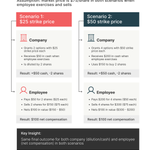
2) Even after 12 months, or in the rare cases where secondaries do impact 409A, the company should not fear greater dilution with a higher strike price because it is able to use the cash from option exercises to buy back stock at current market value (CHART BELOW ILLUSTRATES THIS POINT).
3) The fact that some of the largest private companies in the world (@cerebras, @krakenfx, @LightmatterCo, @Ripple, among many others) allow their stock to trade relatively freely gives evidence that these sophisticated firms are not concerned about this issue.
The bottom line: there is plenty of evidence that 409A valuations are NOT a reason to stop secondary trading.
Link to the full @Hiive_HQ BLOG POST on this topic in the comments below.
Let me know if you can poke holes in our argument!
#liquidity

