

p99 over p50. Variance is where protocols break. Validator economics & wire-layer infra (Solana/Monad). Models, not narrative. @doublezero ambassador
Heinola, Suomi
Joined April 2022
- Tweets1.7K
- Following130
- Followers230
- Likes1.2K







ShadowOfTime — validator economics retweeted

🚀 New in Lumen: lumen://help/docs
A built-in API reference for window.lumen
No more guessing available methods or parameters-everything is documented.
From IPFS and PubSub to Wallet, DNS, Stable Links, Profiles, and more!
Building for Lumen just got much more developer-friendly💚

ShadowOfTime — validator economics retweeted
Found a useful Lumen tool today: lumen://cidscan.lmn 🔍
Paste any Lumen CID and instantly see what it actually contains before opening it.
It detects the real file type, lists archive contents, shows the SHA-256 hash, warns about executables, and lets you cross-check the file on VirusTotal with one click.
Definitely worth bookmarking 👍

Most infra talk is takes. I run the numbers.
Validator P&L, propagation tails, wire-layer economics — the parts that actually decide whether a protocol survives. Sourced, editable, no narrative.
p99 over p50. Variance is where protocols break.
Follow for the math.
Everyone covers @doublezero as "lower latency." The bigger move is economic, and almost no one's talking about it.
At epoch 939 they killed the 5% validator block-reward fee — a working revenue line worth ~$3.5M/yr across 455 validators. Then shipped Edge: validators now sell the shreds they already produce over multicast fiber, traders subscribe in USDC.
The validator went from paying to access the network to earning from it. Cost flipped to income.
The underappreciated number: multicast cut propagation bandwidth ~99.96%. One copy to many instead of one-to-one — the way TradFi exchanges have run for decades.
Revenue splits per epoch: 50% contributors, 32.5% validators, 17.5% clients, 10% burned.
The honest risk: this is a revenue cliff. The old $3.5M is gone, Edge is early. They bet the protocol's income on the switch.
But it's the right bet — turning the network layer from a tax validators tolerate into a stream they own.
The latency story was always the surface. The economics is the protocol.

Everyone benchmarks execution. Bigger blocks, parallel VMs, faster state access.
But a block still has to cross the network within the slot. You can't parallelize the speed of light.
Once compute is cheap, throughput is capped by propagation — and the tail (p99) is where it breaks.
🔁 if your mental model of scaling stops at execution.

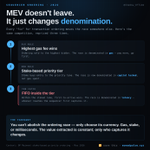
Every chain keeps "fixing" transaction ordering.
Gas auctions → stake tiers → and the race just moves again.
You can't abolish MEV. You can only choose what it's denominated in: gas, stake, or milliseconds.
🔁 if you've watched this cycle repeat.

Everyone prices stablecoin chains by TVL.
$322B float tells you who custodies USDT/USDC.
Active addresses tell you who actually uses them.
Two completely different maps — and most charts show the wrong one.
🔁 if your "Solana stablecoin" thesis just got more complicated.
HYPE at ATH proved one thing to the market.
Latency monetises. Not TVL, not fees, not tokenomics. Latency.
Every serious perp infra from here copies their p99, not their book. This stopped being a DEX story months ago.
Speed is now an asset class.
Solana medians beating Binance on $5k-$20k cbBTC fills is the part everyone is sharing.
The part nobody is asking: this happened before wire-layer multicast, before Alpenglow, before any of the latency upgrades land.
Execution quality won on liquidity topology alone. Add the infra stack and the gap widens, not closes.
Everyone benchmarks perp DEXs on matching engine speed. Nobody benchmarks ingress.
How an order reaches the venue matters as much as how the venue processes it. HL fiber ingress vs Solana gossip fan-out is a 50-100ms gap before the engine even sees the quote.
That's the silent variable.
Everyone treats Jito MEV tips as "extra yield for stakers."
Look at the actual distribution and that framing falls apart.
The top ~5% of leaders capture roughly 80% of total tip flow. Not because they're better validators — because they hold the block slots where searchers are willing to pay. Geographic placement, peering quality, who they're co-located with.
The bottom 50% of the active set sees tips that round to zero on most epochs.
"MEV democratizes staking rewards" is the slogan. The data says MEV concentrates them harder than inflation ever did.
Stake-weighted yield ≠ tip-weighted yield. Worth knowing which one your delegation is actually chasing.
Everyone benchmarks Firedancer vs Agave on mean slot time.
That's the wrong number.
p50 looks clean on both. The story is in p99 — and that's where consensus actually lives or dies under load.
Agave's tail blows out under vote storms because the same thread schedules sigverify, banking, and replay. One contended lock and you're eating 200ms+ on the 99th percentile slot.
Firedancer splits those into separate tiles with pinned cores. The mean barely moves. The tail collapses.
That's not a "faster client" story. That's the difference between a chain that degrades gracefully and one that stalls when somebody airdrops.
Stop quoting averages. Post the p99.
the spreadsheet is open. if my numbers are wrong, fix them and quote me back
that's how we get to a 2026 decentralization conversation that isn't a slogan

Sat down to actually run the P&L on the average Solana validator in 2026.
Closed the laptop. Opened it. Did the math again.
These numbers explain why the network has lost over 70% of its validators in three years — while most of the discourse still says "decentralization" without showing a single spreadsheet.
🧵
Promised the full model + sources from the validator economics thread.
Here it is. Every number checked, every assumption editable, the break-even matrix + Alpenglow scenario in CSV. Import into Sheets or read raw.
gist.github.com/ShadowOfTime…
🧵 xitter.cf/Shadow_OfTime/status/2…

Sat down to actually run the P&L on the average Solana validator in 2026.
Closed the laptop. Opened it. Did the math again.
These numbers explain why the network has lost over 70% of its validators in three years — while most of the discourse still says "decentralization" without showing a single spreadsheet.
🧵
But Alpenglow opens the door to a room everyone already left.
The 1,800+ validators that exited over three years aren't coming back at scale. Hardware sold, operators reassigned, geography already collapsed to three cities.
You can build better economics. You can't refund the time.
Decentralization in 2026 isn't a slogan. It's a P&L and a trace route.
If you can't show me a spreadsheet where a new operator in a new country breaks even today — you don't have decentralization. You have a 750-person club.
Full model + assumptions next week.
Follow if you want infra reality, not narrative.