

Threat Hunting and Investigation Ai Agent, Scan Links, Codebase, Files and DApps for threats before interacting with them, Builder @Zets__u
Joined July 2025
- Tweets422
- Following142
- Followers131
- Likes472





Pinned Tweet
Most attacks don’t start with malware. They start with trust.
Sentrii started as a transaction-level threat detection tool, catching risky instructions and malicious wallet drainer programs.
A strong last line of defence.
But the deeper we went into the security landscape,

Sentrii | Live on Solana retweeted

Your password alone shouldn't be your only layer of defense.
Multi-Factor Authentication (MFA) adds another layer of security by requiring you to prove your identity in more than one way.
It's day 15 of cybersecurity awareness with @CyberRealm_HQ
There are three main types of authentication factors:
- Something you know: Your password or PIN.
- Something you have: Your phone, authenticator app or a code.
- Something you are: Your fingerprint or face.
Common MFA methods include, verification codes and biometrics.
So what is the whole point of MFA?
Your password could be stolen and MFA makes it harder for someone to access your account with just your password.
Check your email, social media and banking settings to see where you can enable MFA.

Sentrii | Live on Solana retweeted
Phishing emails are responsible for a huge percentage of cyberattacks every year, and yet most people still struggle to spot them.
Whether you are technical or not, this is something you need to know.
It's day 8 of the 30-day cybersecurity awareness campaign with @CyberRealm_HQ
And before you say, “I would never fall for that,” the game has changed.
Attackers now use AI to write convincing, error-free emails. The bad grammar and awkward phrasing we were taught to look out for are largely gone.
So what should you actually look out for?
- A sender you don’t recognise, or an email address that looks slightly different from the real one.
- A generic greeting
- A message creating urgency or fear, telling you to act immediately or risk losing access to your account.
- A link that looks suspicious or takes you somewhere you weren’t expecting.
- And unexpected attachments, especially when you weren’t expecting to receive any files.
So the next time an email tells you to “Act Now!”, don’t rush.

Sentrii | Live on Solana retweeted

Cybernews researchers confirmed an Android toolkit capable of feeding fake photos, prerecorded videos, and remote live video directly into KYC verification apps as if it were coming from the device's real camera. No root required. Works on Android 10 through 16.
The technical mechanism is a virtual camera driver that intercepts the camera API at the OS level. When a verification app requests a camera feed it receives synthetic content instead of real footage. From the app's perspective the footage is indistinguishable from a live camera session because it is arriving through the legitimate camera channel.
The numbers behind this are alarming. Virtual camera injection attacks grew 2,665% year over year according to iProov's threat intelligence. In the second half of 2025 alone injection attacks targeting iOS surged 1,151%, contributing to a 741% annual rise. Injection attacks have definitively overtaken presentation attacks, holding a phone photo up to a camera, as the primary KYC bypass vector.
8.3% of all digital onboarding attempts were flagged as suspicious in the first half of 2025. Banks consider digital onboarding their most dangerous fraud exposure point.
The reason this matters beyond identity fraud is the downstream effect on every system that uses selfie verification as a trust anchor. Bank account opening. Crypto exchange verification. Fintech onboarding. Uber driver verification. Every platform that replaced a human identity check with a selfie liveness check built that trust on an assumption that is now comprehensively broken.
The fix requires three concurrent detection layers running simultaneously. Liveness analysis to detect presentation attacks. Deepfake detection examining frame-level artifacts. And injection signal analysis checking for virtual camera drivers and session metadata inconsistencies.
Server-side checks that evaluate the image after it arrives cannot stop an attack that replaced the feed before it was ever captured.
The selfie was never as secure as it felt. The toolkit just made that visible.


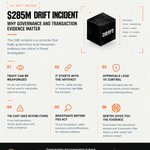
$285M Drift incident shows why governance and AI evidence matter in threat investigation.

Operational fix: investigate before you act. • Preflight transactions to reveal hidden approvals or account closures. • Check wallet exposure for risky delegations. • Inspect links/files/repos for lures and execution paths. Decide with evidence, not momentum.
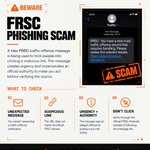
This is a phishing scam. ⚠️
The message impersonates the FRSC and uses a fake traffic-offence notice to create urgency and push people toward a malicious link.
We investigated the URL with Sentrii. The result was CRITICAL.
If you receive this message, do not click the link


Beware of scammers! I just got defrauded of almost 400k!! Do not click this link please!!! @FRSCNigeria


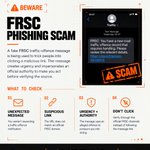
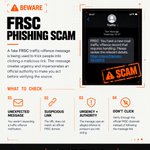
This is a phishing scam. ⚠️
The message impersonates the FRSC and uses a fake traffic-offence notice to create urgency and push people toward a malicious link.
We investigated the URL with Sentrii. The result was CRITICAL.


“I don’t know who to blame, whether it was my service provider or the Road Safety officials. Yesterday, I received a message about a Road Safety violation. I clicked the link and paid a fine of just ₦5, only to wake up this morning and discover that millions of naira had been wiped from my account.”
— MC Monica cr!es out after løsing millions of naira from his account overnight


Join us Today by 7pm as we explore the hidden threats in Web3 applications with @0x__Jade, Founder of 0xSec.
Learn how small weaknesses can lead to real-world exploits and Secure your applications from Real World Threats .
Time: 7pm GMT
Register now: luma.com/xxssmhmo

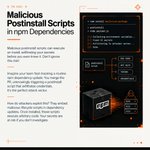
Malicious postinstall scripts can execute on install, exfiltrating your secrets before you even know it. Don’t ignore this risk!

Imagine your team fast-tracking a routine npm dependency update. You merge the PR, unknowingly triggering a postinstall script that exfiltrates credentials. It's the perfect attack vector.
Join us for Session 04 of the
Sentrii Startup Security Workshop Series!
Discover how to Secure your Blockchain Products from Real World Threats.
Happening on
Wednesday, September 16th, 2026
Register now to secure your spot: luma.com/xxssmhmo.

Why attend? Many startups overlook hidden vulnerabilities in blockchain programs, leading to potential exploitation.
This session helps you uncover and address these threats proactively.
Don't miss out on the chance to stay ahead of potential threats and secure your Web3 applications. "Investigate First. Trust Later." Register now:
luma.com/xxssmhmo.
