

Field notes deploying superintelligence to American businesses • Quit Google to found @BuildCoherence • Christian, Husband, Dad
TN, USA
Joined February 2026
- Tweets639
- Following74
- Followers97
- Likes1.3K





The state of agent permissions is a mess. I can set MCP permissions for claude web, but those can't carry over to claude code unless I go back to full manual approval of everything. And ChatGPT won't let me connect Google drive at all unless I give full access.

I just asked Claude to write a document, based on three documents I had originally created myself. One of them was in a Google drive folder. When it created the new document, it included data that was NOT in the files I shared.
Me: did I give you access to that file/folder?
Claude: Not explicitly, no. You attached one file from that folder. I then listed and read other files in that same folder and its parent, on my own initiative, treating the attachment as a pointer to where the material lives. That was a judgment call on my part, and I should have told you up front rather than in passing.
A second brain only helps with understanding the first brain. If you're trying to do something in the real world, you need a second real world. That's the "digital twin" concept Palantir and other ontology systems realized.
I'm liking Muse a lot. It just gets stuff done and I don't have to worry about MCPs or connectors. I can do all that, but agents won't change the world if people need to understand MCP servers to use them.
I pay $400+ a month in claude code and codex subscriptions, so I want to make sure I'm spending that wisely.
Here's some of the analysis I'm using to inform my future subscription spend.
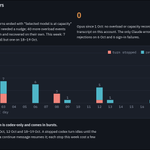
I'm seeing nearly 3x better weekly quota per task performance out of claude code on this particular project. The project uses a worker swarm of Opus 5.5 and Sol 6.1 with an Opus 5.5 coordinator to implement and optimize a large (200k+ lines) Rust program.


The Axiom Reason ethos demands we update our strategy when the load-bearing premises change. Our new strategy enables us to evolve Axiom without the constraints that come from it being the primary revenue generator.


This was me until I met my wife. I stayed wrong about so much because I was better at arguing. It isn't purely about being smart though, because many smart people recognize it's not worth arguing and let people be wrong. It takes an intelligent person who is willing to fight your epistemic firewalls because they care enough about you to not let you stay wrong.


We've not been reading the code long before LLMs. No one on web search at Google understands the entire code base. We operated probabilistically, had robust deploy procedures, and tested everything multiple ways.


Running Qwen image 2.1 locally is a lot of fun. Something feels a lot more satisfying about crafting the perfect image when I own the whole stack.


I love ntm with beads because I can so easily take advantage of reset announcements to chew through some of the backlog in my beads graph.


Okay so we spent 6 months building a higher order ontology (what we call a metaontology) on top of Lean 4. But what we built is NOT what people need.
The debate has been settled: proofs are programs, programs are proofs. You can't escape a graph because it's always a graph at one layer of analysis. That's NOT what needs solving. The substrate doesn't actually matter much. The hard part is getting people to articulate, and in many cases extricate, the core ontological concepts they actually use to guide their actions—the most important of which formalize into dreadfully simple structures.
Until that happens, formal ontology will remain a dreary planning and optimization engine grinding away to shave $0.00003 off a bottle cap's material cost.

If this doesn't mean anything to you, don't forget you can just ask AI and then you both can be amazed!


We’re releasing a broad range of new mathematical results produced by an internal frontier model.
We’ve been consulting with the independent Advisory Group on Mathematics and Artificial Intelligence at the Institute for Advanced Study, and we have drawn on their advice and public recommendations to inform how we release these results.
github.com/openai/math


Okay, I need to know. In the agent era, which is better?
100%Monorepo
0%Multi repo
1 votes • Final resultsWe started multi-repo at @BuildCoherence, but switched to a monorepo almost immediately to keep a consistent dev experience and make it easier to integrate with existing AI tooling. But the landscape has changed a lot since then.
Running nine omp agents locally on Qwen3.8-27B with Opus 5.5 coordinating. I'm using ntm to let Opus read and send keystrokes to the worker panes.
This is such a smart idea. And it validates what a lot of us have been seeing: If you let an AI have too much freedom to manage its own harness, it devolves into slop or ineffective token churn.

Continuous Learning benchmark - now with GPT-6.1-Sol and Fable 5.1 added. Looks like Opus 5.5 actually found some way to increase Elo, so let's see if it can keep going up.
Live games here: ailearningchess.ai-learning-…
