

French American economist and entrepreneur. AI + Compute + Finance. Economics of AI. Catholic. e/acc Miami
Miami, FL
Joined November 2024
- Tweets2.2K
- Following2K
- Followers544
- Likes2.6K







sebastien laye retweeted

Why did Florida (largely) escape the blue wave and Texas didn't?
3 key reasons:
1. Florida had a property tax reduction measure on the ballot. Drove turnout & showed GOP serious about affordability.
40% of Texas voters said economy top issue. So did 37% of Florida voters. But HOW they voted differed a lot.
Among Florida voters who considered economy top issue, 55% voted Republican.
Among Texas voters who saw economy as top issue, only 40% voted Republican.
2. Cuban voters. As @giancarlosopo wrote, they still voted more Republican than other Hispanic blocs, although fewer supported Republicans than in 2024.
3. Florida had an actual socialist candidate. Exit polls showed Texas and Floridians had similar views about socialism, but again, actual voting patterns differed. 87% of those who viewed socialism unfavorably voted for Ashley Moody. Only 79% of those who viewed socialism unfavorably voted for Ken Paxton.

US industrial capacity has been slipping for decades, and so have the prospects of our middle class and, to a meaningful degree, our national security. Data-center construction and continued US leadership in AI finally give us a chance to reverse that decline. The current push to block these projects anywhere and everywhere is effectively handing an advantage to China.
sebastien laye retweeted

US industrial capacity has been eroding for decades, and with it the fortunes of our middle class and to an extent, our national security. Data center development and our leadership in AI can reverse that trend, finally. Current hysteria to block all projects everywhere is a gift to China.
There is a great winner from the 11/4 election that few mentioned: FLORIDA. Now the largest pro business state, with a young and energetic governor. @ByronDonalds
France has found a new thing to tax: the gigabyte. On Friday, with 35 of 577 deputies in the room, the National Assembly voted 11 to 10 to charge 5.5 euro cents for every gigabyte sent to French users. Its Socialist author expects €10 billion a year, aimed at Google, Meta, Amazon and Netflix.
The government opposed it. Finance committee chair Éric Coquerel, one of the 11, says he pressed the wrong button. The same debate floated taxes on companies' AI spending, tokens included. Those failed. The instinct did not.
Germany is catching up. Digital minister Karsten Wildberger said Berlin must "tax the extremely high revenue from this technology," before backpedaling. Karin Prien, deputy leader of the governing CDU, agreed last week: "There is no other way." Chancellor Friedrich Merz, a skeptic, told Monday's digital summit: "We must, we want to become leaders."
Maybe this is why Europe trails in AI. A new industry shows up, and the oldest reflex wakes first: send it a bill. Neither country has built an OpenAI. Both already know how to invoice one.


France's economy unexpectedly shrank in the third quarter while inflation rose more than anticipated, piling pressure on the government ahead of further nationwide protests this weekend that are making it more difficult to cut spending.
The Compute-Token Jevons paradox. @ClemDelangue @PeterDiamandis @JP_O @brivael @alexandr_wang @alexwg
Intelligence is getting cheaper; people consequently consume vastly more of it. More models, more routing, more inference and more agentic workflows translate into higher aggregate GPU-hours unless efficiency improves even faster. This is why falling token prices can coexist with rising GPU rental prices. The fact that even the older H100 is holding/rising despite expected technological depreciation is an especially compelling scarcity signal.


CME and ICE moving toward GPU rental-price futures is a meaningful step. For the first time, there’s a path to price and transfer pure compute risk — not Nvidia equity, not power or real estate, but the hourly cost of the actual asset that generates AI revenue.
From where I sit, this matters less as a pure trading opportunity and more as the missing financial layer for physical compute.
We operate and invest in physical GPU capacity. That gives us direct exposure to the asset class: utilization, power, interconnect, and the real rental rate our capacity can command. At the same time, many of our clients — AI companies, inference providers, and enterprises — have revenues that are highly sensitive to the same rental price. When the hourly rate rises, their compute costs rise and margins compress. When it falls, data-center owners (including us) see revenue pressure.
GPU futures, once liquid, let us couple the two sides of the same balance sheet.
On the physical side, we can hedge the revenue stream of capacity we already own or have under long-term commitment. On the client side, we can offer structured hedges so their compute spend doesn’t blow up their unit economics. In between, the same instruments let us express a directional view on the asset class itself — long compute when we believe scarcity persists, or selective hedges when we think new capacity or efficiency gains will pressure rates — without having to buy or sell the underlying GPUs for every position.
The practical reality is still messy. Benchmarks differ (sometimes materially), liquidity is nascent, and cash-settled contracts do not solve physical delivery or capacity-availability risk. That’s why the combination of owning the real asset and using the financial overlay is more useful than either in isolation. Physical compute gives you the actual GPU-hours and the operational edge; the futures (and OTC compute derivatives that will sit alongside them) give you the ability to manage the price risk and transfer it efficiently.
This is the infrastructure trade that actually matches the cash-flow profile of the AI build-out. I’m interested in how others who own capacity or underwrite large compute commitments are thinking about integrating these new instruments into their risk and investment process.


sebastien laye retweeted

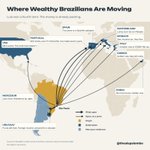
Ken Griffin is pouring billions into Miami.
Larry Page, Sergey Brin, Jeff Bezos, and Mark Zuckerberg are buying up Miami real estate.
Peter Thiel and Keith Rabois have planted roots here.
Palantir moved its headquarters here.
Adam Neumann is building Flow, a venture-backed residential ecosystem connecting real estate, technology, and community, with a major footprint in Miami.
Larry Ellison is in Palm Beach.
And people still want to pretend nothing is happening in South Florida.
Between Miami and Palm Beach, the concentration of capital, influence, and access is becoming impossible to ignore.
San Francisco has an incredible talent pool. Nobody is disputing that. But it’s also one of the most saturated ecosystems in the world.
A lot of people are so deeply rooted in SF that they can’t imagine the next major tech ecosystem developing anywhere else.
But builders aren’t supposed to think about where everyone is today. They’re supposed to think about where the opportunities will be tomorrow.
Capital moves. Talent follows. Ecosystems form.
I’m not dumb enough to act like SF is dead. I’m saying you’d be stupid to assume it will be the only place that matters forever.
The smartest builders think two moves ahead.
Miami is the move.
Don’t be a sheep.
sebastien laye retweeted

NEW: Ken Griffin on Paris riots, Chicago and JB Pritzker
I think Paris should be a real wake up call to every single young American. France is the dream the left talks about. That dream is the nightmare I left from Chicago. That dream doesn’t belong in our country. A society that comes down to how much you can take from others.
Do you see candidates that you’re actually fearful that’s the path they’re going down:
J.B. Pritzker, Governor of Illinois. Yes, 100%. 100%

Ken Griffin on the rise of DSA, Paris riots and looting in Chicago
I'm not so worried about it. It's a New York, Illinois, Michigan, California bit of a bubble.
If you want to see where socialism leads to, look at France last weekend.
It's the socialist dream. The country spends 60% of GDP at the government level.
BTW Paris looked pretty damn similar to Chicago in 2021-22.
It’s a people… (that) are very willing to riot and protest anything. Is that really the future that the US might be looking at?
It’s the future. I lived in Chicago.
I could look out my window at the Dior store. They were very efficient.
We may be more efficient than the French, even at looting.