

Publisher of medieval texts and Christian classics
Joined November 2023
- Tweets4.9K
- Following67
- Followers3.9K
- Likes7.5K





Pinned Tweet
NOW AVAILABLE!
When were the angels created? What kind of fruit did Adam eat from in Paradise? What will the signs of the Antichrist be?
The most celebrated collection of its kind in the Middle Ages, the Questions and Answers to Antiochus the Duke leave no stone unturned. They are now made available in English for the very first time.
Also included in this edition is a translation of the Teachings to Antiochus the Duke, an adaptation of the Shepherd of Hermas for medieval monastics.
Get your copy now:
scriptoriumpress.ca/#antioch…

Scriptorium Press retweeted

With the Norman conquest of Sicily in the 11th century, the Normans started building magnificent cathedrals, abbeys and castles, as they did in Normandy and everywhere else.
And so, the Norman King William II, called the Good, commissioned the massive Monreale Cathedral on a hill above Palermo in 1174.
His reasons were also strategic. He wanted to display royal authority over the ambitious Archbishop of Palermo, Walter Ophamil, formerly the young king’s tutor, following political rivalry and a dispute over a royal burial.
William II wanted Monreale to be a grand royal pantheon and a powerful religious centre directly tied to the crown, reducing Palermo’s influence.
And indeed, Pope Lucius III elevated Monreale to a metropolitan archdiocese in 1183, giving it authority over territory previously controlled by Palermo.
And so there are two magnificent cathedrals in and above Palermo to admire today.


Scriptorium Press retweeted

Certain sections of even the hostile Libri Carolini, in Book III, Ch. 17, the author suggests that the 'learned' can venerate icons properly, but not the 'unlearned', which admits the theoretical point, at least, of the Seventh Ecumenical Council.
archive.org/details/libricar…

Scriptorium Press retweeted

One of the coolest images in any Old English manuscript is that of King David in the Vespasian Psalter, who is depicted holding a lyre.
It’s interesting per se, but becomes doubly important when we compare it to actual Germanic lyres we’ve found, which look identical to his!


👇👇
"The veneration of the saints (including their relics and icons of them) is part of the sacramental nature of the universe and to reject it means you are severely distorting reality and salvation. (i.e. If you get Genesis 1 wrong on Creation, then you will get Revelation 21 wrong on the New Creation and everything in between)."
This is precisely it. The point of Nicaea II was never to show that the Apostles literally mandated Christians kiss portrait icons or they would go to hell (which is a ridiculous Protestant straw-man); the council was concerned with the broader principle of how matter relates to God. How we answer this question directly informs how we think of the sacraments, the incarnation, the nature of the Church, and salvation itself.
Here is what Louth says:
"John [of Damascus]'s defence of icons and their veneration is both far-reaching and fundamental: it makes the icon part of the fundamental fabric of Christian belief, and argues that iconoclasm is more than simply an objection to an isolated devotional practice, but threatens to undermine Christianity itself. In this his defence of icons and their veneration is like Irenaeus’s defence of Christianity against gnosticism or Athanasios’s defence of the divinity of Christ against Arians, or, to come closer to John’s time, Maximos’s defence of the integrity of Christ's humanity against the Monothelites: all these oppose heresy not as an incidental error, but as something that undermines the whole faith." (St. John Damascene: Tradition and Originality in Byzantine Theology(Oxford UP: 2002), p. 219.)

The veneration of the saints (including their relics and icons of them) is part of the sacramental nature of the universe and to reject it means you are severely distorting reality and salvation. (i.e. If you get Genesis 1 wrong on Creation, then you will get Revelation 21 wrong on the New Creation and everything in between)
Ultimately, this icon debate was about two issues "Were icons used for devotional, ritual purposes (i.e. veneration) in the early church?" and "How does the anathema function in councils in relation to heretics and theirr descendents?" So its about the historical record of Orthopraxy as as well the nature of ecclesial authority in relation to heresies.
Of course, the anathema is attached to all sorts of statements of doctrine. (Roman Catholicism has tons of them on very specific details of doctrine such as the nature of the Beatific vision or the Assumption of Mary). Anathematizing heretics is much more focused on them rejecting the true Church and her ancient beliefs/practices.
At the same time, the truth always relates to our participation in Christ (i.e. salvation). This is why we can anathematize those who have a heretical understanding of the Eucharist even if their version is 'close' because the sacraments relate to our salvation and the apostles taught us the way they are to be performed.
That being said, we do have very strong evidence for the existence of portrait icons of Christ and the saints in the earliest centuries, along with prayer directed TO these images, which suggests that "kissing icons" and related devotional acts was indeed part of the primitive deposit of faith, no different than making the sign of the cross.
Scriptorium Press retweeted

For St Wilfrid's saint's day today, here's his crypt at Hexham, #Northumberland, one of two remarkable surviving crypts from his churches at Hexham and Ripon. Stones were reused from nearby Roman Corbridge. It feels astonishing to be in the space he would've used 1300 years ago.

"I see the heterodox assailing the holy Church of God in these days, under the pretence of higher wisdom, and bringing forward works in many volumes in which they offer expositions of the evangelical and apostolic writings, and I fear that if I should be silent and should not put before our members the saving and true doctrines, these teachers might get a hold of curious souls, which, in the absence of wholesome nourishment, might go after food that is forbidden, and, in fact, unclean and horrible."
—Origen, Commentary on John, Book V

Scriptorium Press retweeted
In the Old English translation of Orosius’s History, during the discussion of the Bellum Civile, the translator invents a conversation between Caesar and Pompey at Pharsalus.
Pompey appeals to some sort of custom, and Caesar responds: “you hurt my feelings and now I hate you!”


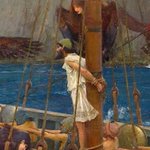
ἀλλά με δεσμῷ
δήσατ᾽ ἐν ἀργαλέῳ, ὄφρ᾽ ἔμπεδον αὐτόθι μίμνω,
ὀρθὸν ἐν ἱστοπέδῃ, ἐκ δ᾽ αὐτοῦ πείρατ᾽ ἀνήφθω.
εἰ δέ κε λίσσωμαι ὑμέας λῦσαί τε κελεύω,
ὑμεῖς δὲ πλεόνεσσι τότ᾽ ἐν δεσμοῖσι πιέζειν
Odyssey, Book 12.161–164

I still can't believe this fresco exists. Otherworldly

A fresco depicting a worshipper performing a ritual in front of the sarcophagus of Osiris. From the temple of Isis in Pompeii.
Ταῦτα μέν νυν καὶ ἄλλα πρὸς τούτοισι, τὰ ἐγὼ φράσω, Ἕλληνες ἀπ᾿ Αἰγυπτίων νενομίκασι.
-
These religious customs then, and others besides, which I shall relate, the Greeks adopted from the Egyptians.
Herodotus 2.51

👏👏👏

In this era of artificial intelligence, it is becoming urgent to distinguish human art from what machines produce. There is an ontological difference, even before an aesthetic one, between art and what a machine can generate through statistical calculation based on millions of images created by others. Algorithms lack the spark of humanity. For this reason, the Church wishes to renew an alliance with artists and cultural institutions to safeguard our humanity.

"Since we are twofold, fashioned of soul and body, and our soul is not naked, but, as it were, covered with a veil, it is impossible for us to go to the spiritual apart from the bodily. So just as we hear with our bodily ears audible words and understand something spiritual, so through bodily sight we come to spiritual contemplation."
St. John of Damascus, On the Holy Images III.12

Scriptorium Press retweeted

A scribe hoists up a psalm verse he forgot to copy onto its right place.
From a 14th-century English psalter-hours, Walters Art Museum.

Beware the siren song of those preaching a "re-enchantment" of the West. We don't need pagan romanticism as a corrective to materialist nominalism.

Did St. Dionysius copy Proclus? A 🧵
The main proof-text that was used by Stiglmayr and Koch in the 1890s to argue for Saint Dionysius the Areopagite's dependence on Proclus was Proclus' short treatise entitled De malorum subsistentia, which contains many verbatim passages shared with Divine Names 4.

A further corroborative element has also come to my attention recently.
Proclus' De malorum survives only in a 13th-century Latin translation by William Moerbeke. What a lot of people don't know is that the 11th-century Byzantine prince Isaac Komnenos produced a Greek paraphrase of it entitled Περὶ τῆς τῶν κακῶν ὑποστάσεως. This was first edited and published in the early 1970s, long after Stiglmayr and Koch's thesis.
Isaac essentially created a 'metaphrasis' (in the medieval sense) of Proclus' work, abridging and Christianizing it and adding some further arguments of his own, but his Greek is still very valuable to scholars for reconstructing the original wording of Proclus' work. Here are the respective openings of Proclus' De malorum and Isaac's version:
Proclus: What the nature of evil is, and where it originates [are questions that] have already been examined by some before us, who have pursued the theory of evil neither incidentally nor for the sake of other things, but have considered evil in itself, whether it exists or not, and if it exists, how it exists and from where it has come into being and existence. It is, however, not a bad thing that we too, especially because we have the time for it, summarize the observations rightly made by each of them and, before them, the speculations of the divine Plato on the essence of evil things. For we shall understand more easily the words of those predecessors and we shall always be closer to an understanding of the problems once we have discovered the thought of Plato and, as it were, kindled a light for our subsequent inquiries. (Opsomer & Steel, p. 57, translation modified).
Isaac: Of the nature of evil, what it is and where it originates, has been examined before us by the great Dionysius the Areopagite (ὁ μέγας Διονύσιος ὁ Ἀρεοπαγίτης), who considered evil in itself, whether it exists or not, and if it exists, how it exists and from where it has come into being and existence, and he presented in turn the difficulties regarding this question and provided their solutions. For our part, we shall by all means be closer to an understanding of the problem once we have reproduced the observations of the aforementioned saint on the nature of evil and endeavoured to discover his thought, kindling from that source, as it were, a light for our inquiries. (Trois études sur la Providence vol. iii, ed. Daniel Isaac, Belle Lettres: 1982).

Now, we are not suggesting that Proclus' original text read "Dionysius the Areopagite" instead of "some before us"!
Still, isn't it interesting that long before the modern pseudonymity thesis, it was so clearly obvious to a learned Byzantine author that Proclus had drawn from Dionysius and not the other way around?