

Activist short selling focused on frauds and promotes. Presume all tweets reflect short positions and biased opinion. Verify independently. Not inv advice.
Joined December 2020
- Tweets426
- Following210
- Followers83.5K
- Likes405





$ABVX Future generations of biotech investors will chuckle about that time people fell for a potential de-worming agent for farm animals. The last anthelmintic to capture hearts and minds was ivermectin during the pandemic, widely used in horses and livestock. Fringe "science" and cult vibes in both cases, judging by the level of vitriol in our feed.
It requires no scientific background to recognize that a drug is highly unlikely to be both safe for long-term use in humans + an effective veterinary anti-parasitic agent at the same time; nor can it be a “highly-selective miR-124 upregulator" in humans for IBD if it's also active across numerous species, nematodes, and protein targets.
This is an interesting situation where a retail investor who doesn’t know science can use common sense and judgement to run circles around specialist biotech funds and MD/PhD’s. The extent to which this stock became a hedge fund hotel is surprising.
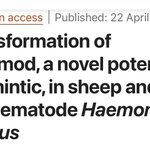
The animal science papers on obefazimod actually seem to exhibit far more scientific integrity than anything in the ABVX corpus. For example, the sheep paper identifies **13 unique metabolites** of the parent drug across sheep and worms. We see only one metabolite described in ABVX papers. A number of the 13 metabolites are potentially concerning.
Metabolites >10% of total exposure require characterization and safety evaluation, per FDA guidance on safety testing of metabolites and separate guidance on mass-balance studies -- we see no disclosure that ABVX has conducted them.
Their last Chief Medical Officer was bounced in Sept just a few months before the anticipated NDA filing - a highly unusual move this late in the process. ABVX is now on its fifth CMO since 2021 - unprecedented turnover. We would not be surprised if their NDA package has serious issues.
Paper on obefazimod as a potential anthelmintic for sheep: nature.com/articles/s41598-0…
Disclosure: We are short ABVX. Please see disclosures on p2/3 of our Nov 20, 2026 report, which this post incorporates fully by reference and is available at scorpioncapital.com.

We don’t usually engage with enthusiasts ranting about their pet ticker, but in this case it helps to elaborate on our $ABVX thesis. “At least your SLNO report was based on actual in-human data” - yes, but it started w the drug’s chemistry, pharmacology, and actual (vs. claimed) mechanism.
We worked backward from there; same process we used for ABVX’s obefazimod . That made it trivial to predict fluid retention and congestive heart failure, and the subsequent VYKAT XR safety debacle, even though there was no such obvious human signal in the trials.
We see time and time again that companies can game, fake, and/or manipulate clinical data. The incentives to do so are overwhelming; if you don’t, your stock could be -70% on a readout. An entire industry of consultants, CROs, and pay-to-play sites/investigators helps pharma companies do this. You can’t fake chemistry and pharmacology, however. We have a particular focus on forensic pharmacology, with respect to biotech shorts, as a result. That’s there the initial clues are usually buried.
You can fake it til you make it inside of a clinical trial setting - especially if your trial is in Ukraine, China, etc - but not in the real world. SLNO found this out rapidly after launch. We don’t think the $ABVX drug will ever make it that far, but if it does the outcome will be similar - only on a scale far larger than for a rare disease drug.
Thus, we think people waiving ABVX’s “positive” Phase 3 clinical results as the basis for their rebuttal are missing the forest for the trees.

At least your $SLNO report was based on actual in-human data.
What you're saying about $ABVX is late to the story wet lab speculation that has already debunked by the existing in human data which very clearly show malignancy rates within or below the expected background rates...Which even your own tables show!
BTW, you seem not to know this, but institutional investors ran these lab studies that you just did years ago already, and those same people ended up becoming some of the company's biggest bulls and current investors. I know you think you published something new here - you didn't. The AhR stuff is old old news. Years late to the story, and the in human data have already played out to $ABVX's favor.
I could go on and on listing the absurdities in this document...discussing monkey tox concerns at 500mg/kg/day (~1000x the human dose!!!), concerns over "Chinese data" when ABTECT-2 had literally ZERO Chinese trial sites.
You point out preclinical phototoxicity signals and speculate that the company didn't know or didn't do anything about it...yet enhanced skin surveillance was BUILT INTO THE STUDIES PROSPECTIVELY by the company! The company itself not only knew about this, but literally specifically designed the studies to test phototox concerns and either confirm it or rule it out....WHICH IT ULTIMATELY DID rule out.
Pointing out that the parent molecule is lipophilic and using that to call it an "agrochemical"... Just laughable sensationalism. We have known the structure of this molecule for over a decade. And BTW, plenty of drugs have lipophilic properties. This is a bizarre and irresponsibly over-sensationalized bit...calling it an "agrochemical"...
BTW, your own malignancy event table shows a malignancy rate BELOW background rates....???
You point out that there were zero remissions the placebo arm in one of the trials in the US and call that an outlier that will concern regulators....the expected number of patients to respond in that arm per the results of the rest of the study would have been 1.6 responders on the placebo arm! 0 instead of 1...that's an anomolous signal to you?
So ultimately your bear argument is this: "This drug has NOT shown increases in cancer in patients. In fact, it has shown rates at or even BELOW the rates of other drugs approved for this disease that have no black box warning for cancer. But hey, who knows, maybe that will change someday down the road!"
BTW, you're aware there's an FDA approved AhR drug on the market already right? One with no cancer risk...
You're claiming that AhR agonism is the top secret *true* mechanism of $ABVX's obefazimod and that this is bad because you claim AhR agonism is going to cause cancer... Again, not only is the AhR agonism theory that you're treating as a revelation actually a point that $ABVX *bulls* have believed for literally years already (i.e. not news from you), but there is actually a drug ON THE MARKET today that literally has that as its exact mechanism of action...and it has no labeled risk of carcinogenicity and no studies in humans or animals supporting carcinogenic risk....So you go through all this bluster about AhR pretending it is news (it isn't) and then claiming it is going to cause cancer (even though the data we have very clearly show that it HASN'T), meanwhile, there's already been an AhR drug on the market for years that has never shown a single piece of evidence for carcinogenicity...
Like I have said in the past - I had previously agreed with some of your work. This piece is irresponsibly poorly done and the use of the word "fraud" is absolutely egregious and slanderous when your thesis ultimately boils down to..."well, they haven't shown cancer signals yet, but maybe they will someday!" Calling this fraud with the evidence you provide sincerely rises to the level of libel, in my opinion.
Some time back, ADAR1 tweeted they had interesting lab work and were debating whether to release it. Given their status as a top $ABVX holder, people would likely appreciate it being publicly released; assuming it exists, which we have no reason to doubt. Particularly since they keep alluding to how good it is. We publish our work b/c we welcome public debate and scrutiny,

NEW: We are short $ABVX Abivax SA - a biotech fraud for the ages. Report now live on our site, along with four scientific abstracts based upon our laboratory experiments. An 11-month investigation, our most intensive research to date.

The $NVDA debacle + extensive media coverage of the @CulperResearch short report feels v similar to the inflection point for shitcos in Feb 2021. Short report by @HindenburgRes flipped it. Golden age of fraud to a golden age of shorting? Recall the sequence:
1. GameStop squeeze from mid to late Jan 2021 killed off Melvin Capital and short selling
2. On Jan 29, 2021 a famous short seller tweeted he was quitting short selling and doing long-only recommendations
3. On Feb 4, 2021 Hindenburg published a short report on Clover Health, a SPAC by @chamath, alleging an undisclosed DOJ investigation.
Then it was off to the races. The GS most shorted index peaked on Jan 29, 2021. It bottomed in late 2023. Then it did a V over the next 3 years. It now sits slightly off the 5 year high:

Scorpion Capital retweeted

Everyone giving Culper Research credit for their short report back in May 2026. Fair.
But let’s not forget this guy who literally gave us this info back in October 2025!!
This is why X is so amazing. The amount of information and the sheer speed in how it is communicated to us normies is willld.


Scorpion Capital retweeted

Next time you think that short sellers just make shit up - have a look at this SIX MONTH OLD tweet - which basically alleges the affair that is now news.

9) $NVDA CEO Huang has walked alongside Megaspeed at every step, and seems to have a close relationship with Megaspeed's Alice Huang. They partied together in June 2024 - same month as the Apex/Alibaba pledge, then dined together in May 2025 - just after U.S. trade restrictions.


$TMDX TransMedics Q3 results are lipstick on a pig - the business is becoming increasingly bizarre. 72% of the already-tiny sequential increase in revenue came from a newly-consolidated German business-jet charter operator -- not organ transplants or medical devices. The core business already appears to be ex-growth without it. TMDX looks like an aviation/logistics business masquerading as a medical device company.
This was the new CFO’s first earnings call. He’s 6 weeks into the gig. Third CFO in two years. His predecessor didn’t last long.
The unusual CFO turnover is typical of scams, as is the bizarre accounting: TMDX acquired a minority equity stake in PAD Aviation, yet consolidates the German operator's revenue under variable interest entity (VIE) accounting. The result: $9.4 million of unrelated private aviation revenue included in TMDX's Q3 results, accounting for nearly three-quarters of its sequential revenue growth.
Excluding PAD, total revenue grew just 2% QoQ, while services revenue was also essentially flat. Gross margin deteriorated, as well.
The stock bounced after-hours on a revenue "beat" and raised 2026 guidance. But the bulk of the increase in the guidance midpoint came from PAD Aviation, the German private aviation operator.
Details:
1. Almost three-quarters of Q3's sequential revenue increase came from German private jet charters unrelated to transplantation
Q3 revenue was $203 million versus $190 million in Q2, an increase of just $13 million. However, $9.4 million - or 72% - came from PAD Aviation. Excluding PAD, revenue increased only $3.7 million, or -2%, sequentially.
2. The core U.S. medical device business appears to have hit a wall
U.S. product revenue has barely budged in three quarters: approximately $102 million in Q1, $106 in Q2, and $107 in Q3. Sequential growth was barely 1% in Q3.
Total product revenue increased only 2% sequentially, from $111 to $113 million.
3. TMDX's services "growth" was almost entirely German jet-charter revenue
Services revenue increased $10.8 million sequentially, from $79 to $90 million. But $9.4 million — or 87% of that increase — came from PAD's unrelated charter operations.
Excluding PAD, services grew just $1.4 million or approximately 2%.
Meanwhile, services have grown to 44% of total revenue -- the revenue mix is shifting away from high-margin medical devices toward lower-margin services, including private jet charters unrelated to transplantation.
4. The guidance "raise" is largely a German charter-jet business dressed up as growth.
TMDX raised the midpoint of 2026 revenue guidance from $747 to $769 million, or $22 million. But $14 million — nearly two-thirds of the increase — is attributable to PAD Aviation.
5. Our analysis of publicly available third-party flight tracking also raises concerns about Q4 revenue. Based on the current run rate, we see risk of a massive miss unless transplant flight activity rebounds sharply in November and December.
Disclosure: We remain short $TMDX. Please refer to the disclosures on p. 2 of our January 10, 2025 report on TransMedics, which this post incorporates fully by reference.
Bear Cave at @hntrbrkmedia - Problems At Twist Bioscience $TWST
thebearcave.substack.com/p/p…
Disclosure: we are short TWST. For the avoidance of doubt, we had no interaction with Hunterbrook or prior awareness of their report.
“That’s complete BS,” said Jeff Leiden, executive chairman of Vertex Pharmaceuticals , recalling a recent conversation with a tech leader who claimed AI would cure 90% of human disease in the next seven years.
Vertex has used roughly 50 AI companies to comb through its data set of 10,000 drug compounds, Leiden said. Not one managed to generate a working drug.
wsj.com/tech/ai/silicon-vall…

AI driven drug discovery - AIDD in the meme-sphere - is just as immaterial. Wouldn’t be surprising if 4 is roughly the number of AIDD orders $TWST Twist Biosience booked as well. Hence their materials are vague (“Triple-digit % growth for AI-enabled Drug Discivery”) without disclosing $ amount or the base/denominator. Could be growth from 2 orders to 4 for all of w know. $ILMN last week was coy about committing to even 1-2% revenue bump in 2027 from AIDD.

Uber recorded ~320 million rides and Uber Eats orders during Halloween week. How many rides came from AI agents? Just FOUR. Yes, 4.
$UBER CFO also says AI agents generated just 500 Uber Eats orders.
Looks like the agentic commerce revolution still has a long way to go.

1
13
8,969
Sudden reality check from $ILMN Illumina. Tanking after hours and taking "AI drug discovery" meme stocks with it, like $TWST. Evasive, weak answer from management when asked about potential contribution/visibility from their AI offering in 2027. Wouldn't even commit to a mere 1-2% revenue increase:
“I think our view right now is somewhere in 2027, there should be some sort of color we should be able to begin to add...but we anticipate that somewhere in 2027, it does become more visible. And the whole point around the new products and BioInsight adding 1 to 2 points of growth for 2027 would certainly be an area."
Hype vs. reality per their earnings call transcript:
The hype - prepared comments, excerpt:
"On the analysis side, we launched the BioInsight platform, which brings our analysis application, AI models and curated biological data together in one place, reducing the need for customers to assemble and manage separate software tools. Through the platform, customers can also access SpliceAI2, our new AI model that predicts how genetic changes affect RNA splicing. In rare disease research data sets, it identified 17% more disease-relevant splice variants than other splicing models."
"I'm proud of the innovation our teams continue to deliver. Our view is that the next era of life sciences innovation will be powered not only by sequencing, but also by the software, AI and differentiated data that unlock the power of the genome. Through BioInsight, Illumina is building the base for AI biology, enabling more powerful foundational models and virtual cell models with the potential to improve our ability to understand and predict biology. As we move nearer to predicting biology, we see a path to using those insights to move health care toward a more proactive future, identifying risks sooner, preventing disease where possible and intervening earlier."
The reality, per Q&A:
Operator
Our next question is from Dan Leonard from RBC.
Daniel Louis Leonard
A bunch. Jacob and Ankur, you talked a bunch about BioInsight. When would BioInsight become more visible in the P&L? Would that be as soon as next year? Or is that a further-out event?
Jacob Thaysen
Yes. So I think, first of all, we are -- we actually established BioInsight approximately a year ago, which was the combination of our software part, which is actually doing extremely well also. And I think for those of you who visited our booth and at our symposiums at ASHG, we really presented how important software is for the ecosystem. So very excited about that. But we combine that with the data because there's a lot of synergies between the two. You have to generate data, but you also have to develop models on top of that.
So we are -- so as we mentioned in 2024 also is that the data and, of course, the multi-omics business would start to generate 1% to 2% in the latter part. So here in '27 of our strategic period when we look to 2024, and that is playing out very well. But I think you will -- depending on how that AI opportunity plays out, which we actually looks very, very promising, this could be substantially bigger. But maybe, Ankur, you have comments on that also.
Ankur Dhingra
Yes. I think our view right now is somewhere in 2027, there should be some sort of color we should be able to begin to add the Billion Cell Atlas and then the second gen, we've talked about it expanding to 5 billion cells certainly would be one of the first drivers within that. Jacob mentioned, we actually have a very broad spectrum of customers in discussion about the Cell Atlas and several other new bio AI-based applications that they are working on. But we anticipate that somewhere in 2027, it does become more visible. And the whole point around the new products and BioInsight adding 1 to 2 points of growth for 2027 would certainly be an area.
Source: CapitalIQ earnings call transcript
No mention of $TWST in Anthropic's list of six AI drug discovery partners announced yesterday, highlighting that legacy shitcos like Twist Bioscience, Genscript (HK 1548), and frothy ARKG names have no seat at this table vs. emerging AI-native, VC-backed players. We infer that Twist was sidelined in favor of BigHat Biosciences, a private company that's raised $223 million for AI-native protein/antibody lead optimization.
Full-stack platforms like BigHat that combine a high-throughput, automated wet lab + AI computational models with proprietary data are clearly poised to win this race -- versus old-school manual, labor-intensive, commodity CRO's like TWST and Genscript, which compete with each other via Google keyword ads in a race to the bottom on pricing and discounts. Details of the BigHat partnership and its work with Anthropic - xitter.cf/BigHatBio/status/21151….
Recent Anthropic papers include minor mention of TWST as a mere CRO - we are of the impression that the total spend for that project was immaterial, perhaps low six-figures, between TWST and a small private company (Adaptyv Bio), but this is unverified speculation. In contrast, the Anthropic announcement yesterday clearly refers to BigHat and others as partnerships.
In its earlier experiments, Anthropic used Twist as a CRO to validate AI-designed protein binders. With BigHat, Claude was integrated directly into an automated antibody-discovery platform, iteratively designing and optimizing drug leads using proprietary experimental data. Twist provided commodity laboratory services, while BigHat participated in the AI-driven drug-discovery process itself - totally different positions in the value chain.
Moreover, TWST is barely a player in antibodies/proteins, which makes the idea of any AI-related oppty a head-scratcher - antibody discovery is an immaterial part of their business. The company is a provider of commodity DNA synthesis, oligos and NGS products -- totally different than antibodies. It tried getting into antibody discovery with its acquisition of Abveris in 2021 -- the acquisition was a failure.
Twist now folds its small antibody-discovery business into a broader "DNA synthesis and protein solutions" revenue category, eliminating separate disclosure of its performance. Previous to Nov 2025, it reported antibody revenue separately as its "Biopharma" category. In Q4 FY2025 and for the full fiscal year 2025, Biopharma/antibody discovery revenue represented approximately 6.5% and 6.2% of Twist's total sales, respectively.
In other words, antibody revenue is de minimis - but TWST's disclosure change now obscure this fact, else the market would see it has no real play in AI drug discovery (ie, antibodies).
Hence, Twist’s press release this morning announcing the launch of “Express Screening Antibodies” - a weak attempt to stay relevant amidst the AI drug discovery chatter.
Disclosure - we remain short $TWST.

Over the past few months, Anthropic scientists have engaged in deep research partnerships with six organizations developing new medicines. We've also begun drug discovery efforts of our own.
In doing so, we’ve learned much more about how Claude can support the many stages of drug development.
In this blog post, we share some early results from these efforts, and describe how this work fits in with our wider ambitions in the life sciences.
anthropic.com/research/early…

Founder of Mithril Medicine, one-person drug company acquired by Anthropic, is not a scientist or academic as we assumed but a Harvard MBA (2025) + ex-Goldman Sachs banking analyst + ex-hedge fund guy tweeting as @Prof_Oak_ . Drug he made with Claude is indicated to potentially enter human trials in 2028.
Obviously a talented founder with a great background, but Anthropic calling this acquisition the beginning “of our drug discovery efforts” is quite the gimmick days before an IPO roadshow.
The hedge-fund-analyst-turned-biotech-wizard path was blazed by Vivek Ramaswamy. We still recall the Forbes cover for his Axovant IPO in 2015 marking the top of that biotech bubble - took about 5 yrs for the index to recover to that level. For those unfamiliar with that saga, it went from the largest biotech IPO in history at that time to delisiting/penny stock/liquidation.


The best way to identify and work through the bottlenecks of drug development is to get deeply involved in real drug programs, across many different therapeutic areas and stages of development. Over the past several months, our scientists have engaged in deep research partnerships with six organizations developing new medicines: The Column Group, Generate Biomedicines, BigHat Biosciences, Divergence Labs, Enveda, and Bristol Myers Squibb. We’ve also begun our own drug discovery efforts through the acquisition of Mithril Medicine, a single-person biotech company co-founded by @atlasventure.
Today we’re sharing early progress in accelerating drug discovery from these research collaborations. With Claude, we are streamlining operations and working to derisk novel targets with TCG, redesigning lab protocols with BigHat, designing CAR-T cell therapies with Generate, and multi-specific therapeutic antibodies with Divergence, drafting regulatory filings with Enveda, and supporting portfolio-level decision making with BMS. Our early collaborations span pre-clinical and clinical work on potential treatments for cancer, allergies, rare genetic diseases including forms of childhood muscular dystrophy, and more.
My team has been working with @Prof_Oak_ , founder of Mithril Medicine, for the past year. Jason Rhodes, General Partner @atlasventure and Chairman of the Mithril Board said this about Mithril: “We prioritized LAMA2-Related Congenital Muscular Dystrophy (LAMA2-RD) as the lead indication, in part, because of the enormous unmet need. These patients present with the disease at birth, spend their lives in wheelchairs and on ventilators, and rarely live past their mid-twenties; yet no therapy is available, and few are in active development. We believed Mithril would be the company to change that.” Anthropic acquired Mithril and we are pushing the frontier of how a single skilled operator, with Claude, can run an entire pipeline of drugs.
We’re working with these teams to show how AI can assist drug developers at many stages of the process already, and to prioritize improvements to our models based on the benchmarks we’re building with collaborators. Our blog includes links to technical reports written with our partners: anthropic.com/research/early…
Superb investigative reporting by @adamfeuerstein on Soleno's drug VYKAT XR, now owned by Neurocrine $NBIX (no position). Detailed article that's a must read. The circumstances surrounding the kids who died after starting the drug are devastating - excerpts below. Highlights from the article:
-Case narratives of 7 fatalities obtained via FDA FOIA, plus ~100 hospitalizations
-Article extensively quotes an ex-FDA official with a PWS child who is pushing the agency to withdraw the drug from market, the same remedy requested in our pending Citizen Petition. The official is a pediatric endocrinologist, as well.
-FDA website states that as of Sep 4, 2026, the "FDA is evaluating the need for regulatory action"
Some excerpts:
"In my opinion, all of these deaths are related to Vykat,” said Karen Vogt, a pediatric endocrinologist and former medical officer at the Food and Drug Administration whose teenage son has Prader-Willi: "Six of the seven patients died from heart or respiratory failure, the seventh died from a severe brain injury. All of the deaths were precipitated by significant fluid retention or hyperglycemia that are known and concerning side effects of Vykat,” she added."
"Vogt, the former FDA medical officer, has emerged as a vocal critic of Vykat. In recent weeks, she has written a letter to the scientific investigative branch of the agency, urging it to re-evaluate its decision to approve Vykat. She has shared her views of the drug on a listserv read by endocrinologists, in Facebook groups for Prader-Willi families, and with the drug’s maker, Neurocrine.”
“Vykat is a dangerous and not-very-effective drug that should have never made it to the U.S. market,” Vogt told STAT, citing her own independent review of the drug’s post-marketing safety reports and publicly available FDA documents."
The details of individual fatalties are disturbing:
"In one case, a 9-year-old girl taking Vykat for one month was rushed to the hospital suffering from severe complications of diabetes, despite never having been diagnosed with diabetes previously. She went into cardiac arrest and died from swelling in the brain."
"In another, a boy, 16, experienced severe edema, an abnormal buildup of fluid in the body, including around his lungs and heart, after starting Vykat. He eventually gained 100 pounds from fluid retention and died due to a blood clot that could not be cleared because fluid blocked it."
"A third case involved a 48-year-old man with a post-Vykat edema so severe it caused a wound to open on his leg. He was hospitalized and died spitting up blood from a gastrointestinal hemorrhage."

New story from me:
Concerns grow on safety issues tied to Neurocrine $NBIX rare disease drug, Vykat.
18 months after its approval to treat patients with Prader-Willi syndrome, Vykat has been tied to seven deaths and 100 hospitalizations.
I obtained case reports on the seven deaths via the Freedom of Information Act. The reports do not prove causality, but some experts say the evidence is sufficient to conclude Vykat is causing unacceptable harm.
“In my opinion, all of these deaths are related to Vykat,” said Karen Vogt, a pediatric endocrinologist and former medical officer at the Food and Drug Administration whose teenage son has Prader-Willi.
“Six of the seven patients died from heart or respiratory failure, the seventh died from a severe brain injury. All of the deaths were precipitated by significant fluid retention or hyperglycemia that are known and concerning side effects of Vykat,” she added.
Vogt believes the FDA should withdraw Vykat from the market. It should never have been approved, she told me.
Story here:
statnews.com/2026/10/13/neur…

$TWST The negative KOL check on the AI drug discovery hype is directionally correct but barely scratches the surface on what a fraudy, bottom-of-the-barrel, commodity business it is, with no realistic tailwind from AI. We’ll have a lot more to say in the coming days.

Some takeaways from Evercore ISI AI Drug Discovery discussion w/ KOL who worked for 20 years in molecular biology/ clinical space.
- AI is not diverting funding away from traditional wt lab experiments
- Their AI spend could be $100M w/ future ceiling of 1Bn
- Oligos --> dont usually request 1000s of copies.. goal is to limit # of attempts
- 70% of cases are specific oligo orders w/ 30% having variability of tens to max 100 oligos ordered
- $TWST doesn't have significant timing/ speed advantage
- $TWST good but not exceptional or highly differentiated
- $TMO is preferred vendor; biggest & most innovative
- CROs & CDMOs --> $TMO is now a one-stop-shop; gives them a huge advantage as big pharma prefers to consolidate with one vendor
- Billion Cell Atlas --> valuable & useful in early stages, but not majorly impactful due to complex multifactorial nature of human system.. very difficult to answer question of how a disease/ problem is developed
- Reagents --> no changes over last 6 years in preference or mkt share of vendors
Overall seems like big winner of this whole theme is $TMO. Also $TWST has no edge.

$TWST Twist Bioscience CEO Emily Leproust dumped $56 million of stock on Thurs 5/17, the most aggressive sale of her career. The plan blew out all 356,546 shares with its inaugural trades, $158 avg, per Form 4. ~11% of the day's volume.
Source: sec.gov/Archives/edgar/data/…
Disclosure: We are short TWST
$TWST Twist Bioscience CEO Emily Leproust filed a Form 144 yesterday that provides notice of her intent to sell 356,546 shares — a highly aggressive amount that represents 40% of her currently saleable stock and options holdings. We expect to know shortly whether she just executed the largest sale of her career.
Caveat emptor.
This would be the first selling under her new Rule 10b5-1 trading plan, which can sell up to 624,134 shares over the next 12 months.
It remains unclear whether all 356,546 shares were sold yesterday or whether the shares will be dribbled out over the coming days. Either way, the amount is aggressive.
Our analysis is awaiting the corresponding Form 4 filing for confirmation and is therefore preliminary and subject to change. That said, we expect the Form 4 to confirm that Leproust just executed the largest sale of her career, based on a review of her pattern of prior Form 144 filings.
Disclosure: we remain short TWST.
$TWST Twist Biosciences AI drug-discovery story is a speculative delusion with no disclosure of an Anthropic partnership. If the results reported in Anthropic's paper generalize, it would be highly deflationary for Twist and crush their revenue. In fact, Anthropic's note explicity diminishes Twist as merely an "independent contract research organization (CRO)” - not an AI drug-discovery technology partner.
TWST issued what looks like a reactive 8-K confirming the Anthropic post - not even worthy of a press release - which was filed under Item 7.01 Reg FD, not 1.01 Entry Into A Material Definitive Agreement.
Anthropic's post stated that 22%-35% of Claude-designed proteins successfully bound their targets versus a stated 10%-15% hit rate for typical protein-design campaigns. That means scientists would need to order only about half as many physical constructs per successful binder - bearish and deflationary.
1. Late yesterday, TD Cowen analyst Brendan Smith hyped an Anthropic blog post about a protein-design project and named Anthropic as a Twist customer, saying this supports the “quality and durability” of AI-driven demand for Twist. This appears to have triggered a broader meltup across AI/biology names like $TEM and $TXG. We suspect Smith's exuberance caught everyone off guard, including Twist, given the immaterial nature of the Anthropic post.
2. Piper Sandler's David Westenberg fanned the flames with a note pushing it even further, calling it a partnership - a word missing in both Twist and Anthropic's 8-K/post -- "We believe the partnership between Anthropic and TWST marks a significant milestone..."
3. Anthropic's blog post/paper never refer to Twist as a partner, merely as an "external evaluator," whatever that means. The technical details in the note portray Twist as a commodity CRO (contract research organization) that provided outsourced wet-lab production and testing services -- not an AI drug-discovery technology partner. Twist operates in a low-end cesspool, competing against Chinese vendors like Genscript using Google search ads in a race to the bottom on price.
(Anthropic paper summarized in the post referring to Twist as a CRO - www-cdn.anthropic.com/30bf50…).
4. Cowen's characterization of the relationship as significant is highly misleading: "While Twist management has not disclosed which quarter revenues from this specific project will fall into, the identification of Anthropic as a customer directly supports the quality and durability of the underlying AI demand." If any economics were involved, we suspect they are trivial given the technical details in the post, and certainly not material enough to merit a quarterly revenue disclosure.
Disclosure - We are short $TWST Twist Biosciences.