

Making science easier to understand, one discovery at a time.
Joined November 2019
- Tweets722
- Following0
- Followers16K
- Likes6








Most people are still figuring out where the printer is on day three of a new job. Wolf Cukier found a planet.
In 2019, the 17-year-old from Scarsdale, New York started interning at NASA Goddard, scanning TESS data for dips in starlight. Three days in, he spotted one in a system called TOI 1338. The timing didn't fit either star. It was a planet.
TOI 1338 b is 6.9 times the size of Earth and orbits two suns at once, 1,300 light-years away in the constellation Pictor. It became TESS's first circumbinary planet, an actual Tatooine.
His brother pitched naming it Wolftopia. NASA settled on TOI 1338 b.


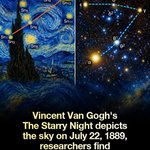
The most famous sky in art history now has a date: July 22, 1889.
For decades everyone said June. Van Gogh wrote to Theo around June 18 that he’d finished a new study of a starry sky, and an earlier reading matched it to June 19 and called the swirling stars Aries.
A Korean team thinks that’s the wrong constellation. Shape analysis matched the five central stars to the Hyades in Taurus, and his later pen drawing fits even better.
Around July 22, the Hyades rose in the east beside Venus, with a moon close to the crescent on the canvas. Weather records suggest the sky was clear enough to see it.
He may have dreamed it up in June and finished after July 22.


In France, whenever a meteorological station records a temperature over 40°C, an alarm is triggered.
Between 1950 and 2000, 30 alarms were triggered.
In 2026, 114 alarms have already been triggered.


