

Chainlink evangelist. $LINK 🌐
Bangladesh
Joined October 2020
- Tweets1.9K
- Following2.8K
- Followers363
- Likes2.3K





SchwiftyLink retweeted

NEW: LG CNS, the technology arm of LG Group, enters a strategic partnership with Chainlink to advance Korea’s $68B digital asset market.
LG Group is one of Korea’s largest business groups, with approximately ₩186 trillion in assets across 63 affiliates. LG CNS is the lead contractor for the Bank of Korea’s flagship digital currency initiative, Project Hangang.
Through the partnership, LG CNS and Chainlink will:
• Enhance LG CNS’s digital asset platform solution with Chainlink’s cross-chain, data, and orchestration infrastructure
• Collaborate on digital asset solutions for Korean institutions using the full Chainlink platform
• Advance the next generation of technical standards underpinning Korea’s digital asset economy
The partnership is built for one of the world’s most active and technologically advanced digital asset markets. Korea is Asia's second-largest digital asset market, with the Korean won consistently ranking second in crypto trading volume, behind only the U.S. dollar.
By combining LG CNS’s institutional expertise with Chainlink technology standards, the partnership establishes the foundation for compliant digital asset infrastructure in Korea and for global expansion.

SchwiftyLink retweeted

$Link He is not wrong... I fed Chat gpt all the sibos news from the week along with a sample of fee's on a tx and asked its thoughts and here is what it said..
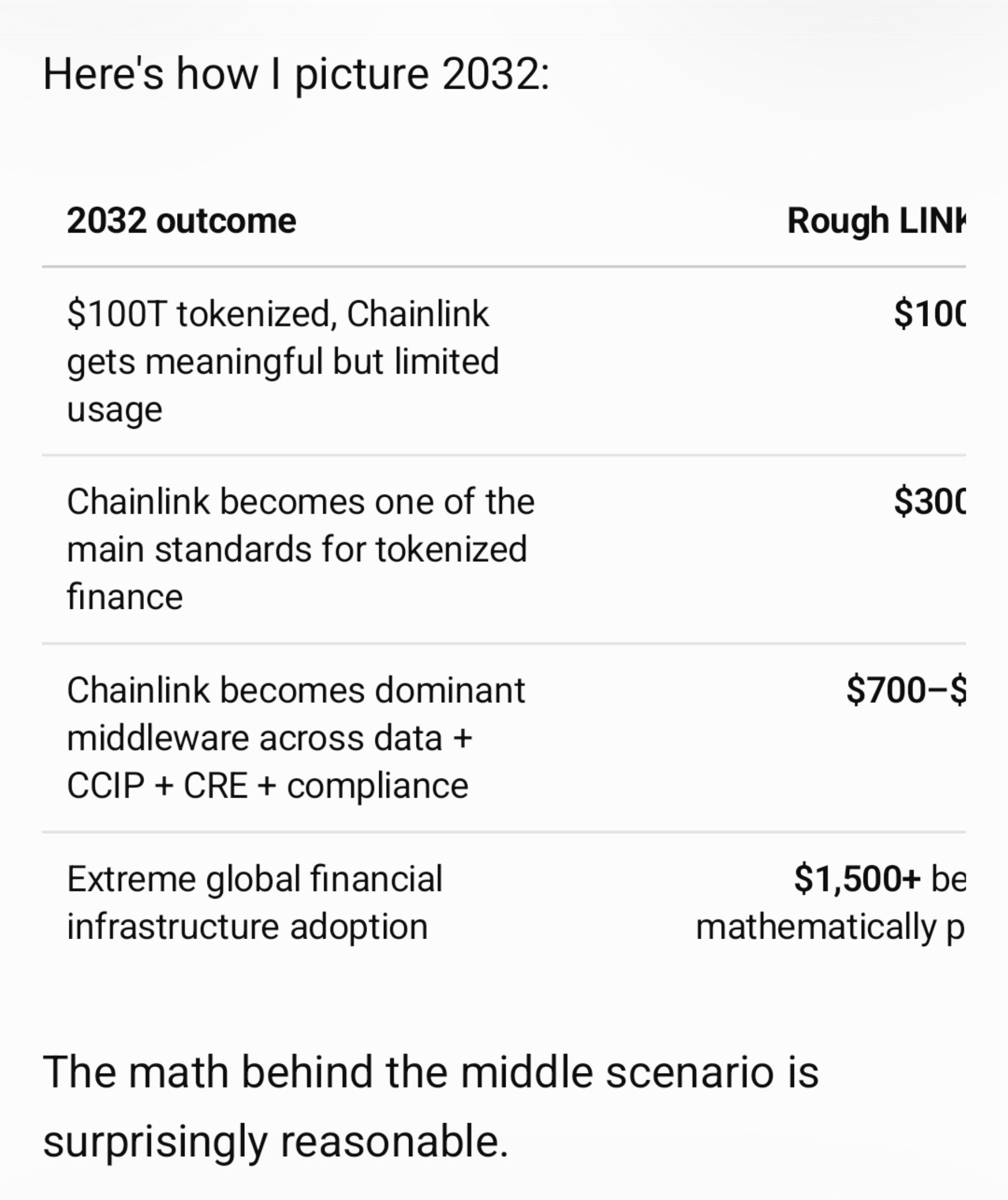
If Chainlink keeps winning institutional adoption at roughly the pace we’re seeing now, and there are around $100 trillion of tokenized assets by 2032, I could reasonably see LINK trading somewhere in the $300 to $800 range, with roughly $500 as a middle-of-the-road estimate. That assumes Chainlink becomes one of the main infrastructure layers used for things like data, cross-chain transfers, compliance, proof of reserves, and financial workflow orchestration.
The key is that Chainlink would not just benefit from the value of those assets being moved onchain once. A tokenized bond, fund, security, or other asset could rely on Chainlink repeatedly throughout its life for pricing data, collateral updates, transfers, compliance checks, payments, and settlement. That means the real opportunity is not simply “$100 trillion gets tokenized,” but how much recurring activity that $100 trillion generates.
For example, if Chainlink eventually captured the equivalent of just 0.01% per year in economic fees across a $100 trillion tokenized ecosystem, that would equal about $10 billion in annual revenue. At a 30x valuation multiple, that would imply roughly a $300 billion network value, or about $300 per LINK using the full 1 billion token supply. If recurring usage were heavier and annual revenue reached $20 billion, the same math would point toward roughly $600 per LINK.
That is why I think $300 to $800 is a reasonable range under strong adoption, while $1,000 to $1,500+ becomes possible if Chainlink turns into the dominant middleware layer connecting major financial institutions, blockchains, tokenized assets, and automated financial workflows. The biggest thing that would push me toward the higher end would be clear production evidence that Swift, DTCC, major banks, and asset managers are generating recurring LINK-linked fees at scale.
Just curious, Would you hold till 2032 for a $1500?


SchwiftyLink retweeted

WHAT IS THE INTERNETS WORTH?
Let's try to find out...
Models like Matcalfe's Law help explain its exponential value from billions of users interacting.
Meaning, when we take into account the internets massive role in global commerce, innovation, and daily life, it would be worth around $100 to $200 trillion as a base value.
What if I told you, we're about to improve on that system with a new layer, adding Cryptographic Security, transparency, fraud reduction, and AI Safeguarding. Add to this layer the entire global financial sector, including real world assets.
This combined impact would have the potential to double or even triple its worth to a potential $600 trillion dollars.
These estimates are speculative but underline how added security and smart technology can multiply the internet’s benefits. We call that WEB3 or the 4th industrial revolution.
This all will be built on the Chainlink Standard.
What if I told you, you could own a piece of that internet. It's called $LINK


SchwiftyLink retweeted

🇺🇸 Everyone watched CLARITY fail in the Senate and called it a loss for crypto. They're missing the bigger story!
🏦 While Congress stalled, the standard that will run institutional finance was already being built — quietly, for over a year...
📝 This is post on ERC-3643 and why @chainlink sits underneath all of it.
ERC-3643 (aka T-REX — Token for Regulated EXchanges) is a token standard built with a focus on on-chain compliance-first.
Unlike a normal ERC-20, transfers only execute if the wallet passes identity/eligibility checks, which are baked into the smart contract itself. This was the point from day one: assets that enforce their own regulatory rules on-chain.
The problem: compliance built this way stays bound to its native chain. Move the asset across chains and the compliance state doesn't travel with it. No unified interoperability layer, no compliance-rich middleware, no "unified golden ledger" tying it all together. That's the gap that matters the most…
🔔 {{Chainlink has joined the chat}} 🔔
ACE (Automated Compliance Engine) + CCID (Cross-Chain Identity) were built in direct collaboration with the @ERC3643Org Association, @ApexGlobalGroup and @GLEIF: embedding Chainlink's compliance and identity layer directly into the T-REX framework.
💎 Apex Group (services $3.5T annually) committed to T-REX as its default multi-chain infrastructure. Apex also acquired Tokeny, the company that built T-REX in the first place. Further, Apex's Commercial Head of Digital Assets, Angie Walker, was previously Chainlink Labs' own Global Head of Banking and Capital Markets.
💎 DTCC's Dec 2025 SEC no-action letter explicitly names ERC-3643 as "compliance-aware."
💎 SEC Chair @SECPaulSAtkins has directly cited ERC-3643 by name as the model for smart-contract-embedded compliance.
💎 The Enterprise Ethereum Alliance, Etherealize, and Linux Foundation Decentralized Trust have all petitioned alongside the ERC-3643 Association to push this standard into US market structure.
Then yesterday, CLARITY failed 49-50 in the Senate. 👎
Both Chairs Atkins and Selig immediately said the same thing: their agencies will move forward with rulemaking regardless. Rulemaking, not legislation, is now the operative path.
Here's why that might actually be better for Chainlink, not worse..
.
Sitting inside that rulemaking pipeline right now is Taylor Lindman, former Chainlink Labs deputy general counsel, who is now the Chief Counsel of the SEC's Crypto Task Force. Sergey Nazarov, Chainlink co-founder, sits on the CFTC's Innovation Advisory Committee.
Rulemaking is less "sticky" than legislation, meaning it can be reversed. BUT, once compliance-first infrastructure like ERC-3643 is running on Chainlink's ACE/CCID and gets embedded as the plumbing of capital markets at scale, no future administration can unwind that.
You don't rip out settlement infrastructure over a policy disagreement! 🛑
CCIP now touches 60+ chains, DeFi-native and institutional alike. Circle's Arc just launched mainnet with Chainlink live from block one, alongside xStocks, Aave, and a validator set that includes BlackRock, DTCC, and Visa.
Chainlink isn't betting on one chain winning. It's becoming the connective layer underneath all of them, the mycelium of the whole system.
Legislation failed but real infrastructure didn't wait for it. $LINK


SchwiftyLink retweeted
Where did the idea of cryptographic truth come from?
For @SergeyNazarov, it all started with #Bitcoin.
SCHWIFTYLINK IS LIVE ON PONSFAMILY 🌀🧪
The oracle got lobotomized. The multiverse is cooked. Chat, we’re officially on-chain.
Zero thoughts. Infinite aura. Interdimensional brainrot.
Get linked. Get schwifty. Stay delulu.
CA: 0x91B53c9c23b9D27681f37d549dCBd8260709b05b
25
SchwiftyLink retweeted
NEW: Top-three Swift service provider, Bottomline, has entered a strategic partnership with Chainlink to unlock cross-chain, cross-border payments for its 600+ bank customers.
Bottomline moves more than $16 trillion in payments annually across its platforms.
Through the partnership, Chainlink is providing the secure interop and orchestration layer connecting Bottomline’s existing payment infrastructure to public and private blockchains.
TradFi is moving onchain at a rapidly accelerating pace, and CCIP is enabling tokenized value to move securely across chains, with the Chainlink Runtime Environment (CRE) coordinating payment workflows end-to-end.
The result is that Bottomline’s banks can continue using familiar ISO 20022 messaging to access onchain payment rails through a single, network-agnostic connection.

SchwiftyLink retweeted
Everyone building tokenized assets is chasing the same prize which is liquidity.
Instant settlement. 24/7 markets. Collateral that can move anywhere.
For me, liquidity is the unlock. But acceptance is the collision point and algorithmic decision-makers are the deadline.
The clearest way to describe where we are now is: Liquidity is not issued. It is accepted.
An instrument that settles in seconds but takes weeks to accept is not liquid. It is stranded. Static whitelists work for a small, stable universe of familiar assets. They do not scale to thousands of assets whose backing, controls, authority and eligibility can change continuously.
The 2nd force has a hard edge. An algorithm making decisions in milliseconds cannot read a PDF, chase an email or wait for a committee.
When the counterparty becomes software, evidence must become machine-verifiable. Otherwise, the human review queue becomes the ceiling on the entire system.
Tokenization does not unlock liquidity by making assets move faster.
It unlocks liquidity when counterparties can decide, safely and immediately, whether to accept what arrives.
SchwiftyLink retweeted
Why this matters -> a tokenized security has crossed from issuance into the ordinary operations of regulated traditional funds.
This is a major market-structure signal because tokenization is moving from producing assets to having regulated institutions operationally accept them.

BREAKING: $872 BILLION Franklin Templeton just got the first-ever SEC clearance to put tokenized assets inside traditional investment funds.
Its blockchain-based money market fund BENJI can now be held as collateral inside ETFs and mutual funds, bringing tokenized assets into portfolios that never asked for them.
The move could take effect as early as Q4, per Bloomberg.


SchwiftyLink retweeted
Read the full announcement to learn how Chainlink is helping establish the blueprint for the next generation of regulated, cross-border finance ⬇️
prnewswire.com/news-releases…

SchwiftyLink retweeted

i still get asked very frequently what i think about bitcoin. i wrote this 18 mos ago and still feel the same: blog.samaltman.com/thoughts-…