




Jim Thompson retweeted

“Who in the room doesn’t matter enough that we should not check for their understanding?” Great talk from @teacherhead at @ResearchEd_CL
Jim Thompson retweeted

When will the Ed. system stop being driven by untested theories?
Yup, I can tell you these digital exams are terrible for elementary school-age children.

After a yearslong transition to digital exams, New York is considering whether to let NYC schools go back to paper-and-pencil state tests. chalkbeat.org/newyork/2026/1…

Jim Thompson retweeted
Interesting article.
“If someone is taking notes, it’s a simple way of saying what is happening right now is important enough for me to capture it. It also sends us a message that this is what we do — we pay attention and we try to get smarter and more thoughtful.”
nytimes.com/athletic/7672297…

Jim Thompson retweeted

A recent NYT op-ed argued that writing doesn't advance thinking.
That argument is misleading, contrary to the evidence--and to the extent it implies that it's OK for students to let AI write for them, dangerous.
More in my new post on Minding the Gap:
nataliewexler.substack.com/p…


Jim Thompson retweeted

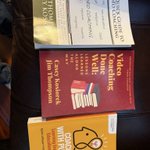
Look what came in the mail today 👀
Can't wait to get into it (after my daughter's wedding next week)!
Congratulations to @nsachdeva2019 and @New_Old_Paul
See you in Toronto for @researchEDCan on the 24th

Jim Thompson retweeted

Every year I take a picture of the spine of each book read in my class. I usually clumped the books together in a classroom chart. This year students are putting the books that they have read on their individual lockers. It also serves as an easy visual to see at a quick glance what each student is reading.

Jim Thompson retweeted
This, from @j_amesmarriott on @EconTalker is an argument for why we have to fight hard(er) to re-center English classes around whole books.
“There is a kind of truth about life which is only accessible through prose fiction, with its capacity to show us the inside of other minds. This recreation of human consciousness through words is one of our species' most remarkable inventions. The strange empathetic hallucination induced by the novel, the feeling we have that we might know what it is to be Elizabeth Bennet or David Copperfield is perhaps the closest we can ever come the experience of being a person other than ourselves.”
Jim Thompson retweeted
Many schools have such tunnel vision when it come to literacy and state testing. Districts purchase reading programs with a heavy emphasis on passage reading because the passages/questions mirror the state test. I guess to some this might seem logical in that this is the way to produce better state test results. The issue is that it generally doesn't. You can still read full length class novels while also focusing on things that will be on the state test.
Today my class began the modern classic, Number the Stars. It is a perfect book for 5th graders when introducing students to WW2 and the Holocaust. I use the novel unit from the Reading Reconsidered curriculum. Lois Lowry is a superb writer. In Number the Stars she is known for changing the mood in the story on a dime. This happens throughout the book. We analyzed the mood of the story within the first two pages of this novel. All seemed cheery for the first few paragraphs until the word Halte! Annemarie, Ellen, and Kirsti encoutered two rifles, two sets of cold eyes, four shiny boots, and two helmits. If you have read the book you know exactly what I'm talking about. Students learned about mood and how authors create this with the specific words they use.
There is no need to practice "state test questions" on mood by reading passages that don't really connect with anything. Teach mood within a great novel.
The added benefit (this is inevitable) is that many students will want to read a bunch more novels from the WW2 time period. Students favorites are The War That Saved My Life, The Boy on the Wooden Box, Snow Treasure, Echo, and anything written by Alan Gratz like Allies and Projekt 1065. I have to say The War That Saved My Life is one of my absolute favorites. I haven't had a student not fall in love with this story.

Jim Thompson retweeted

🚨 Waterloo is often described as the MIT of Canada. On CBC, Waterloo math instructor Dan Wolczuk describes first-year students arriving with inflated grades, missing foundational math skills, and unprepared for university math. The problem has worsened over time.
He makes several important points:
- High school math classes have been weakened so students can get better grades.
- Less testing in high school and fewer standardized tests both hurt student learning and lead to grade inflation.
- Grade inflation doesn't help students in the long run. It's demoralizing to get 99% in high school and fail your first calculus test b/c prerequisite knowledge isn't secure.
- Some memorization is necessary in math. Math builds on itself and students need to be able to easily retrieve foundational knowledge.
- The testing effect matters. More testing helps students retain information long term.
- More low stakes testing also helps curb test anxiety.
Dan thinks we need a national standardized test in Canada. I wholeheardedly agree.
Link below (Excellent job by @KrissyHolmes CBC, Newfoundland & Labrador, Sept 9) @CBCNL 👇
Jim Thompson retweeted
Cold Call- a great illustration and a great example on video:
teachlikeachampion.org/blog/…

Jim Thompson retweeted

🚨WOW!!!
A Bronx pizzeria owner saw a woman eating out of his GARBAGE.
He walked outside, took her by the hand, led her in, and pulled a hot slice straight from the oven for her.
She sat down and cried. He said: "Don't cry. Eat. I don't want you eating out of a garbage." ❤️
His name is Daniel Romano.
He owns D'Romano's Pizza in the Throggs Neck section of the Bronx.
He didn't shoo her away.
"I grabbed her by the hand and I led her to the pizzeria and I went in the oven and I got her a fresh slice and gave it to her. Sat down and she started crying. I said, 'don't cry, eat. This is not a problem.'"
In that moment, he decided he'd never let it happen to anyone again.
So he grabbed a marker, wrote a sign by hand, and taped it in his window for the whole neighborhood to see:
"To the people eating out of my garbage, I have more love for you than you think. Please come in and tell me you're hungry. I will forever give you a slice and fresh water to drink."
When they asked him why, his answer was simple.
"Right now, I think this world is shot. There's too much hate. Too much negativity. Why not put a smile on someone's face?"
And it turns out this runs deep for Daniel.
It goes all the way back to his mother, Carmella.
"She had a saying in Italian. She used to say, 'a desperate person will always make a better decision on a full stomach than on an empty.'
"It always stuck with me. So I feed people."
A desperate person makes a better decision on a full stomach.
That handwritten sign has traveled way past the Bronx now.
Daniel says people are calling him from Texas, Arkansas, Hawaii, even Alaska, all wanting to chip in and buy slices for hungry strangers they'll NEVER MEET.
"Don't ask me, I didn't even know Alaska had a phone."
It all started with one slice.
One woman.
One man who did something kind.
GOD BLESS Daniel Romano. 🇺🇸🇺🇸🇺🇸
Jim Thompson retweeted

.@smorrisey believes we can teach 2,000 vocabulary words per year — far more than vocabulary experts suggest.
Intentional vocabulary instruction during novel study is one of his ingredients.
Intentional efforts in science and social studies, another ingredient.
Yet the biggest ingredient is 30 minutes of word study, using his Word Mapping Project design.
"Vocabulary, morphology, spelling, fluency, and sentence composition are all taught in one interwoven “word study” block that approximately lasts 30-40 minutes daily."
There's a shout to @margaretmckeow2 in this column. I'm curious for her take.

Jim Thompson retweeted
My greatest fear is that concern about kids' capacity to engage with whole books will become a self-fulfilling prophecy.
I can share plenty of evidence to put pressure on this teacher's statement, such as the recent RAND study.
But you hear this all the time, the perception that kids capacity to read books has been altered by the technology landscape.
If everyone stops assigning books because they believe kids can't work with whole books, they will contribute to making it so.

Jim Thompson retweeted
Let’s make this trend, y’all.
“The district is requiring salaried central office employees to work as substitute teachers 8 days during the school year, 4 days each semester.”
HT @DrBrianLusk!

Jim Thompson retweeted

New Substack: : Students should only use AI for things that they already know how to do well.
dtwuva.substack.com/p/studen…
Jim Thompson retweeted

This is a fascinating and important report: internationally, teachers now spend more time than ever dealing with behaviour. This is the biggest international survey of teachers and principals. And it's a huge data set.
According to TALIS, Between 2018 and 2024, teachers report a 23% (!!) increase in there share of classroom time consumed by maintaining calms and order. But there's more...

Is student discipline getting worse?
OECD data show that teachers now spend more time keeping order in their classes than they did six years ago...
... this could impact the number of teachers leaving the profession.
See more: bit.ly/46UFRCS


Jim Thompson retweeted
Teachers have been trying to tell us that the tech-centered classroom is too easily a portal to distraction.
The #1 feature that teachers want in a digital reader: the ability to block kids from going to the internet instead of reading.

Jim Thompson retweeted
This one hits like a gut punch:
Austin Sarat, my favorite college professor, pens a fierce OpEd on @AmherstCollege students’ inability to read challenging texts.
He rightly pins blame on “a K-12 system that has quietly stopped asking them to finish books at all.”
“This past term, I enlisted a few colleagues to teach a short course called “Why Read?” We spent three weeks working through essays on the value of reading by scholars like Martha Nussbaum and Edward Said. What struck me wasn’t students’ lack of interest — it was how unevenly prepared they were even to attempt something long and difficult.
It was clear to me that the students had very different approaches to and comfort with reading difficult material. I tried to help them see that when it comes to reading, similar to physical exercise, the most benefit comes with the most exertion. Reading longer things requires patience and attentiveness, it cultivates the capacity to follow an argument or a plot, and it requires sustained effort to decode meanings.
Surely, this single course won’t end students’ entrenched habits and reverse their retreat from reading. But before we ask our students to read difficult material, those of us who teach in college owe it to all of them to explain that reading books in their entirety matters. If we won’t, or can’t, then higher education will have a bleak future.”

Jim Thompson retweeted

Fewer people read books today—both kids and adults. This blog compares building reading skills to training for a 5K run: small steps build stamina over time. Schools should require students to read full books (not just excerpts), which boosts brain power, vocabulary, and creates shared bonding experiences—much like runners bond through shared training goals. open.substack.com/pub/bgeogh…
